
United
States Securities and Exchange Commission
Washington,
D.C. 20549
FORM
10-K
(Mark
One)
|
(x)
|
ANNUAL
REPORT UNDER SECTION 13 OR 15(d) OF THE SECURITIES EXCHANGE ACT OF
1934
|
|
|
FOR
THE FISCAL YEAR ENDED DECEMBER 31, 2017
|
|
( )
|
TRANSITION
REPORT PURSUANT TO SECTION 13 OR 15(d) OF THE SECURITIES EXCHANGE
ACT OF 1934
|
|
|
|
FOR THE TRANSITION PERIOD
FROM
TO
|
|
|
Commission File
Number 0-1665
|
KINGSTONE
COMPANIES, INC.
(Exact name of
registrant as specified in its charter)
|
Delaware
|
36-2476480
|
|
(State or other
jurisdiction of incorporation or organization)
|
(I.R.S. Employer
Identification No.)
|
|
15 Joys Lane, Kingston, New York
|
12401
|
|
(Address of
principal executive offices)
|
(Zip
Code)
|
|
(845) 802-7900
|
|
(Registrant’s
telephone number, including area code)
|
Securities
registered pursuant to Section 12(b) of the Act:
|
Title of each class
|
Name of each exchange on which registered
|
|
Common
Stock
|
NASDAQ
|
Securities
registered pursuant to Section 12(g) of the Act:
None
Indicate by check
mark if the registrant is a well-known seasoned issuer, as defined
in Rule 405 of the Securities Act. Yes ☐ No
☒
Indicate by check
mark if the registrant is not required to file reports pursuant to
Section 13 or Section 15(d) of the Exchange Act. Yes ☐ No
☒
Indicate by check
mark whether the registrant (1) has filed all reports required to
be filed by Section 13 or 15(d) of the Securities Exchange Act of
1934 during the preceding 12 months (or for such shorter period
that the registrant was required to file such reports), and (2) has
been subject to such filing requirements for the past 90 days. Yes
☒ No ☐
Indicate by check
mark whether the registrant has submitted electronically and posted
on its corporate Web site, if any, every Interactive Data File
required to be submitted and posted pursuant to Rule 405 of
Regulation S-T during the preceding 12 months (or for such shorter
period that the registrant was required to submit and post such
files). Yes ☒ No ☐
Indicate by check
mark if disclosure of delinquent filers pursuant to Item 405 of
Regulation S-K is not contained herein, and will not be contained,
to the best of registrant’s knowledge, in definitive proxy or
information statements incorporated by reference in Part III of
this Form 10-K or any amendment to this Form
10-K.
Indicate by check
mark whether the registrant is a large accelerated filer, an
accelerated filer, a non-accelerated filer, or a smaller reporting
company. See the definitions of “large accelerated
filer,” “accelerated filer”” and
“smaller reporting company” in Rule 12b-2 of the
Exchange Act. (Check one):
|
Large accelerated
filer __
|
Accelerated filer
X
|
|
|
|
|
Non-accelerated __
(Do not check if a smaller reporting company)
|
Smaller reporting
company __
|
|
|
|
|
Emerging growth
company__
|
|
Indicate by check
mark whether the registrant is a shell company (as defined in Rule
12b-2 of the Exchange Act). Yes ☐ No ☒
As of June 30,
2017, the aggregate market value of the registrant’s common
stock held by non-affiliates of the registrant was $149,176,821
based on the closing sale price as reported on the NASDAQ Capital
Market. As of March 12, 2018, there were 10,684,329 shares of
common stock outstanding.
DOCUMENTS
INCORPORATED BY REFERENCE
None
INDEX
|
|
Page No.
|
||
|
2
|
|||
|
PART
I
|
|
|
|
|
3
|
|||
|
21
|
|||
|
21
|
|||
|
21
|
|||
|
21
|
|||
|
21
|
|||
|
PART
II
|
|
|
|
|
22
|
|||
|
23
|
|||
|
24
|
|||
|
63
|
|||
|
63
|
|||
|
63
|
|||
|
63
|
|||
|
66
|
|||
|
PART
III
|
|
|
|
|
66
|
|||
|
71
|
|||
|
74
|
|||
|
76
|
|||
|
77
|
|||
|
PART
IV
|
|
|
|
|
78
|
|||
|
80
|
|||
|
|
81
|
||
PART I
Forward-Looking
Statements
This
Annual Report contains forward-looking statements as that term is
defined in the federal securities laws. The events described in
forward-looking statements contained in this Annual Report may not
occur. Generally these statements relate to business plans or
strategies, projected or anticipated results or other consequences
of our plans or strategies, projected or anticipated results from
acquisitions to be made by us, or projections involving anticipated
revenues, earnings, costs or other aspects of our operating
results. The words “may,” “will,”
“expect,” “believe,”
“anticipate,” “project,”
“plan,” “intend,” “estimate,”
and “continue,” and their opposites and similar
expressions are intended to identify forward-looking statements. We
caution you that these statements are not guarantees of future
performance or events and are subject to a number of uncertainties,
risks and other influences, many of which are beyond our control,
which may influence the accuracy of the statements and the
projections upon which the statements are based. Factors which may
affect our results include, but are not limited to, the risks and
uncertainties discussed in Item 7 of this Annual Report under
“Factors That May Affect Future Results and Financial
Condition”.
Any one or more of
these uncertainties, risks and other influences could materially
affect our results of operations and whether forward-looking
statements made by us ultimately prove to be accurate. Our actual
results, performance and achievements could differ materially from
those expressed or implied in these forward-looking statements. We
undertake no obligation to publicly update or revise any
forward-looking statements, whether from new information, future
events or otherwise.
ITEM
1.
BUSINESS.
(a)
Business Development
General
As used in this
Annual Report on Form 10-K (the “Annual Report”),
references to the “Company”, “we”,
“us”, or “our” refer to Kingstone
Companies, Inc. (“Kingstone”) and its
subsidiaries.
We offer property
and casualty insurance products to individuals and small businesses
through our wholly owned subsidiary, Kingstone Insurance Company
(“KICO”). KICO is a licensed property and casualty
insurance company in New York, New Jersey, Connecticut,
Massachusetts, Pennsylvania, Rhode Island and Texas. KICO is
currently offering its property and casualty insurance products in
New York, New Jersey, Rhode Island and Pennsylvania. Although in
2017 KICO wrote 98.5% of its direct written premiums in New York,
we believe that New Jersey, Rhode Island and other states will
represent an increasing portion of the total over the next several
years.
Recent
Developments
Developments During 2017
● Public
Offering of Common Stock
In January and
February 2017, we sold a total of 2,692,500 newly issued shares of
common stock in an underwritten public offering at a public
offering price of $12.00 per share. We received net proceeds from
the public offering of approximately $30,137,000 after deducting
underwriting discounts and commissions, and other offering
expenses. Concurrently, selling shareholders sold a total of
700,000 shares of our common stock. On March 1, 2017, we used
$23,000,000 of the net proceeds from the offering to contribute
capital to KICO in support of our ratings upgrade plan and
anticipated growth, including geographic and product
expansion.
● A.M.
Best Rating
In April 2017, A.M.
Best upgraded our financial strength rating from B++ (Good) to A-
(Excellent). This upgrade means that KICO has achieved its
long-standing goal of becoming an A-rated carrier. The upgrade has
resulted in increased growth from existing agents and additional
opportunities with new agents and in new markets.
● Expanded Licensing; New Jersey,
Rhode Island and Massachusetts Expansion
In 2017, KICO
expanded its ability to write property and casualty insurance by
obtaining a license to write insurance policies in Massachusetts.
Also in 2017, KICO’s homeowners insurance products were
launched in New Jersey and Rhode Island. We began writing New
Jersey homeowners business in May and Rhode Island homeowners
business in December. We anticipate to start writing business in
Massachusetts in 2018.
● Increased Rate of Dividends
Declared
In May 2017, we
increased the quarterly dividends on our common stock from $.0625
per share to $.08 per share.
A dividend of
$.0625 per share was declared on February 7, 2017 and was paid on
March 15, 2017. Dividends of $.08 per share were declared on May
10, 2017, August 9, 2017 and November 8, 2017 and were paid on June
15, 2017, September 15, 2017, and December 15, 2017,
respectively.
● Reduced Reliance on Quota Share
Reinsurance
Effective July 1,
2017, KICO reduced the ceding percentage for its personal lines
quota share reinsurance treaty from 40% to 20%. The reduction of
the quota share ceding percentage allows KICO to retain a higher
portion of its premiums and resultant expected
profits.
● Increased Catastrophe Reinsurance
Coverage
Effective July 1,
2017, KICO increased the top limit of its catastrophe reinsurance
coverage to $320,000,000, which equates to more than a 1-in-250
year storm event according to the primary industry catastrophe
model that we follow.
● Member of the Federal Home Loan
Bank of New York (“FHLBNY”),
In July 2017, KICO
became a member of the Federal Home Loan Bank of New York
(“FHLBNY”), which provides additional access to
liquidity. Members have access to a variety of flexible, low cost
funding through FHLBNY’s credit products, enabling members to
customize advances. Advances are to be fully collateralized;
eligible collateral to pledge includes residential and commercial
mortgage backed securities, along with U.S. Treasury and agency
securities.
● Public
Debt offering
On December 19,
2017, we issued $30,000,000 of our 5.50% Senior Unsecured Notes due
December 30, 2022, in an underwritten public offering. The net
proceeds to us were approximately $29,122,000. On December 20,
2017, we used $25,000,000 of the net proceeds from the debt
offering to contribute capital to KICO, to support additional
growth. The remainder of the net proceeds will be used for general
corporate purposes. Interest will be payable semi-annually in
arrears on June 30 and December 30 of each year, beginning on June
30 2018 at the rate of 5.50% per year from December 19,
2017.
Developments During 2016
● Expanded
Licensing to Additional State; New Jersey Rate
Approval
In 2016, KICO
expanded its ability to write property and casualty insurance by
obtaining a license to write insurance policies in Rhode Island.
Also in 2016, KICO’s homeowners insurance rate, rule, and
policy form filing was approved by the New Jersey Department of
Banking and Insurance.
● A.M.
Best Rating
In 2016, A.M. Best
revised the outlook to positive from stable for the issuer credit
rating (“ICR”) of KICO. A.M. Best also affirmed
KICO’s financial strength rating of B++ (Good) and ICR of
“bbb”, and affirmed our ICR of
“bb”.
● Increased Catastrophe Reinsurance
Coverage
Effective July 1,
2016, KICO increased the top limit of its catastrophe reinsurance
coverage to $252,000,000, which at that time equated to more than a
1-in-250 year storm event according to the primary industry
catastrophe model that we follow.
● Continued
Quarterly Dividends
Dividends of $.0625
per share were declared on each of February 8, 2016, May 12, 2016,
August 11, 2016 and November 10, 2016 and were paid on March 15,
2016, June 15, 2016, September 15, 2016 and December 15, 2016,
respectively.
● Private
Placement of Common Stock
In April 2016,
we sold
595,238 newly issued shares of common stock to RenaissanceRe
Ventures Ltd., a subsidiary of RenaissanceRe Holdings Ltd.
(“RenaissanceRe”), for a purchase price of $8.40 per
share. We received $4,808,000 in net proceeds from the sale.
RenaissanceRe is a global provider of catastrophe and specialty
reinsurance and insurance.
(b)
Business
Property
and Casualty Insurance
Overview
Generally, property
and casualty insurance companies write insurance policies in
exchange for premiums paid by their customers (the
“insureds”). An insurance policy is a contract between
the insurance company and its insureds where the insurance company
agrees to pay for losses suffered by the insured that are covered
under the contract. Such contracts are subject to legal
interpretation by courts, sometimes involving legislative rulings
and/or arbitration. Property insurance generally covers the
financial consequences of accidental losses to the insured’s
property, such as a home and the personal property in it, or a
business’ building, inventory and equipment. Casualty
insurance (often referred to as liability insurance) generally
covers the financial consequences related to the legal liability of
an individual or an organization resulting from negligent acts and
omissions causing bodily injury and/or property damage to a third
party. Claims for property coverage generally are reported and
settled in a relatively short period of time, whereas those for
casualty coverage can take many years to settle.
We generate
revenues from earned premiums, ceding commissions from quota share
reinsurance, net investment income generated from our investment
portfolio, and net realized gains and losses on investment
securities. We also receive installment fee income and fees charged
to reinstate a policy after it has been cancelled for non-payment.
Earned premiums represent premiums received from insureds, which
are recognized as revenue over the period of time that insurance
coverage is provided (i.e., ratably over the life of the policy).
All of our policies are 12 month policies; therefore a significant
period of time can elapse between the receipt of insurance premiums
and the payment of insurance claims. During this time, KICO invests
the premiums, earns investment income and generates net realized
and unrealized investment gains and losses on
investments.
Insurance companies
incur a significant amount of their total expenses from
policyholder losses, which are commonly referred to as claims. In
settling policyholder losses, various loss adjustment expenses
(“LAE”) are incurred such as insurance adjusters’
fees and legal expenses. In addition, insurance companies incur
policy acquisition expenses, such as commissions paid to producers
and premium taxes, and other expenses related to the underwriting
process, including their employees’ compensation and
benefits.
The key measure of
relative underwriting performance for an insurance company is the
combined ratio. An insurance company’s combined ratio is
calculated by taking the ratio of incurred loss and LAE to earned
premiums (the “loss and LAE ratio”) and adding it to
the ratio of policy acquisition and other underwriting expenses to
earned premiums (the “expense ratio”). A combined ratio
under 100% indicates that an insurance company is generating an
underwriting profit prior to the impact of investment income. After
considering investment income and investment gains or losses,
insurance companies operating at a combined ratio of greater than
100% can also be profitable.
General; Strategy
We are a
property and casualty insurance holding company whose principal
operating subsidiary is Kingstone Insurance Company
(“KICO”), domiciled in the State of New York. We are a
multi-line regional property and casualty insurance company writing
business exclusively through independent retail and wholesale
agents and brokers (“producers”). We are licensed to
write insurance policies in New York, New Jersey, Connecticut,
Massachusetts, Pennsylvania, Rhode Island and Texas.
We seek to deliver
an attractive return on capital and to provide consistent earnings
growth through underwriting profits and income from our investment
portfolio. Our goal is to allocate capital efficiently to those
lines of business that generate sustainable underwriting profits
and to avoid lines of business for which an underwriting profit is
not likely. Our strategy is to be the preferred multi-line property
and casualty insurance company for selected producers in the
geographic markets in which we operate. We believe producers place
profitable business with us because we provide excellent,
consistent service to policyholders and claimants and provide a
consistent market with stable and competitive rate and commission
structures. We offer a wide array of personal and commercial lines
products, which further differentiate us from other insurance
companies that also distribute through our selected
producers.
Our principal
objectives are to increase the volume of profitable business that
we write while managing risk through prudent use of reinsurance in
order to preserve and grow our capital base. We seek to generate
underwriting income by writing profitable insurance policies and by
effectively managing our other underwriting and operating expenses.
We are pursuing profitable growth by selectively expanding the
geographic regions in which we operate, increasing the volume of
business that we write with existing producers, developing new
selected producer relationships, and introducing niche insurance
products that are relevant to our producers and
policyholders.
For the year ended
December 31, 2017, our gross written premiums totaled $121.6
million, an increase of 17.8% from the $103.2 million in gross
written premium for the year ended December 31, 2016.
Product Lines
Our product lines
include the following:
Personal lines - Our largest line of
business is personal lines, consisting of homeowners and dwelling
fire multi-peril, cooperative/condominiums, renters, and personal
umbrella policies. Personal lines policies accounted for 78.9% of
our gross written premiums for the year ended December 31,
2017.
Commercial liability - We offer
businessowners policies which consist primarily of small business
retail, service and office risks without a residential exposure. We
also write artisan’s liability policies for small independent
contractors with seven or fewer employees. In addition, we
write special multi-peril policies for larger and more specialized
risks businessowners risks, including those with limited
residential exposures. Further, we write commercial umbrella
policies above our supporting commercial lines policies. Commercial
lines policies accounted for 12.0% of our gross written premiums
for the year ended December 31, 2017.
Livery physical damage - We write
for-hire vehicle physical damage only policies for livery and car
service vehicles and taxicabs, primarily based in New York City.
These policies insure only the physical damage portion of insurance
for such vehicles, with no liability coverage included. These
policies accounted for 8.8% of our gross written premiums for the
year ended December 31, 2017.
Other - We write canine legal liability
policies and also have a small participation in mandatory state
joint underwriting associations. These policies accounted for 0.3%
of our gross written premiums for the year ended December 31,
2017.
Our Competitive Strengths
History of Growing Our Profitable Operations
Our insurance
company subsidiary, KICO, has been in operation in the State of New
York for over 130 years. We have consistently increased the amount
of profitable business that we write by introducing new insurance
products, increasing the volume of business that we write with our
selected producers and developing new producer relationships. KICO
has earned an underwriting profit in each of the past ten years,
including in 2012 and 2013 when our financial results were
adversely impacted by Superstorm Sandy. The extensive heritage of
our insurance company subsidiary and our commitment to the markets
in which we operate is a competitive advantage with producers and
policyholders.
Strong Producer Relationships
Within our selected
producers’ offices, we compete with other property and
casualty insurance carriers available to those producers. We
carefully select the producers that distribute our insurance
policies and continuously monitor and evaluate their performance.
We believe our insurance producers value their relationships with
us because we provide excellent, consistent personal service
coupled with competitive rates and commission levels. We have
consistently been rated by insurance producers as above average in
the important areas of underwriting, claims handling and service.
In the biennial performance surveys conducted by the Professional
Insurance Agents of New York and New Jersey of its membership since
2010, KICO was rated as one of the top performing insurance
companies in New York, twice ranking as the top rated carrier among
all those surveyed. Our relationship with selected producers was
further strengthened by the A.M. Best upgrade to a financial
strength rating of A- (Excellent) in April 2017. This has allowed
us to provide many producers with an A- rated carrier option that
was not previously available to them in the markets where we
operate.
We offer our
selected producers the ability to write a wide array of personal
lines and commercial lines policies, including some which are
unique to us. Many of our producers write multiple lines of
business with us which provides an advantage over those competitors
who are focused on a single product. We provide a multi-policy
discount on homeowners policies in order to attract and retain more
of this multi-line business. We have had a consistent presence in
the New York market and we believe that producers value the
longevity of our relationship with them. We believe that the
excellent service we provide to our selected producers, our broad
product offerings, and our consistent prices and financial
stability provide a strong foundation for continued profitable
growth.
Sophisticated Underwriting and Risk Management
Practices
We believe that we
have a significant underwriting advantage due to our local market
presence and expertise. Our underwriting process evaluates and
screens out certain risks based on property reports, individual
insurance scoring, information collected from physical property
inspections, and driving records. We maintain certain policy
exclusions that reduce our exposure to risks that can create severe
losses. We target a more preferred risk profile in order to reduce
adverse selection from risks seeking the lowest premiums and
minimal coverage levels.
Our underwriting
procedures, premium rates and policy terms support the underwriting
profitability of our personal lines policies. We apply premium
surcharges for certain coastal properties and maintain deductibles
for hurricane-prone exposures in order to provide an appropriate
premium rate for the risk of loss. We manage coastal risk exposure
through the use of individual catastrophe risk scoring and through
prudent use of reinsurance.
Our underwriting
expertise and risk management practices enable us to profitably
write personal and commercial lines business in our markets without
the need for frequent rate adjustments, in contrast to many of our
competitors. We believe that the consistency in rates and the
reliable availability of our insurance products are important
factors in maintaining our selected producer
relationships.
Effective Utilization of Reinsurance
Our reinsurance
treaties allow us to limit our exposure to the financial impact of
catastrophe losses and to reduce our net liability on individual
risks. Our reinsurance program is structured to enable us to grow
our premium volume while maintaining regulatory capital and other
financial ratios within thresholds used for regulatory oversight
purposes.
Our reinsurance
program also provides income as a result of ceding commissions
earned pursuant to the quota share reinsurance contracts. The
income we earn from ceding commissions typically exceeds our fixed
operating costs, which consist of other underwriting expenses.
Quota share reinsurance treaties transfer a portion of the profit
(or loss) associated with the subject insurance policies to the
reinsurers. We believe that a prudent reduction in our reliance on
quota share reinsurance could increase our overall net underwriting
profits.
Experienced Management Team
Our management team
has significant expertise in underwriting, agency management and
claims management. Barry Goldstein, our Chairman and Chief
Executive Officer, has extensive experience in the insurance
industry and managing public companies, serving in his current
capacity since 2001. Benjamin Walden, Executive Vice President and
Chief Actuary of KICO, has 28 years of experience with both large
and small insurance carriers and has also worked for actuarial
consulting firms. Throughout his career, he has specialized in many
of the markets that are a primary focus for KICO. Our underwriting
and claims managers have extensive experience in the insurance
industry averaging over of 28 years of experience in the markets we
serve.
Scalable, Low-Cost Operations
We focus on
keeping expenses low, but invest in tools and processes that
improve the efficiency and effectiveness of underwriting risks and
processing claims. We evaluate the costs and benefits of each new
tool or process in order to achieve optimal results. While the
majority of our policies are written for risks in downstate New
York, our Kingston, New York location provides a lower cost
operating environment. We also take a proactive approach to
settling outstanding claims rather than engaging in protracted
litigation, which results in more favorable claim outcomes and
reduced reserve uncertainty.
We have made
investments to develop online application and quoting systems for
many of our personal lines and commercial products. Since 2015, we
have leveraged a paperless workflow management and document storage
tool in order to improve efficiency and reduce costs. In late 2017,
we introduced an online payment portal that provides the ability
for insureds to make payments and to view policy information for
all of our products in one location. We now have a dedicated
customer service unit located in our Kingston office that has
significantly improved the speed at which we respond to our
customers. We have enhanced our website to improve our handling of
underwriting, claims, and billing related questions. Our ability to
control the growth of our operating and other expenses while
expanding our operations and growing revenue at a higher rate is a
key component of our business model and is important to our future
financial success.
Underwriting and Claims Management Philosophy
Our underwriting
philosophy is to target niche risk segments for which we have
detailed expertise and can take advantage of market conditions. We
monitor results on a regular basis and all of our selected
producers are reviewed by management on at least a quarterly
basis.
We
believe that our rates are competitive with other carriers’
rates in our markets. We believe that rate consistency and
the reliable availability of our insurance products is important to
our producers. We do not seek to grow by competing based
solely upon price. We seek to develop long-term relationships
with our selected producers who understand and appreciate the
consistent path we have chosen. We carefully underwrite our
business utilizing the Comprehensive Loss Underwriting Exchange
industry claims database, insurance scoring reports, physical
inspection of risks and other individual risk underwriting tools.
In the event that a material misrepresentation is discovered in the
underwriting application, the policy is voided. If a material
misrepresentation is discovered after a claim is presented, we deny
the claim. We write homeowners and dwelling fire business in
coastal markets and are cognizant of our exposure to hurricanes. We
have mitigated this risk through appropriate catastrophe
reinsurance and application of mandatory hurricane deductibles. Our
claims and underwriting expertise in these markets enables us to
profitably write personal lines business in all the territories in
which we write.
Distribution
We generate
business through our relationships with over 400 independent
producers. We carefully select our producers by evaluating numerous
factors such as their need for our products, premium production
potential, loss history with other insurance companies that they
represent, product and market knowledge, and the size of the
agency. We only distribute through independent agents and have
never sought to distribute our products direct to the consumer. We
will not appoint any agency owned or controlled by another carrier
that distributes its products direct to the consumer. We monitor
and evaluate the performance of our producers through periodic
reviews of volume and profitability. Our senior executives are
actively involved in managing our producer
relationships.
Each
producer is assigned to a personal and commercial lines underwriter
and the producer can call that underwriter directly on any matter.
We believe that the close relationship with their underwriters is a
principal reason producers place their business with us. Our
producers have access to a KICO website portal that provides them
the ability to quote risks for various products and to review
policy forms and underwriting guidelines for all lines of business.
We send out frequent “Producer Grams” in order to
inform our producers of updates at KICO. In addition, we have an
active Producer Council and have at least one annual meeting with
all of our producers.
Competition; Market
The
insurance industry is highly competitive. We constantly assess and
project the market conditions and prices for our products, but we
cannot fully know our profitability until all claims have been
reported and settled.
Our
policyholders are located primarily in the downstate regions of New
York State, but we are actively growing into nearby markets, and
introduced homeowners products in New Jersey and Rhode Island
during 2017. In addition, we are licensed to write insurance
policies in Connecticut, Massachusetts, Pennsylvania, and Texas. We
anticipate launching a homeowners product in Massachusetts in 2018.
These new homeowners markets align well with the niche markets that
have generated profitable results in New York, and we believe that
our market expertise can be effectively utilized in these new
markets.
In 2016, KICO was
the 18th largest writer of homeowners and dwelling fire insurance
in the State of New York, according to data compiled by SNL
Financial LC. Based on the same data, in 2016, we had a 1.0% market
share for this combined group of personal lines property business.
We compete with large national carriers as well as regional and
local carriers in the property and casualty marketplace in New York
and other states. We believe that many national and regional
carriers have chosen to limit their rate of premium growth or to
decrease their presence in northeastern states due to the
relatively high coastal population and associated catastrophe risk
that exists in the region.
Given present
market conditions, we believe that we have the opportunity to
significantly expand the size of our personal and commercial lines
business in New York and other northeastern states in which we are
licensed.
Loss and Loss Adjustment Expense Reserves
We are required to
establish reserves for incurred losses that are unpaid, including
reserves for claims and loss adjustment expenses
(“LAE”), which represent the expenses of settling and
adjusting those claims. These reserves are balance sheet
liabilities representing estimates of future amounts required to
pay losses and loss expenses for claims that have occurred at or
before the balance sheet date, whether already known to us or not
yet reported. We establish these reserves after considering all
information known to us as of the date they are
recorded.
Loss reserves fall
into two categories: case reserves for reported losses and LAE
associated with specific reported claims, and reserves for losses
and LAE that are incurred but not reported (“IBNR”). We
establish these two categories of loss reserves as
follows:
Reserves for reported losses - When a
claim is received, we establish a case reserve for the estimated
amount of its ultimate settlement and its estimated loss expenses.
We establish case reserves based upon the known facts about each
claim at the time the claim is reported and we may subsequently
increase or reduce the case reserves as additional facts and
information about each claim develops.
IBNR reserves - We also estimate and
establish reserves for loss and LAE amounts incurred but not yet
reported (“IBNR”). IBNR reserves are calculated in bulk
as an estimate of ultimate losses and LAE less reported losses and
LAE. There are two types of IBNR; the first is a provision for
claims that have occurred but are not yet reported or known. We
refer to this as ‘Pure’ IBNR, and due to the fact that
we write primarily quickly reported property lines of business,
this type of IBNR does not make up a large portion of KICO’s
total IBNR. The second type of IBNR is a provision for expected
future development on known claims, from the evaluation date until
the time claims are settled and closed. We refer to this as
‘Case Development’ IBNR and it makes up the majority of
the IBNR that KICO records. Ultimate losses driving the
determination of appropriate IBNR levels are projected by using
generally accepted actuarial techniques.
The
liability for loss and LAE represents our best estimate of the
ultimate cost of all reported and unreported losses that are unpaid
as of the balance sheet evaluation date. The liability for loss and
LAE is estimated on an undiscounted basis, using individual
case-basis valuations, statistical analyses and various actuarial
procedures. The projection of future claim payment and reporting is
based on an analysis of our historical experience, supplemented by
analyses of industry loss data. We believe that the reserves for
loss and LAE are adequate to cover the ultimate cost of losses and
claims to date. However, because of the uncertainty from various
sources, including changes in claims settlement patterns and
handling procedures, litigation trends, judicial decisions, and
economic conditions, actual loss experience may not conform to the
assumptions used in determining the estimated amounts for such
liabilities at the balance sheet date. As adjustments to these
estimates become necessary, such adjustments are reflected in the
period in which the estimates are changed. Because of the nature of
the business historically written, we believe that we have limited
exposure to asbestos and environmental claim
liabilities.
We engage an
independent external actuarial specialist (the ‘Appointed
Actuary’) to opine on our recorded statutory reserves. The
Appointed Actuary estimates a range of ultimate losses, along with
a range and recommended central estimate of IBNR reserve amounts.
Our carried IBNR reserves are based on an internal actuarial
analysis and reflect management’s best estimate of unpaid
loss and LAE liabilities, and fall within the range of those
determined as reasonable by the Appointed Actuary.
Reconciliation of Loss and Loss Adjustment Expenses
The
table below shows the reconciliation of loss and LAE on a gross and
net basis, reflecting changes in losses incurred and paid
losses:
|
|
Years ended
|
|
|
|
December 31,
|
|
|
|
2017
|
2016
|
|
Balance
at beginning of period
|
$41,736,719
|
$39,876,500
|
|
Less
reinsurance recoverables
|
(15,776,880)
|
(16,706,364)
|
|
Net
balance, beginning of period
|
25,959,839
|
23,170,136
|
|
|
|
|
|
Incurred
related to:
|
|
|
|
Current
year
|
34,246,081
|
27,853,010
|
|
Prior
years
|
(60,544)
|
(63,349)
|
|
Total
incurred
|
34,185,537
|
27,789,661
|
|
|
|
|
|
Paid
related to:
|
|
|
|
Current
year
|
18,194,860
|
16,496,648
|
|
Prior
years
|
9,899,802
|
8,503,310
|
|
Total
paid
|
28,094,662
|
24,999,958
|
|
|
|
|
|
Net
balance at end of period
|
32,050,714
|
25,959,839
|
|
Add
reinsurance recoverables
|
16,748,908
|
15,776,880
|
|
Balance
at end of period
|
$48,799,622
|
$41,736,719
|
Our
claims reserving practices are designed to set reserves that, in
the aggregate, are adequate to pay all claims at their ultimate
settlement value.
Loss and Loss Adjustment Expenses Development
The
table below shows the net loss development of reserves held as of
each calendar year-end from 2007 through 2017.
The
first section of the table reflects the changes in our loss and LAE
reserves after each subsequent calendar year of development. The
table displays the re-estimated values of incurred losses and LAE
at each succeeding calendar year-end, including payments made
during the years indicated. The second section of the table shows
by year the cumulative amounts of loss and LAE payments, net of
amounts recoverable from reinsurers, as of the end of each
succeeding year. For example, with respect to the net loss and LAE
reserves of $6,001,000 as of December 31, 2009, by December 31,
2011 (two years later), $3,992,000 had actually been paid in
settlement of the claims that relate to liabilities as of December
31, 2009.
The
“cumulative redundancy (deficiency)” represents, as of
December 31, 2017, the difference between the latest re-estimated
liability and the amounts as originally estimated. A redundancy
means that the original estimate was higher than the current
estimate. A deficiency means that the current estimate is higher
than the original estimate. Estimates for the liabilities in place
as of more recent evaluation dates have developed more favorably
than those from older evaluation points, especially as a percentage
of the starting estimate.
|
(in thousands of $)
|
2007
|
2008
|
2009
|
2010
|
2011
|
2012
|
2013
|
2014
|
2015
|
2016
|
2017
|
|
Reserve
for loss and loss adjustment expenses, net of reinsurance
recoverables
|
4,799
|
5,823
|
6,001
|
7,280
|
8,520
|
12,065
|
17,139
|
21,663
|
23,170
|
25,960
|
32,051
|
|
Net
reserve estimated as of One year later
|
5,430
|
6,119
|
6,235
|
7,483
|
9,261
|
13,886
|
18,903
|
21,200
|
23,107
|
25,899
|
|
|
Two
years later
|
5,867
|
6,609
|
6,393
|
8,289
|
11,022
|
16,875
|
18,332
|
21,501
|
24,413
|
|
|
|
Three
years later
|
6,433
|
6,729
|
6,486
|
9,170
|
12,968
|
16,624
|
18,687
|
22,576
|
|
|
|
|
Four
years later
|
6,569
|
6,711
|
7,182
|
10,128
|
12,552
|
16,767
|
19,386
|
|
|
|
|
|
Five
years later
|
6,683
|
7,261
|
7,766
|
9,925
|
12,440
|
16,985
|
|
|
|
|
|
|
Six
years later
|
7,245
|
7,727
|
7,602
|
9,932
|
12,367
|
|
|
|
|
|
|
|
Seven
years later
|
7,721
|
7,554
|
7,615
|
9,779
|
|
|
|
|
|
|
|
|
Eight
years later
|
7,568
|
7,511
|
7,455
|
|
|
|
|
|
|
|
|
|
Nine
years later
|
7,527
|
7,330
|
|
|
|
|
|
|
|
|
|
|
Ten
years later
|
7,347
|
|
|
|
|
|
|
|
|
|
|
|
Net
cumulative redundancy (deficiency)
|
(2,548)
|
(1,507)
|
(1,454)
|
(2,499)
|
(3,847)
|
(4,920)
|
(2,247)
|
(913)
|
(1,243)
|
61
|
|
|
(in thousands of $)
|
2007
|
2008
|
2009
|
2010
|
2011
|
2012
|
2013
|
2014
|
2015
|
2016
|
2017
|
|
Cumulative
amount of reserve paid, net of reinsurance recoverable
through
|
|
|
|
|
|
|
|
|
|
|
|
|
One
year later
|
1,855
|
2,533
|
2,307
|
3,201
|
3,237
|
4,804
|
6,156
|
8,500
|
8,503
|
9,900
|
|
|
Two
years later
|
3,339
|
3,974
|
3,992
|
4,947
|
5,661
|
8,833
|
10,629
|
12,853
|
14,456
|
|
|
|
Three
years later
|
4,339
|
5,054
|
4,659
|
6,199
|
8,221
|
11,873
|
13,571
|
16,564
|
|
|
|
|
Four
years later
|
5,146
|
5,373
|
5,238
|
7,737
|
10,100
|
13,785
|
16,166
|
|
|
|
|
|
Five
years later
|
5,424
|
5,717
|
5,997
|
8,585
|
10,903
|
15,479
|
|
|
|
|
|
|
Six
years later
|
5,738
|
6,224
|
6,562
|
8,941
|
11,417
|
|
|
|
|
|
|
|
Seven
years later
|
6,247
|
6,718
|
6,749
|
9,275
|
|
|
|
|
|
|
|
|
Eight
years later
|
6,740
|
6,853
|
7,022
|
|
|
|
|
|
|
|
|
|
Nine
years later
|
6,875
|
7,103
|
|
|
|
|
|
|
|
|
|
|
Ten
years later
|
7,123
|
|
|
|
|
|
|
|
|
|
|
|
|
|
|
|
|
|
|
|
|
|
|
|
|
Net
reserve -
|
|
|
|
|
|
|
|
|
|
|
|
|
December
31,
|
4,799
|
5,823
|
6,001
|
7,280
|
8,520
|
12,065
|
17,139
|
21,663
|
23,170
|
25,960
|
32,051
|
|
*
Reinsurance Recoverable
|
6,693
|
9,766
|
10,512
|
10,432
|
9,960
|
18,420
|
17,364
|
18,250
|
16,707
|
15,777
|
16,749
|
|
*
Gross reserves -
|
|
|
|
|
|
|
|
|
|
|
|
|
December
31,
|
11,492
|
15,589
|
16,513
|
17,712
|
18,480
|
30,485
|
34,503
|
39,913
|
39,877
|
41,737
|
48,800
|
|
|
|
|
|
|
|
|
|
|
|
|
|
|
Net
re-estimated reserve
|
7,347
|
7,330
|
7,455
|
9,779
|
12,367
|
16,985
|
19,386
|
22,576
|
24,413
|
25,899
|
|
|
Re-estimated
reinsurance recoverable
|
10,896
|
12,589
|
12,642
|
13,280
|
13,881
|
28,337
|
20,740
|
20,280
|
17,663
|
16,221
|
|
|
Gross
re-estimated reserve
|
18,243
|
19,919
|
20,097
|
23,059
|
26,248
|
45,322
|
40,126
|
42,856
|
42,076
|
42,120
|
|
|
|
|
|
|
|
|
|
|
|
|
|
|
|
Gross
cumulative redundancy (deficiency)
|
(6,751)
|
(4,330)
|
(3,584)
|
(5,347)
|
(7,768)
|
(14,837)
|
(5,623)
|
(2,943)
|
(2,199)
|
(383)
|
|
See “Management’s Discussion
and Analysis of Financial Condition and Results of Operations
– Factors That May Affect
Future Results and Financial Condition” in Item 7 of this
Annual Report.
Reinsurance
We
purchase reinsurance to reduce our net liability on individual
risks, to protect against possible catastrophes, to remain within a
target ratio of net premiums written to policyholders’
surplus, and to expand our underwriting capacity. Participation in
reinsurance arrangements does not relieve us from our obligations
to policyholders. Our reinsurance program is structured to reflect
our obligations and goals.
Reinsurance
via quota share allows for a carrier to write business without
increasing its underwriting leverage above a ratio determined by
management. The business written under a quota share
reinsurance structure obligates a reinsurer to assume some portion
of the risks involved, and gives the reinsurer the profit (or loss)
associated with such in exchange for a ceding commission. We
have determined it to be in the best interests of our shareholders
to prudently reduce our reliance on quota share reinsurance.
This will result in higher earned premiums and a reduction in
ceding commission revenue in future years, but will allow us to
retain more net income from our profitable business.
Our
quota share reinsurance treaties in effect for the year ended
December 31, 2017 for our personal lines business, which primarily
consists of homeowners policies, were covered under the July 1,
2016/June 30, 2017 treaty year (“2016/2017 Treaty”) and
July 1, 2017/June 30, 2018 treaty year (“2017/2019
Treaty”) (two year treaty). The expired 2016/2017 Treaty was
at a 40% quota share percentage and the current 2017/2019 Treaty is
at a 20% quota share percentage.
Excess of loss contracts provide coverage for
individual loss occurrences exceeding a certain threshold. The
quota share reinsurance treaties inure to the benefit of our excess
of loss treaties, as the maximum net retention on any single risk
occurrence is first limited through the excess of loss treaty, and
then that loss is shared again through the quota share reinsurance
treaty. Our maximum net retention under the quota share and excess
of loss treaties for any one personal lines occurrence for dates of
loss on or after July 1, 2017 is $800,000. Commercial lines
policies are not subject to a quota share reinsurance treaty. Our
maximum net retention under the excess of loss treaties for any one
commercial general liability occurrence for dates of loss on or
after July 1, 2017 is $750,000.
We
earn ceding commission revenue under the quota share reinsurance
treaties based on a provisional commission rate on all premiums
ceded to the reinsurers as adjusted by a sliding scale based on the
ultimate treaty year loss ratios on the policies reinsured under
each agreement. The sliding scale provides minimum and maximum
ceding commission rates in relation to specified ultimate loss
ratios.
Under
the 2017/2019 Treaty and 2016/2017 Treaty, KICO is receiving a
higher upfront fixed provisional rate than in prior years’
treaties. In exchange for the higher provisional rate, KICO has a
reduced opportunity to earn sliding scale contingent
commissions.
The
2017/2019 Treaty and the 2016/2017 Treaty are on a
“net” of catastrophe reinsurance basis, as opposed to
the “gross” arrangement that existed in prior treaties.
Under a “net” arrangement, all catastrophe reinsurance
coverage is purchased directly by us. Since we pay for all of the
catastrophe coverage, none of the losses covered under a
catastrophic event will be included in the quota share ceded
amounts, drastically reducing the adverse impact that a
catastrophic event can have on ceding commissions.
In
2017, we purchased catastrophe reinsurance to provide coverage of
up to $320,000,000 for losses associated with a single event. One
of the most commonly used catastrophe forecasting models prepared
for us indicates that the catastrophe reinsurance treaties provide
coverage in excess of our estimated probable maximum loss
associated with a single more than one-in-250 year storm event. The
direct retention for any single catastrophe event is $5,000,000.
Effective July 1, 2017 losses on personal lines policies are
subject to the 20% quota share treaty, which results in a net
retention by us of $4,000,000 of exposure per catastrophe
occurrence. Effective July 1, 2017, we have reinstatement premium
protection on the first $145,000,000 layer of catastrophe coverage
in excess of $5,000,000. This protects us from having to pay an
additional premium to reinstate catastrophe coverage for an event
up to this level.
Investments
Our
investment portfolio, including cash and cash equivalents, and
short term investments, as of December 31, 2017 and 2016, is
summarized in the table below by type of investment.
|
|
December
31, 2017
|
December
31, 2016
|
||
|
|
Carrying
|
%
of
|
Carrying
|
%
of
|
|
Category
|
Value
|
Portfolio
|
Value
|
Portfolio
|
|
|
|
|
|
|
|
Cash
and cash equivalents
|
$48,381,633
|
25.8%
|
$12,044,520
|
11.2%
|
|
|
|
|
|
|
|
Held
to maturity
|
|
|
|
|
|
U.S.
Treasury securities and
|
|
|
|
|
|
obligations
of U.S. government
|
|
|
|
|
|
corporations
and agencies
|
729,466
|
0.4%
|
606,427
|
0.6%
|
|
|
|
|
|
|
|
Political
subdivisions of states,
|
|
|
|
|
|
territories
and possessions
|
998,984
|
0.5%
|
1,349,916
|
1.3%
|
|
|
|
|
|
|
|
Corporate
and other bonds
|
|
|
|
|
|
Industrial
and miscellaneous
|
3,141,358
|
1.7%
|
3,138,559
|
2.9%
|
|
|
|
|
|
|
|
Available
for sale
|
|
|
|
|
|
Political
subdivisions of states,
|
|
|
|
|
|
territories
and possessions
|
11,315,443
|
6.0%
|
8,205,888
|
7.6%
|
|
|
|
|
|
|
|
Corporate
and other bonds
|
|
|
|
|
|
Industrial
and miscellaneous
|
88,141,465
|
47.0%
|
53,685,189
|
49.9%
|
|
|
|
|
|
|
|
Residential
mortgage
backed
securities
|
20,531,348
|
10.9%
|
18,537,751
|
17.2%
|
|
|
|
|
|
|
|
Preferred
stocks
|
7,000,941
|
3.7%
|
5,685,001
|
5.3%
|
|
|
|
|
|
|
|
Common
stocks
|
7,285,257
|
3.9%
|
4,302,685
|
4.0%
|
|
Total
|
$187,525,895
|
100.0%
|
$107,555,936
|
100.0%
|
The
table below summarizes the credit quality of our fixed-maturity
securities available-for-sale as of December 31, 2017 and 2016 as
rated by Standard and Poor’s (or if unavailable from Standard
and Poor’s, then Moody’s or Fitch):
|
|
December
31, 2017
|
December
31, 2016
|
||
|
|
|
Percentage
of
|
|
Percentage
of
|
|
|
Fair
Market
|
Fair
Market
|
Fair
Market
|
Fair
Market
|
|
|
Value
|
Value
|
Value
|
Value
|
|
Rating
|
|
|
|
|
|
U.S.
Treasury securities
|
$-
|
0.0%
|
$-
|
0.0%
|
|
Corporate
and municipal bonds
|
|
|
|
|
|
AAA
|
1,358,143
|
1.1%
|
1,801,106
|
2.2%
|
|
AA
|
11,319,057
|
9.4%
|
7,236,457
|
|
|
A
|
17,199,631
|
14.3%
|
13,944,784
|
17.3%
|
|
BBB
|
68,704,768
|
57.3%
|
38,908,731
|
48.4%
|
|
BB
|
875,310
|
0.7%
|
-
|
0.0%
|
|
Total corporate and municipal bonds
|
99,456,909
|
82.8%
|
61,891,078
|
76.9%
|
|
Residential
mortgage backed securities
|
|
|
|
|
|
AAA
|
2,013,010
|
1.7%
|
-
|
0.0%
|
|
AA
|
11,021,144
|
9.2%
|
14,143,828
|
17.7%
|
|
A
|
3,902,768
|
3.3%
|
173,973
|
0.2%
|
|
CCC
|
1,420,296
|
1.2%
|
513,369
|
0.6%
|
|
CC
|
120,742
|
0.1%
|
-
|
0.0%
|
|
C
|
28,963
|
0.0%
|
112,136
|
0.1%
|
|
D
|
1,659,479
|
1.4%
|
3,594,444
|
4.5%
|
|
Non
rated
|
364,945
|
0.3%
|
-
|
0.0%
|
|
Total residential mortgage backed
securities
|
20,531,347
|
17.2%
|
18,537,750
|
23.1%
|
|
Total
|
$119,988,256
|
100.0%
|
$80,428,828
|
100.0%
|
Additional
financial information regarding our investments is presented under
the subheading “Investments” in Item 7 of this Annual
Report.
Ratings
Many insurance
buyers, agents, brokers and secured lenders use the ratings
assigned by A.M. Best and other agencies to assist them in
assessing the financial strength and overall quality of the
companies with which they do business and from which they are
considering purchasing insurance or in determining the financial
strength of the company that provides insurance with respect to the
collateral they hold. A.M. Best financial strength ratings are
derived from an in-depth evaluation of an insurance company’s
balance sheet strengths, operating performances and business
profiles. A.M. Best evaluates, among other factors, the
company’s capitalization, underwriting leverage, financial
leverage, asset leverage, capital structure, quality and
appropriateness of reinsurance, adequacy of reserves, quality and
diversification of assets, liquidity, profitability, spread of
risk, revenue composition, market position, management, market risk
and event risk. A.M. Best financial strength ratings are intended
to provide an independent opinion of an insurer’s ability to
meet its obligations to policyholders and are not an evaluation
directed at investors.
In November 2016,
we commenced a plan of action to upgrade KICO’s A. M. Best
rating. In April 2017, A.M. Best upgraded the Financial Strength
Rating (FSR) of KICO to A- (Excellent) from B++ (Good). The A.M.
Best financial strength rating of A- (Excellent) has created
significant additional demand from our existing producers,
particularly for our New York homeowners business where we compete
against many carriers that are not A- rated by A.M. Best. Other
ratings assigned to KICO and Kingstone by A.M Best and Kroll Bond
Rating Agency are as follows:
|
|
|
Kingstone
|
|
|
KICO
|
Companies
|
|
A.M.
Best Long-Term issuer credit rating (ICR)
|
a-
(stable outlook)
|
bbb-
(stable outlook)
|
|
A.M.
Best Long-Term issue credit rating (IR)
|
|
|
|
$30.0
million, 5.50% senior unsecured notes due Dec. 30,
2022
|
n/a
|
bbb-
(stable outlook)
|
|
Kroll
Bond Rating Agency insurance financial strength rating
(IFSR)
|
A-
(stable outlook)
|
n/a
|
|
Kroll
Bond Rating Agency issuer rating
|
n/a
|
BBB-
(stable outlook)
|
|
$30.0
million, 5.50% senior unsecured notes due Dec. 30,
2022
|
n/a
|
BBB-
(stable outlook)
|
KICO also has a
Demotech financial stability rating of A (Exceptional) which
generally makes its policies acceptable to mortgage lenders that
require homeowners to purchase insurance from highly rated
carriers.
Severe Winter Weather
Our predominant
market, downstate New York, suffered severe weather during the
winter of 2016. We include severe
winter weather in our definition of catastrophe. The catastrophe
component of the 2016 severe winter was determined by the number of
claims in excess of our threshold of average claims from severe
winter weather. These claims were primarily from losses due to
frozen pipes and related water damage resulting from abnormally low
temperatures for an extended period. The effects of severe
winter weather increased our net loss ratio by 2.3 percentage
points in 2016. However, the relatively mild winter of 2017
resulted in no catastrophe impact.
The computation to
determine contingent ceding commission revenue includes direct
catastrophe losses and loss adjustment expenses incurred from
severe winter weather. Catastrophe losses for 2016 had no impact on
our contingent ceding commission revenue since the ultimate loss
ratio used to determine these commissions was not affected by the
2016 severe winter weather.
Government Regulation
Holding Company Regulation
We,
as the parent of KICO, are subject to the insurance holding company
laws of the state of New York. These laws generally require an
insurance company to register with the New York State Department of
Financial Services (the “DFS”) and to furnish annually
financial and other information about the operations of companies
within our holding company system. Generally under these laws, all
material transactions among companies in the holding company system
to which KICO is a party must be fair and reasonable and, if
material or of a specified category, require prior notice and
approval or acknowledgement (absence of disapproval) by the
DFS.
Change of Control
The
insurance holding company laws of the state of New York require
approval by the DFS for any change of control of an insurer.
“Control” is generally defined as the possession,
direct or indirect, of the power to direct or cause the direction
of the management and policies of the company, whether through the
ownership of voting securities, by contract or otherwise. Control
is generally presumed to exist through the direct or indirect
ownership of 10% or more of the voting securities of a domestic
insurance company or any entity that controls a domestic insurance
company. Any future transactions that would constitute a change of
control of KICO, including a change of control of Kingstone
Companies, Inc., would generally require the party acquiring
control to obtain the approval of the DFS (and in any other state
in which KICO may operate). Obtaining these approvals may result in
the material delay of, or deter, any such transaction. These laws
may discourage potential acquisition proposals and may delay, deter
or prevent a change of control of Kingstone Companies, Inc.,
including through transactions, and in particular unsolicited
transactions, that some or all of our stockholders might consider
to be desirable.
State Insurance Regulation
Insurance
companies are subject to regulation and supervision by the
department of insurance in the state in which they are domiciled
and, to a lesser extent, other states in which they conduct
business. The primary purpose of such regulatory powers is to
protect individual policyholders. State insurance authorities have
broad regulatory, supervisory and administrative powers, including,
among other things, the power to grant and revoke licenses to
transact business, set the standards of solvency to be met and
maintained, determine the nature of, and limitations on,
investments and dividends, approve policy forms and rates, and in
some instances to regulate unfair trade and claims
practices.
KICO
is required to file detailed financial statements and other reports
with the insurance regulatory authorities in the states in which it
is licensed to transact business. These financial statements are
subject to periodic examination by the insurance
regulators.
In
addition, many states have laws and regulations that limit an
insurer’s ability to withdraw from a particular market. For
example, states may limit an insurer’s ability to cancel or
not renew policies. Furthermore, certain states prohibit an insurer
from withdrawing from one or more lines of business written in the
state, except pursuant to a plan that is approved by the insurance
regulatory authority. The state regulator may disapprove a plan
that may lead to market disruption. Laws and regulations, including
those in New York, that limit cancellation and non-renewal and that
subject program withdrawals to prior approval requirements may
restrict the ability of KICO to exit unprofitable markets. Such
laws did not affect KICO’s ability to withdraw from the
commercial auto market in New York State in 2015.
Federal and State Legislative and Regulatory Changes
From
time to time, various regulatory and legislative changes have been
proposed in the insurance industry. Among the proposals that either
have been or are being considered are the possible introduction of
Federal regulation in addition to, or in lieu of, the current
system of state regulation of insurers, and proposals in various
state legislatures (some of which proposals have been enacted) to
conform portions of their insurance laws and regulations to various
model acts adopted by the National Association of Insurance
Commissioners (the “NAIC”).
In
2017, the DFS implemented new comprehensive cybersecurity
regulations which became effective on March 1, 2017 with
transitional implementation periods. When fully implemented, the
regulations require covered entities, including KICO, to establish
a cybersecurity policy, a chief information security officer,
oversight over third party service providers, penetration and
vulnerability assessments, secure systems to maintain an audit
trail, risk assessments to include access privileges to nonpublic
information, use of multi-factor authentication, and an incident
response plan, among other provisions. Commencing February 15,
2018, and annually thereafter, KICO must certify compliance to the
DFS with the applicable cybersecurity regulatory
provisions.
In
2010 the Dodd-Frank Wall Street Reform and Consumer Protection Act
(the “Dodd-Frank Act”) became law. It established a
Federal Insurance Office (the “FIO”) within the U.S.
Department of the Treasury. The FIO is initially charged with
monitoring all aspects of the insurance industry (other than health
insurance, certain long-term care insurance and crop insurance),
gathering data, and conducting a study on methods to modernize and
improve the insurance regulatory system in the United States. In
December 2013, the FIO issued a report (as required under the
Dodd-Frank Act) entitled “How to Modernize and Improve the
System of Insurance Regulation in the United States” (the
“Report”), which stated that, given the
“uneven” progress the states have made with several
near-term state reforms, should the states fail to accomplish the
necessary modernization reforms in the near term, “Congress
should strongly consider direct federal involvement.” The FIO
continues to support the current state-based regulatory regime, but
will consider federal regulation should the states fail to take
steps to greater uniformity (e.g., federal licensing of insurers).
In 2017, the new President indicated that the provisions of this
law should be reviewed. In its September 2017 Annual Report on the
Insurance Industry, FIO provided a survey of Insurance Industry
Financial Overview, Domestic Regulatory and Market Developments,
and U.S. Competitiveness in Global Markets.
State Regulatory Examinations
As
part of their regulatory oversight process, state regulatory
authorities conduct periodic detailed examinations of the financial
reporting of insurance companies domiciled in their states,
generally once every three to five years. Examinations are
generally carried out in cooperation with the insurance regulators
of other states under guidelines promulgated by the NAIC. The New
York DFS commenced its examination of KICO in 2016 as of December
31, 2015. The examination was completed in 2017 and had no material
adverse findings.
Risk-Based Capital Regulations
State
regulatory authorities impose risk-based capital
(“RBC”) requirements on insurance enterprises. The RBC
Model serves as a benchmark for the regulation of insurance
companies. RBC provides for targeted surplus levels based on
formulas, which specify various weighting factors that are applied
to financial balances or various levels of activity based on the
perceived degree of risk, and are set forth in the RBC
requirements. Such formulas focus on four general types of risk:
(a) the risk with respect to the company’s assets (asset
or default risk); (b) the risk of default on amounts due from
reinsurers, policyholders, or other creditors (credit risk);
(c) the risk of underestimating liabilities from business
already written or inadequately pricing business to be written in
the coming year (underwriting risk); and (d) the risk
associated with items such as excessive premium growth, contingent
liabilities, and other items not reflected on the balance sheet
(off-balance sheet risk). The amount determined under such formulas
is called the authorized control level RBC
(“ACL”).
The
RBC guidelines define specific capital levels based on a
company’s ACL that are determined by the ratio of the
company’s total adjusted capital (“TAC”) to its
ACL. TAC is equal to statutory capital, plus or minus certain other
specified adjustments. KICO’s TAC is far above the ACL and is
in compliance with New York’s RBC requirements as of December
31, 2017.
Dividend Limitations
Our ability to receive dividends from KICO is
restricted by the state laws and insurance regulations of New York.
These restrictions are related to surplus and net investment
income. Dividends are restricted to the lesser of 10% of
surplus or 100% of investment income (on a statutory accounting
basis) for the trailing 36 months, less dividends by KICO paid
during such period.
Insurance Regulatory Information System Ratios
The
Insurance Regulatory Information System (“IRIS”) was
developed by the NAIC and is intended primarily to assist state
insurance regulators in meeting their statutory mandates to oversee
the financial condition of insurance companies operating in their
respective states. IRIS identifies thirteen industry ratios and
specifies “usual values” for each ratio. Departure from
the usual values on four or more of the ratios can lead to
inquiries from individual state insurance commissioners as to
certain aspects of an insurer’s business.
As
of December 31, 2017, as a result of its growth and the $23 million
and $25 million contributions of capital we made to KICO in March
2017 and December 2017, respectively, KICO had two ratios outside
the usual range due to changes in net premiums written and gross
change in surplus.
Accounting Principles
Statutory
accounting principles (“SAP”) are a basis of accounting
developed by the NAIC. They are used to prepare the statutory
financial statements of insurance companies and to assist insurance
regulators in monitoring and regulating the solvency of insurance
companies. SAP is primarily concerned with measuring an
insurer’s policyholder surplus. Accordingly, statutory
accounting focuses on valuing assets and liabilities of insurers at
financial reporting dates in accordance with appropriate insurance
law and regulatory provisions applicable in each insurer’s
domiciliary state.
Generally
accepted accounting principles (“GAAP”) are concerned
with a company’s solvency, but are also concerned with other
financial measurements, principally income and cash flows.
Accordingly, GAAP gives more consideration to appropriate matching
of revenue and expenses and accounting for management’s
stewardship of assets than does SAP. As a direct result, different
types and amounts of assets and liabilities will be reflected in
financial statements prepared in accordance with GAAP as compared
to SAP.
Statutory
accounting practices established by the NAIC and adopted in part by
New York insurance regulators determine, among other things, the
amount of statutory surplus and statutory net income of KICO and
thus determine, in part, the amount of funds that are available to
Kingstone Companies, Inc. from which to pay dividends.
Legal
Structure
We
were incorporated in 1961 and assumed the name DCAP Group, Inc. in
1999. On July 1, 2009, we changed our name to Kingstone Companies,
Inc.
Offices
Our principal executive offices are located at 15
Joys Lane, Kingston, New York 12401, and our telephone number is
(845) 802-7900. Our insurance underwriting business is
located principally at 15 Joys Lane, Kingston, New York 12401. Our
insurance underwriting business maintains an executive office
located at 70 East Sunrise Highway, Valley Stream, New York 11581.
Our website is
www.kingstonecompanies.com. Our internet website and the
information contained therein or connected thereto are not intended
to be incorporated by reference into this Annual
Report.
Employees
As
of December 31, 2017, we had 97 employees all of whom are located
in New York. None of our employees are covered by a collective
bargaining agreement. We believe that our relationship with our
employees is good.
ITEM 1A. RISK
FACTORS.
Not
applicable to first year accelerated filers. See, however,
“Management’s Discussion and Analysis of Financial
Condition and Results of Operations – Factors That May Affect
Future Results and Financial Condition” in Item 7 of this
Annual Report.
ITEM 1B. UNRESOLVED STAFF
COMMENTS.
Not
applicable.
ITEM 2.
PROPERTIES.
Our principal
executive offices are currently located at 15 Joys Lane, Kingston, New York 12401. Our
insurance underwriting business is located principally at 15 Joys
Lane, Kingston, New York 12401. Our insurance underwriting business
also maintains an executive office located at 70 East Sunrise
Highway, Valley Stream, New York 11581, at which we lease 4,985
square feet of space.
We own the building
at which our insurance underwriting business principally operates,
free of mortgage.
ITEM 3. LEGAL
PROCEEDINGS.
None.
ITEM 4. MINE SAFETY
DISCLOSURES.
Not
applicable.
PART II
ITEM 5.
MARKET FOR
REGISTRANT’S COMMON EQUITY, RELATED STOCKHOLDER MATTERS AND
ISSUER PURCHASES OF EQUITY SECURITIES.
Market
Information
Our common stock is
quoted on The NASDAQ Capital Market under the symbol
“KINS.”
Set forth below are
the high and low sales prices for our common stock for the periods
indicated, as reported on The NASDAQ Capital Market.
|
|
High
|
Low
|
|
2017
Calendar Year
|
|
|
|
First
Quarter
|
$15.90
|
$11.80
|
|
Second
Quarter
|
16.50
|
14.00
|
|
Third
Quarter
|
16.55
|
13.96
|
|
Fourth
Quarter
|
19.60
|
15.10
|
|
|
High
|
Low
|
|
2016
Calendar Year
|
|
|
|
First
Quarter
|
$9.25
|
$7.21
|
|
Second
Quarter
|
9.62
|
8.21
|
|
Third
Quarter
|
9.39
|
8.45
|
|
Fourth
Quarter
|
14.15
|
9.25
|
Holders
As of
March 12, 2018, there were approximately 251 record holders of our
common stock.
Dividends
Holders of
our common stock are entitled to dividends when, as and if declared
by our Board of Directors out of funds legally available. Since
September 2011 and through December 31, 2017, we have paid
quarterly dividends as follows:
|
Payment Date
|
Dividend Per
Share
|
|
September 2011
– June 2012
|
$.03
|
|
September 2012
– June 2014
|
$.04
|
|
September 2014
– September 2015
|
$.05
|
|
December 2015
– March 2017
|
$.0625
|
|
June 2017 –
December 2017
|
$.08
|
On February 2, 2018
our Board of Directors declared a dividend $.10 per share payable
in cash on March 15, 2018 to stockholders of record as February 28,
2018.
Future dividend
policy will be subject to the discretion of our Board of Directors
and will be contingent upon future earnings, if any, our financial
condition, capital requirements, general business conditions, and
other factors. Therefore, we can give no assurance that future
dividends of any kind will continue to be paid to holders of our
common stock.
Our ability to pay
dividends depends, in part, upon on the ability of KICO to pay
dividends to us. KICO, as an insurance subsidiary, is subject to
significant regulatory restrictions limiting its ability to declare
and pay dividends. These restrictions
are related to surplus and net investment income. Without the prior
approval of the DFS, dividends are restricted to the lesser
of 10% of surplus or 100% of investment income (on a statutory
accounting basis) for the trailing 36 months, less dividends paid
by KICO during such period.
As of December 31, 2017, the maximum
distribution that KICO could pay without prior regulatory approval
was approximately $3,324,000, which is based on investment income
for the trailing 36 months, net of dividends paid by KICO during
such period. See “Business – Government
Regulation” and “Management’s Discussion and
Analysis of Financial Condition and Results of Operation –
Liquidity” in Items 1 and 7, respectively, of this Annual
Report.
We declared and
paid dividends on our common stock as follows:
|
|
2017
|
2016
|
|
|
|
|
|
Common
stock dividends declared and paid
|
$3,214,471
|
$1,941,271
|
Recent
Sales of Unregistered Securities
None.
Issuer
Purchases of Equity Securities
There were no
purchases of common stock made by us or any “affiliated
purchaser” during the quarter ended December 31,
2017.
ITEM
6.
SELECTED FINANCIAL
DATA.
Not
applicable.
ITEM 7.
MANAGEMENT’S
DISCUSSION AND ANALYSIS OF FINANCIAL CONDITION AND RESULTS OF
OPERATIONS.
Overview
We
offer property and casualty insurance products to individuals and
small businesses through our wholly owned subsidiary, Kingstone
Insurance Company (“KICO”). KICO’s insureds are
located primarily in downstate New York, consisting of New York
City, Long Island and Westchester County. We are also licensed in
the States of New Jersey, Connecticut, Pennsylvania, Rhode Island,
Massachusetts and Texas. We are currently offering our property and
casualty insurance products in New York, New Jersey, Rhode Island
and Pennsylvania. Although New Jersey and Rhode Island are now
growing expansion markets for us, 98.5% of KICO’s direct
written premiums for the year ended December 31, 2017 were written
in the State of New York. In February 2018, a homeowners rate,
rule, and form filing was made with the State of Massachusetts.
KICO anticipates writing business there in 2018.
We derive
substantially all of our revenue from KICO, which includes revenues
from earned premiums, ceding commissions from quota share
reinsurance, net investment income generated from its portfolio,
and net realized gains and losses on investment securities. All of
KICO’s insurance policies are for a one year period. Earned
premiums represent premiums received from insureds, which are
recognized as revenue over the period of time that insurance
coverage is provided (i.e., ratably over the one year life of the
policy). A significant period of time normally elapses between the
receipt of insurance premiums and the payment of insurance claims.
During this time, KICO invests the premiums, earns investment
income and generates net realized and unrealized investment gains
and losses on investments.
Our
expenses include the insurance underwriting expenses of KICO and
other operating expenses. Insurance companies incur a significant
amount of their total expenses from losses incurred, which are
commonly referred to as claims. In settling these claims, various
loss adjustment expenses (“LAE”) are incurred such as
insurance adjusters’ fees and legal expenses. In addition,
insurance companies incur policy acquisition costs. Policy
acquisition costs include commissions paid to producers, premium
taxes, and other expenses related to the underwriting process,
including employees’ compensation and benefits.
Other operating
expenses include our corporate expenses as a holding company. These
expenses include legal and auditing fees, executive employment
costs, and other costs directly associated with being a public
company.
Principal
Revenue and Expense Items
Net premiums
earned. Net premiums earned is the
earned portion of our written premiums, less that portion of
premium that is ceded to third party reinsurers under reinsurance
agreements. The amount ceded under these reinsurance agreements is
based on a contractual formula contained in the individual
reinsurance agreement. Insurance premiums are earned on a pro rata
basis over the term of the policy. At the end of each reporting
period, premiums written that are not earned are classified as
unearned premiums and are earned in subsequent periods over the
remaining term of the policy. Our insurance policies have a term of
one year. Accordingly, for a one-year policy written on July 1,
2017, we would earn half of the premiums in 2017 and the other half
in 2018.
Ceding commission
revenue. Commissions on reinsurance premiums
ceded are earned in a manner consistent with the recognition of the
direct acquisition costs of the underlying insurance policies,
generally on a pro-rata basis over the terms of the policies
reinsured.
Net investment income and
net realized gains (losses) on investments. We
invest in cash and cash equivalents, short-term investments,
fixed-maturity and equity securities. Our net investment income
includes interest and dividends earned on our invested assets, less
investment expenses. Net realized gains and losses on our
investments are reported separately from our net investment income.
Net realized gains occur when our investment securities are sold
for more than their costs or amortized costs, as applicable. Net
realized losses occur when our investment securities are sold for
less than their costs or amortized costs, as applicable, or are
written down as a result of other-than-temporary impairment. We
classify equity securities as available-for-sale and our
fixed-maturity securities as either available-for-sale or
held-to-maturity. Net unrealized gains (losses) on those securities
classified as available-for-sale are reported separately within
accumulated other comprehensive income on our balance
sheet.
Other
income. We recognize installment fee income and
fees charged to reinstate a policy after it has been cancelled for
non-payment.
Loss and loss adjustment
expenses incurred. Loss and LAE incurred
represent our largest expense item, and for any given reporting
period include estimates of future claim payments, changes in those
estimates from prior reporting periods and costs associated with
investigating, defending and servicing claims. These expenses
fluctuate based on the amount and types of risks we insure. We
record loss and LAE related to estimates of future claim payments
based on case-by-case valuations, statistical analyses and
actuarial procedures. We seek to establish all reserves at the most
likely ultimate liability based on our historical claims
experience. It is typical for certain claims to take several years
to settle and we revise our estimates as we receive additional
information on such claims. Our ability to estimate loss and LAE
accurately at the time of pricing our insurance policies is a
critical factor affecting our profitability.
Commission expenses and
other underwriting expenses. Other underwriting
expenses include policy acquisition costs and other expenses
related to the underwriting of policies. Policy acquisition costs
represent the costs of originating new insurance policies that vary
with, and are primarily related to, the production of insurance
policies (principally commissions, premium taxes and certain
underwriting salaries). Policy acquisition costs are deferred and
recognized as expense as the related premiums are earned. Other
underwriting expenses represent general and administrative expenses
of our insurance business and are comprised of other costs
associated with our insurance activities such as regulatory fees,
telecommunication and technology costs, occupancy costs, employment
costs, and legal and auditing fees.
Other operating
expenses. Other operating expenses include the corporate
expenses of our holding company, Kingstone Companies, Inc. These
expenses include executive employment costs, legal and auditing
fees, and other costs directly associated with being a public
company.
Stock-based
compensation. Non-cash equity compensation includes the fair
value of stock grants issued to our directors, officers and
employees, and amortization of stock options issued to the
same.
Depreciation and
amortization. Depreciation and amortization includes the
amortization of intangibles related to the acquisition of KICO,
depreciation of the real estate used in KICO’s operations, as
well as depreciation of capital expenditures for information
technology projects, office equipment and furniture.
Interest
expense. Interest expense represents amounts we
incur on our outstanding indebtedness at the applicable interest
rates. Interest expense also includes amortization of debt discount
and issuance costs.
Income tax
expense. We incur federal income tax expense on
our consolidated operations as well as state income tax expense for
our non-insurance underwriting subsidiaries.
Product
Lines
Our product lines
include the following:
Personal lines: Our largest line of
business is personal lines, consisting of homeowners and dwelling
fire multi-peril, cooperative/condominium, renters, and personal
umbrella policies.
Commercial
liability: We offer
businessowners policies, which consist primarily of small business
retail, service, and office risks without a residential exposure.
We also write artisan’s liability policies for small
independent contractors with seven or fewer employees. In
addition, we write special multi-peril policies for larger and more
specialized businessowners risks, including those with limited
residential exposures. Further, we offer commercial umbrella
policies written above our supporting commercial lines
policies.
Livery physical
damage: We
write for-hire vehicle physical damage only policies for livery and
car service vehicles and taxicabs. These policies insure only the
physical damage portion of insurance for such vehicles, with no
liability coverage included.
Other: We write
canine legal liability policies and also have a small participation
in mandatory state joint underwriting associations.
Key
Measures
We utilize the
following key measures in analyzing the results of our insurance
underwriting business:
Net loss ratio: The
net loss ratio is a measure of the underwriting profitability of an
insurance company’s business. Expressed as a percentage, this
is the ratio of net losses and loss adjustment expenses
(“LAE”) incurred to net premiums earned.
Net underwriting expense
ratio: The net underwriting expense ratio is a
measure of an insurance company’s operational efficiency in
administering its business. Expressed as a percentage, this is the
ratio of the sum of acquisition costs (the most significant being
commissions paid to our producers) and other underwriting expenses
less ceding commission revenue less other income to net premiums
earned.
Net combined
ratio: The net combined ratio is a measure of an
insurance company’s overall underwriting profit. This is the
sum of the net loss and net underwriting expense ratios. If the net
combined ratio is at or above 100 percent, an insurance company
cannot be profitable without investment income, and may not be
profitable if investment income is insufficient.
Underwriting income:
Underwriting income is net pre-tax income attributable to our
insurance underwriting business before investment activity. It
excludes net investment income, net realized gains from
investments, and depreciation and amortization (net premiums earned
less expenses included in combined ratio). Underwriting income is a
measure of an insurance company’s overall operating
profitability before items such as investment income, depreciation
and amortization, interest expense and income taxes.
Critical
Accounting Policies and Estimates
Our consolidated
financial statements include the accounts of Kingstone Companies,
Inc. and all majority-owned and controlled subsidiaries. The
preparation of financial statements in conformity with accounting
principles generally accepted in the United States requires our
management to make estimates and assumptions in certain
circumstances that affect amounts reported in our consolidated
financial statements and related notes. In preparing these
consolidated financial statements, our management has utilized
information including our past history, industry standards, and the
current economic environment, among other factors, in forming its
estimates and judgments of certain amounts included in the
consolidated financial statements, giving due consideration to
materiality. It is possible that the ultimate outcome as
anticipated by our management in formulating estimates inherent in
these financial statements might not materialize. However,
application of the critical accounting policies involves the
exercise of judgment and use of assumptions as to future
uncertainties and, as a result, actual results could differ from
these estimates. In addition, other companies may utilize different
estimates, which may impact comparability of our results of
operations to those of companies in similar
businesses.
We believe that the
most critical accounting policies relate to the reporting of
reserves for loss and LAE, including losses that have occurred but
have not been reported prior to the reporting date, amounts
recoverable from third party reinsurers, deferred ceding commission
revenue, deferred policy acquisition costs, deferred income taxes,
the impairment of investment securities, intangible assets and the
valuation of stock-based compensation. See Note 2 (Accounting
Policies and Basis of Presentation) of the Notes to Consolidated
Financial Statements following Item 15 of this Annual
Report.
Consolidated
Results of Operations
The
following table summarizes the changes in the results of our
operations for the periods indicated:
|
|
Year
ended December 31,
|
|||
|
($ in thousands)
|
2017
|
2016
|
Change
|
Percent
|
|
Revenues
|
|
|
|
|
|
Direct
written premiums
|
$121,575
|
$103,192
|
$18,383
|
17.8%
|
|
Assumed
written premiums
|
23
|
29
|
(6)
|
(20.7)%
|
|
|
121,598
|
103,221
|
18,377
|
17.8%
|
|
Ceded
written premiums
|
|
|
|
|
|
Ceded
to quota share treaties in force during the period
|
23,623
|
26,377
|
(2,754)
|
(10.4)%
|
|
Return
of premiums previously ceded to prior quota share treaties
(1)
|
(7,140)
|
-
|
(7,140)
|
na
|
|
Ceded
to quota share treaties
|
16,483
|
26,377
|
(9,894)
|
(37.5)%
|
|
Ceded
to excess of loss treaties
|
1,209
|
1,389
|
(180)
|
(13.0)%
|
|
Ceded
to catastrophe treaties
|
11,037
|
9,529
|
1,508
|
15.8%
|
|
Total
ceded written premiums
|
28,729
|
37,295
|
(8,566)
|
(23.0)%
|
|
|
|
|
|
|
|
Net
written premiums
|
92,869
|
65,926
|
26,943
|
40.9%
|
|
|
|
|
|
|
|
Change
in unearned premiums
|
|
|
|
|
|
Direct
and assumed
|
(10,653)
|
(6,104)
|
(4,549)
|
74.5%
|
|
Ceded
to quota share treaties
|
(4,865)
|
1,586
|
(6,451)
|
(406.7)%
|
|
Change
in net unearned premiums
|
(15,518)
|
(4,518)
|
(11,000)
|
243.5%
|
|
|
|
|
|
|
|
Premiums
earned
|
|
|
|
|
|
Direct
and assumed
|
110,945
|
97,116
|
13,829
|
14.2%
|
|
Ceded
to quota share treaties
|
(33,594)
|
(35,708)
|
2,114
|
(5.9)%
|
|
Net
premiums earned
|
77,351
|
61,408
|
15,943
|
26.0%
|
|
Ceding
commission revenue
|
9,933
|
11,268
|
(1,335)
|
(11.8)%
|
|
Net
investment income
|
4,133
|
3,116
|
1,017
|
32.6%
|
|
Net
realized gains on investments
|
84
|
529
|
(445)
|
(84.1)%
|
|
Other
income
|
1,268
|
1,115
|
153
|
13.7%
|
|
Total
revenues
|
92,769
|
77,436
|
15,333
|
19.8%
|
(1)
Effective July 1,
2017, we decreased the quota share ceding rate in our personal
lines quota share treaty from 40% to 20%. The Cut-off of this
treaty on July 1, 2017 resulted in a $7,140,000 return of unearned
premiums from our reinsurers that were previously ceded under the
expiring personal lines quota share treaty.
|
|
Year
ended December 31,
|
|||
|
($ in thousands)
|
2017
|
2016
|
Change
|
Percent
|
|
Total revenues (continued)
|
92,769
|
77,436
|
15,333
|
19.8%
|
|
|
|
|
|
|
|
Expenses
|
|
|
|
|
|
Loss
and loss adjustment expenses
|
|
|
|
|
|
Direct
and assumed:
|
|
|
|
|
|
Loss
and loss adjustment expenses excluding the effect of
catastrophes
|
48,253
|
37,249
|
11,004
|
29.5%
|
|
Losses
from catastrophes (1)
|
-
|
2,337
|
(2,337)
|
(100.0)
|
|
Total
direct and assumed loss and loss adjustment expenses
|
48,253
|
39,586
|
8,667
|
21.9%
|
|
|
|
|
|
|
|
Ceded
loss and loss adjustment expenses:
|
|
|
|
|
|
Loss
and loss adjustment expenses excluding the effect of
catastrophes
|
14,067
|
10,862
|
3,205
|
29.5%
|
|
Losses
from catastrophes (1)
|
-
|
935
|
(935)
|
(100.0)
|
|
Total
ceded loss and loss adjustment expenses
|
14,067
|
11,797
|
2,270
|
19.2%
|
|
|
|
|
|
|
|
Net
loss and loss adjustment expenses:
|
|
|
|
|
|
Loss
and loss adjustment expenses excluding the effect of
catastrophes
|
34,186
|
26,387
|
7,799
|
29.6%
|
|
Losses
from catastrophes (1)
|
-
|
1,402
|
(1,402)
|
(100.0)
|
|
Net
loss and loss adjustment expenses
|
34,186
|
27,789
|
6,397
|
23.0%
|
|
|
|
|
|
|
|
Commission
expense
|
21,182
|
18,327
|
2,855
|
15.6%
|
|
Other
underwriting expenses
|
18,116
|
14,867
|
3,249
|
21.9%
|
|
Other
operating expenses
|
3,513
|
1,910
|
1,603
|
83.9%
|
|
Depreciation
and amortization
|
1,403
|
1,125
|
278
|
24.7%
|
|
Interest
expense
|
60
|
-
|
60
|
na
|
|
Total
expenses
|
78,460
|
64,018
|
14,442
|
22.6%
|
|
|
|
|
|
|
|
Income
from operations before taxes
|
14,309
|
13,418
|
891
|
6.6%
|
|
Provision
for income tax
|
4,323
|
4,518
|
(195)
|
(4.3)
|
|
Net income
|
$9,986
|
$8,900
|
$1,086
|
12.2%
|
(1)
The
year ended December 31, 2016, includes the effects of severe winter
weather (which we define as a catastrophe). We define a
“catastrophe” as an event or series of related events
that involve multiple first party policyholders, or an event or
series of events that produce a number of claims in excess of a
preset, per-event threshold of average claims in a specific area,
occurring within a certain amount of time constituting the event or
series of events. Catastrophes are caused by various natural
events including high winds, excessive rain, winter storms, severe
winter weather, tornadoes, hailstorms, wildfires, tropical storms,
and hurricanes.
|
|
Year
ended December 31,
|
|||
|
|
2017
|
2016
|
Percentage
Point
Change
|
Percent
Change
|
|
Key ratios:
|
|
|
|
|
|
Net
loss ratio
|
44.2%
|
45.3%
|
(1.1)
|
(2.4)
|
|
Net
underwriting expense ratio
|
36.4%
|
33.9%
|
2.5
|
7.4%
|
|
Net
combined ratio
|
80.6%
|
79.2%
|
1.4
|
1.8%
|
Direct Written Premiums
Direct written premiums during the year ended
December 31, 2017 (“2017”) were $121,575,000 compared
to $103,192,000 during the year ended December 31, 2016
(“2016”). The increase of $18,383,000, or 17.8%, was
primarily due to an increase in policies in-force during 2017 as
compared to 2016. We wrote more new policies as a result of
continued demand for our products in the markets that we serve. We
believe that a portion of our growth in new policies is
attributable to our upgraded A.M. Best rating of A- Excellent that
we received in April 2017. In 2017, we started writing homeowners
policies in New Jersey and Rhode Island. We refer to our New York
business as our “Core” business and the business
outside of New York as our “Expansion” business. Direct
written premiums from our Expansion business were $1,800,000 in
2017. Policies in-force increased by 17.2% as of December 31, 2017
compared to December 31, 2016.
Net Written Premiums and Net Premiums Earned
The
following table describes the quota share reinsurance ceding rates
in effect during 2017 and 2016. For purposes of the discussion
herein, the change in quota share ceding rates on July 1, 2017 will
be referred to as “the Cut-off”. This table should be
referred to in conjunction with the discussions for net written
premiums, net premiums earned, ceding commission revenue and net
loss and loss adjustment expenses that follow.
|
|
Year ended December 31, 2017
|
Year ended December 31, 2016
|
||
|
|
January
1,
|
July
1,
|
January
1,
|
July
1,
|
|
|
to
|
to
|
to
|
to
|
|
|
June 30,
|
December 31,
|
June 30,
|
December 31,
|
|
|
("2016/2017
Treaty")
|
("2017/2019
Treaty")
|
("2015/2016
Treaty")
|
("2016/2017
Treaty")
|
|
Quota share reinsurance rates
|
|
|
|
|
|
Personal
lines
|
40%
|
20%
|
40%
|
40%
|
See
“Reinsurance” below for changes to our personal lines
quota share treaty effective July 1, 2017.
Net written premiums increased
$26,943,000, or 40.9%, to
$92,869,000 in 2017 from
$65,926,000 in 2016. Net written
premiums include direct and assumed premiums, less the amount of
written premiums ceded under our reinsurance treaties (quota share,
excess of loss, and catastrophe). Our personal lines business is
currently subject to a quota share treaty. A reduction to the quota
share percentage or elimination of a quota share treaty will reduce
our ceded written premiums, which will result in a corresponding
increase to our net written premiums.
Change in quota share ceding rate
Effective
July 1, 2017, we decreased the quota share ceding rate in our
personal lines quota share treaty from 40% to 20%. The Cut-off of
this treaty on July 1, 2017 resulted in a $7,140,000 return of
unearned premiums from our reinsurers that were previously ceded
under the expiring personal lines quota share treaty. We did not
change our quota share ceding rate on July 1, 2016, and
accordingly, there was no return of unearned premiums from our
reinsurers (in contrast with what occurred on July 1, 2017), thus
magnifying the percentage increase in net written premiums in 2017.
The table below shows the effect of the $7,140,000 return of ceded
premiums on net written premiums for 2017:
|
|
Year ended December 31,
|
|||
|
($ in thousands)
|
2017
|
2016
|
Change
|
Percent
|
|
Net
written premiums
|
$92,869
|
$65,926
|
$26,943
|
40.9%
|
|
Return
of premiums previously ceded to prior quota share
treaties
|
7,140
|
-
|
7,140
|
na
|
|
Net
written premiums without the effect of the July 1, 2017
Cut-off
|
$85,729
|
$65,926
|
$19,803
|
30.0%
|
Without
the $7,140,000 effect of the Cut-off in 2017, net written premiums
increased by $19,803,000, or 30.0%, in 2017 compared to
2016.
Excess of loss reinsurance treaties
An
increase in written premiums will also increase the premiums ceded
under our excess of loss treaties, which incrementally reduces our
net written premiums, all else being equal. However, in 2017, our
ceded excess of loss reinsurance premiums decreased by $180,000
over the comparable ceded premiums for 2016. The decrease was due
to more favorable reinsurance rates in 2017, partially offset by an
increase in premiums subject to excess of loss
reinsurance.
Catastrophe reinsurance treaty
Most
of the premiums written under our personal lines are also subject
to our catastrophe treaty. An increase in our personal lines
business gives rise to more property exposure, which increases our
exposure to catastrophe risk; therefore, our premiums for
catastrophe insurance will increase. This results in an increase in
premiums ceded under our catastrophe treaty, which reduces net
written premiums. In 2017, our catastrophe reinsurance premiums
increased by $1,508,000 over the comparable ceded premiums for
2016. The increase was due to an increase in our catastrophe
coverage and an increase in premiums subject to catastrophe
reinsurance, partially offset by more favorable reinsurance rates
in 2017
Our
ceded catastrophe premiums are paid based on the total direct
written premiums subject to the catastrophe reinsurance
treaty.
Net premiums earned
Net premiums earned increased
$15,943,000, or 26.0%, to
$77,351,000 in 2017 from
$61,408,000 in 2016. The increase was
due to the increase in written premiums discussed above and our
retaining more earned premiums effective July 1, 2017, as a result
of the reduction of the quota share percentage in our personal
lines quota share treaty. The decrease in our quota share ceding
percentage from the July 1, 2017 Cut-off gave us a $7,140,000
return of premiums previously ceded, which led to an increase in
our net premiums earned during the period after the Cut-off. Due to
our Expansion business beginning in 2017, net premiums earned from
this business were only $344,000 in 2017.
Ceding Commission Revenue
The
following table details the quota share provisional ceding
commission rates in effect during 2017 and 2016. This table should
be referred to in conjunction with the discussion for ceding
commission revenue that follows.
|
|
Year ended December 31, 2017
|
Year ended December 31, 2016
|
||
|
|
January
1,
|
July
1,
|
January
1,
|
July
1,
|
|
|
to
|
to
|
to
|
to
|
|
|
June 30,
|
December 31,
|
June 30,
|
December 31,
|
|
|
("2016/2017
Treaty")
|
("2017/2019
Treaty")
|
("2015/2016
Treaty")
|
("2016/2017
Treaty")
|
|
Provisional
ceding commission rate on quota share treaty
|
||||
|
Personal
lines
|
52%
|
53%
|
55%
|
52%
|
The
following table summarizes the changes in the components of ceding
commission revenue (in thousands) for the periods
indicated:
|
|
Year ended December 31,
|
|||
|
($
in thousands)
|
2017
|
2016
|
Change
|
Percent
|
|
Provisional
ceding commissions earned
|
$10,677
|
$12,769
|
$(2,092)
|
(16.4)
|
|
Contingent
ceding commissions earned
|
(744)
|
(1,501)
|
757
|
50.4%
|
|
|
|
|
|
|
|
Total
ceding commission revenue
|
$9,933
|
$11,268
|
$(1,335)
|
(11.8)
|
Ceding commission revenue was $9,933,000
in 2017 compared to $11,268,000
in 2016. The decrease of
$1,335,000, or 11.8%, was due to a
decrease in provisional ceding commissions earned, partially offset
by an increase in contingent ceding commissions
earned.
Provisional Ceding Commissions
Earned
We
receive a provisional ceding commission based on ceded written
premiums. In 2017 our provisional ceding rate was 52% from January
1, 2017 through June 30, 2017 under the 2016/2017 Treaty and was
increased to 53% effective July 1, 2017 under the 2017/2019 Treaty.
In 2016 our provisional ceding rate was 55% from January 1, 2016
through June 30, 2016 under the 2015/2016 Treaty and was decreased
to 52% effective July 1, 2016 under the 2016/2017 Treaty. The
$2,092,000 decrease in provisional ceding commissions earned is
primarily due to the decrease in quota share ceding rate effective
July 1, 2017 to 20%, from the 40% rate in effect from January 1,
2016 through June 30, 2017; thus there was less ceded premiums
beginning July 1, 2017 available to earn ceding commissions than
there was in 2016. The decrease was partially offset by an increase
in personal lines direct written premiums subject to the quota
share and by the increase in our provisional ceding commission rate
as discussed above.
Contingent Ceding Commissions Earned
We
receive a contingent ceding commission based on a sliding scale in
relation to the losses incurred under our quota share treaties. The
lower the ceded loss ratio, the more contingent commission we
receive. The amount of contingent ceding commissions we are
eligible to receive under the personal lines quota share treaties
detailed in the table above that were in effect during 2017 are
subject to change based on losses incurred from claims with
accident dates beginning July 1, 2016. The amount of contingent
ceding commissions we are eligible to receive under our prior
years’ quota share treaties is subject to change based on
losses incurred related to claims with accident dates before July
1, 2016.
The
2017/2019 Treaty, 2016/2017 Treaty and 2015/2016 Treaty structure
limits the amount of contingent ceding commissions that we can
receive by setting the provisional commission rate higher than the
rates we received in prior years. As a result of the higher upfront
provisional ceding commissions that we receive, there is only a
limited opportunity to earn contingent ceding commissions under
these treaties. Under our current “net” treaty
structure, catastrophe losses in excess of the $5,000,000 retention
will fall outside of the quota share treaty and such losses will
not have an impact on contingent ceding commissions. See
“Reinsurance” below for changes to our personal lines
quota share treaty effective July 1, 2017.
Net Investment Income
Net investment income was $4,133,000
in 2017 compared to $3,116,000
in 2016. The increase of
$1,017,000, or 32.6%, was due to an
increase in average invested assets in 2017. The average yield on
invested assets was 3.66% as of December 31, 2017 compared to 3.99%
as of December 31, 2016. The pre-tax equivalent yield on invested
assets was 3.70% and 4.26% as of December 31, 2017 and 2016,
respectively.
Cash
and invested assets were $187,526,000 as of December 31, 2017,
compared to $107,556,000 as of December 31, 2016. The $79,970,000
increase in cash and invested assets resulted primarily from the
net proceeds of approximately $30,137,000 that we received in
January and February 2017 from our public offering, approximately
$29,122,000 that we received in December 2017 from our debt
offering and operating cash flows of approximately $28,000,000,
partially offset by dividends paid of approximately
$2,800,000.
Other Income
Other income was
$1,268,000 in 2017 compared to $1,115,000 in 2016. The increase of $153,000, or 13.7%, was primarily
due to an increase in installment and other fees earned in our
insurance underwriting business.
Net Loss and LAE
Net loss and LAE was $34,186,000
in 2017 compared to $27,789,000
in 2016. The net loss ratio was 44.2%
in 2017 compared to 45.3% in 2016, a decrease of 1.1 percentage
points.
The
following graphs summarize the changes in the components of net
loss ratio for the periods indicated:
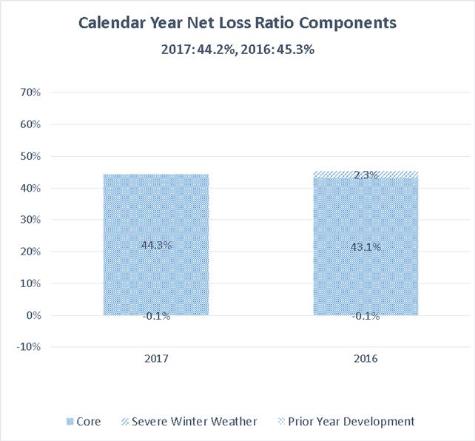
During 2017, the
net loss ratio decreased compared to 2016 due to a combination of
several factors. First, there was a reduction in the impact of
severe winter weather, defined as the losses incurred above those
expected in an average winter. In 2017 we recorded no impact from
severe winter weather, compared to 2.3 points in 2016, or a
decrease of 2.3 points. Partially offsetting this impact, the core
loss ratio excluding the impact of severe winter weather and prior
year development increased to 44.3% in 2017 from 43.1% in 2016, or
an increase of 1.2 points. In addition, we recorded 0.1 points of
favorable prior year loss development in 2017 which was the same as
the 0.1 point favorable prior year development impact recorded in
2016. The increase in the core net loss ratio is driven by
increased claim severity in both personal and commercial lines.
Personal lines was impacted by an increased frequency of large fire
claims compared to 2016. See table below under “Additional
Financial Information” summarizing net loss ratios by line of
business.
Commission Expense
Commission expense was $21,182,000
in 2017 or 19.1 % of direct earned
premiums. Commission expense was $18,327,000 in 2016 or 18.9% of direct earned premiums. The
increase of $2,855,000 is due
to the increase in direct written premiums in 2017 as compared to
2016.
Other Underwriting Expenses
Other
underwriting expenses were $18,116,000 in 2017 compared to
$14,867,000 in 2016. The increase of $3,249,000, or 21.9%, was
primarily due to expenses related to growth in direct written
premiums. These expenses can vary directly or indirectly as a
percentage of written premiums. Expenses that vary directly with
written premiums include underwriting expenses, software usage
fees, and state premium taxes. Some expenses such as salaries,
related employment costs, professional fees, and data services are
indirectly related to written premiums. Such expenses are not
proportional to written premiums and for our Expansion business
these expenses are incurred in advance of policies written
(“Expansion Expenses”). Expansion Expenses were
$1,044,000 in 2017 compared to $476,000 in 2016. The increase of
$568,000 includes the costs of salaries and employment costs,
professional fees, IT and data services specifically attributable
to the expansion into new states.
Core
salaries and employment costs were $7,385,000 in 2017 compared to
$6,788,000 in 2016. The increase of $597,000, or 8.8%, was less
than the 17.8% increase in total direct written premiums, which is
not yet materially affected by our Expansion business. The increase
in employment costs was due to hiring of additional staff to
service our current level of business and anticipated growth in
volume as well as annual rate increases in salaries. Growth related
to our Expansion business creates a lag in net premiums earned
compared to direct written premiums for that business. This lag in
net premiums earned along with the reduction to quota share rates
distorts net underwriting expense ratio comparisons between
periods. Therefore, we believe that reviewing the ratio of Core
other underwriting expenses to Core net premiums earned offers a
more consistent comparison between periods and is a more accurate
indicator of our overall other underwriting expense efficiency. The
following table breaks out the Core and Expansion components of our
underwriting expense ratio for the periods indicated:
|
|
Year
ended
|
$
or
|
|
|
|
December 31,
|
Point
|
|
|
|
2017
|
2016
|
Change
|
|
Net
premiums earned
|
|
|
|
|
Core
|
$77,007
|
$61,408
|
$15,599
|
|
Expansion
|
344
|
-
|
344
|
|
Total
|
$77,351
|
$61,408
|
$15,943
|
|
|
|
|
|
|
Other
underwriting expenses
|
|
|
|
|
Core
|
$17,072
|
$14,391
|
$2,681
|
|
Expansion
|
1,044
|
476
|
568
|
|
Total
|
$18,116
|
$14,867
|
$3,249
|
|
|
|
|
|
|
Other
underwriting expenses as a percentage
|
|
|
|
|
of
net premiums earned
|
|
|
|
|
Core
|
22.2%
|
23.4%
|
-1.3%
|
|
Expansion
|
303.5%
|
na
|
na
|
|
Total
|
23.4%
|
24.2%
|
-0.8%
|
The
ratio of Core other underwriting expenses to Core net premiums
earned was 22.2% in 2017 compared to 23.4% in 2016, a decrease of
1.3 percentage points.
Our
net underwriting expense ratio in 2017 was 36.4% compared with
33.9% in 2016. The following table shows the individual components
of our net underwriting expense ratio for the periods
indicated:
|
|
Year
ended
|
|
|
|
|
December 31,
|
Percentage
|
|
|
|
2017
|
2016
|
Point Change
|
|
Ceding
commission revenue - provisional
|
(13.8)
|
(20.8)
|
7.0
|
|
Ceding
commission revenue - contingent
|
1.0
|
2.4
|
(1.4)
|
|
Other
income
|
(1.6)
|
(1.8)
|
0.2
|
|
Acquisition
costs and other underwriting expenses:
|
|
|
|
|
Commission
expense
|
27.4
|
29.9
|
(2.5)
|
|
|
13.0
|
9.7
|
3.3
|
|
Other
underwriting expenses
|
|
|
|
|
Core
|
|
|
|
|
Employment
costs
|
9.5
|
11.1
|
(1.6)
|
|
Other
Core Expenses
|
12.6
|
12.3
|
0.3
|
|
Total
Core Expenses
|
22.1
|
23.4
|
(1.3)
|
|
Expansion
Expenses
|
1.3
|
0.8
|
0.5
|
|
Total
other underwriting expenses
|
23.4
|
24.2
|
(0.8)
|
|
|
|
|
|
|
Net
underwriting expense ratio
|
36.4%
|
33.9%
|
2.5
|
The
decrease in our other underwriting expense ratio excluding the
impact of ceding commission revenue and commission expense was
driven by a decline in the impact from employment costs
attributable to our growing Core business, partially offset by the
impact from increased costs related to Core and Expansion
business.
The
overall increase of 2.5 percentage points in the net underwriting
expense ratio was impacted by the change in our quota share ceding
rates and its impact on provisional ceding commission revenue as a
result of the additional retention resulting from the Cut-off to
our quota share treaties on July 1, 2017. The increase to the net
underwriting expense ratio was impacted more by reductions in the
reinsurance ceding commission revenue components than it was to
changes in the commission expense and other underwriting expense
components, each of which declined as a ratio to net premiums
earned.
Other Operating Expenses
Other operating expenses, related to the expenses
of our holding company, were $3,513,000 in 2017 compared to $1,910,000 in 2016. The increase in 2017 of
$1,603,000, or 83.9%, was primarily
due to increases in executive bonus compensation, executive
compensation due to annual rate increases and hiring of additional
staff, and equity compensation. The increase in executive bonus
compensation includes $945,000 of accrued long-term bonus
compensation pursuant to the three year employment agreement
effective January 1, 2017 with our Chief Executive Officer. In 2016
there was no long-term bonus compensation plan in
place. The
bonus is a one-time payment computed at the end of three year
period, and the amount accrued in 2017 will only be paid if the
three year computation meets the required terms of
profitability.
Depreciation and Amortization
Depreciation
and amortization was $1,403,000 in 2017 compared to $1,125,000 in
2016. The increase of $278,000, or 24.7%, in depreciation and
amortization was primarily due to depreciation of our new system
platform for handling business being written in Expansion states.
The increase was also impacted by newly purchased assets used to
upgrade our systems infrastructure and improvements to the
Kingston, New York home office building from which we
operate.
Interest Expense
Interest
expense in 2017 was $60,000 and -0- in 2016. We incurred
interest expense in connection with our $30.0 million issuance of
long-term debt in December 2017.
Income Tax Expense
Income
tax expense in 2017 was $4,323,000, which resulted in an effective
tax rate of 30.2%. Income tax expense in 2016 was $4,518,000, which
resulted in an effective tax rate of 33.7%. Income before taxes was
$14,309,000 in 2017 compared to $13,418,000 in 2016. On December
22, 2017, the Tax Cuts and Jobs Act of 2017 (the
“Act”), was enacted by the U.S. federal government. The
Act provides for significant changes to corporate taxation
including the decrease of the corporate tax rate to 21%. We have
accounted for the 2017 material impacts of the Act by re-measuring
our net deferred tax liabilities at the new 21% enacted tax rate.
The impact of the change in tax rate was a decrease in net deferred
income tax liabilities of $405,000 with a corresponding increase in
deferred income tax benefit, resulting in reduction of our
effective tax rate by 2.8 percentage points in 2017.
Net Income
Net
income was $9,986,000 in 2017 compared to $8,900,000 in 2016. The
increase in net income of $1,086,000, or 12.2%, was due to the
circumstances described above that caused the increase in our net
premiums earned, net investment income and other income and a
decrease in our net loss ratio, partially offset by a decrease in
ceding commission revenue and net realized gains on sales of
investments, and increases in other underwriting expenses related
to premium growth, other operating expenses, depreciation and
amortization, and interest expense.
Additional Financial Information
We
operate our business as one segment, property and casualty
insurance. Within this segment, we offer a wide array of property
and casualty policies to our producers. The following table
summarizes gross and net premiums written, net premiums earned, and
loss and loss adjustment expenses by major product type, which were
determined based primarily on similar economic characteristics and
risks of loss.
|
|
Year
ended
|
|
|
|
December 31,
|
|
|
|
2017
|
2016
|
|
Gross
premiums written:
|
|
|
|
Personal
lines
|
$95,993,591
|
$79,256,251
|
|
Commercial
lines
|
14,632,300
|
12,759,351
|
|
Livery
physical damage
|
10,727,707
|
10,955,785
|
|
Other(1)
|
244,427
|
249,130
|
|
Total
|
$121,598,025
|
$103,220,517
|
|
|
|
|
|
Net
premiums written:
|
|
|
|
Personal
lines
|
|
|
|
Excluding
the effect of quota share adjustments on July 1
|
$61,756,415
|
$43,485,866
|
|
Return
of premiums previously ceded to prior quota share treaties prior
quota share treaties
|
7,140,088
|
-
|
|
Personal
lines (2)
|
68,896,503
|
43,485,866
|
|
Commercial
lines
|
13,038,640
|
11,413,717
|
|
Livery
physical damage
|
10,727,707
|
10,955,785
|
|
Other(1)
|
206,026
|
70,819
|
|
Total
|
$92,868,876
|
$65,926,187
|
|
|
|
|
|
Net
premiums earned:
|
|
|
|
Personal
lines (2)
|
$53,556,294
|
$40,325,585
|
|
Commercial
lines
|
12,163,104
|
11,120,890
|
|
Livery
physical damage
|
11,441,168
|
9,783,792
|
|
Other(1)
|
190,457
|
177,639
|
|
Total
|
$77,351,023
|
$61,407,906
|
|
|
|
|
|
Net
loss and loss adjustment expenses:
|
|
|
|
Personal
lines
|
$20,866,628
|
$16,116,325
|
|
Commercial
lines
|
6,368,927
|
5,408,168
|
|
Livery
physical damage
|
4,870,947
|
4,777,308
|
|
Other(1)
|
(14,686)
|
(304,404)
|
|
Unallocated
loss adjustment expenses
|
2,093,721
|
1,792,264
|
|
Total
|
$34,185,537
|
$27,789,661
|
|
|
|
|
|
Net
loss ratio:
|
|
|
|
Personal
lines
|
39.0%
|
40.0%
|
|
Commercial
lines
|
52.4%
|
48.6%
|
|
Livery
physical damage
|
42.6%
|
48.8%
|
|
Other(1)
|
-7.7%
|
-171.4%
|
|
Total
|
44.2%
|
45.3%
|
(1)
“Other”
includes, among other things, premiums and loss and loss adjustment
expenses from commercial auto and our participation in a mandatory
state joint underwriting association.
(2)
See discussions
above with regard to “Net Written Premiums and Net Premiums
Earned”, as to change in quota share ceding rate effective
July 1, 2017.
Insurance
Underwriting Business on a Standalone Basis
Our insurance underwriting business reported on a
standalone basis for the years ended December 31, 2017 and 2016
follows:
|
|
Year
ended
|
|
|
|
December 31,
|
|
|
|
2017
|
2016
|
|
Revenues
|
|
|
|
Net
premiums earned
|
$77,351,023
|
$61,407,906
|
|
Ceding
commission revenue
|
9,933,133
|
11,268,241
|
|
Net
investment income
|
4,132,586
|
3,115,583
|
|
Net
realized gain on investments
|
84,313
|
529,448
|
|
Other
income
|
1,210,897
|
1,102,352
|
|
Total
revenues
|
92,711,952
|
77,423,530
|
|
|
|
|
|
Expenses
|
|
|
|
Loss
and loss adjustment expenses
|
34,185,537
|
27,789,661
|
|
Commission
expense
|
21,182,254
|
18,327,190
|
|
Other
underwriting expenses
|
18,115,614
|
14,866,646
|
|
Depreciation
and amortization
|
1,402,928
|
1,123,763
|
|
Total
expenses
|
74,886,333
|
62,107,260
|
|
|
|
|
|
Income
from operations
|
17,825,619
|
15,316,270
|
|
Income
tax expense
|
5,764,191
|
5,208,772
|
|
Net income
|
$12,061,428
|
$10,107,498
|
|
|
|
|
|
Key Measures:
|
|
|
|
Net
loss ratio
|
44.2%
|
45.3%
|
|
Net
underwriting expense ratio
|
36.4%
|
33.9%
|
|
Net
combined ratio
|
80.6%
|
79.2%
|
|
|
|
|
|
Reconciliation
of net underwriting expense ratio:
|
|
|
|
Acquisition
costs and other
|
|
|
|
underwriting
expenses
|
$39,297,868
|
$33,193,836
|
|
Less:
Ceding commission revenue
|
(9,933,133)
|
(11,268,241)
|
|
Less:
Other income
|
(1,210,897)
|
(1,102,352)
|
|
Net
underwriting expenses
|
$28,153,838
|
$20,823,243
|
|
|
|
|
|
Net
premiums earned
|
$77,351,023
|
$61,407,906
|
|
|
|
|
|
Net
Underwriting Expense Ratio
|
36.4%
|
33.9%
|
An analysis of our
direct, assumed and ceded earned premiums, loss and loss adjustment
expenses, and loss ratios is shown below:
|
|
Direct
|
Assumed
|
Ceded
|
Net
|
|
Year ended December 31, 2017
|
|
|
|
|
|
Written
premiums
|
$121,575,178
|
$22,847
|
$(28,729,149)
|
$92,868,876
|
|
Change
in unearned premiums
|
(10,662,744)
|
9,456
|
(4,864,565)
|
(15,517,853)
|
|
Earned
premiums
|
$110,912,434
|
$32,303
|
$(33,593,714)
|
$77,351,023
|
|
|
|
|
|
|
|
Loss
and loss adjustment expenses exluding
|
|
|
|
|
|
the
effect of catastrophes
|
$48,222,147
|
$30,417
|
$(14,067,027)
|
$34,185,537
|
|
Catastrophe
loss
|
-
|
-
|
-
|
-
|
|
Loss
and loss adjustment expenses
|
$48,222,147
|
$30,417
|
$(14,067,027)
|
$34,185,537
|
|
|
|
|
|
|
|
Loss
ratio excluding the effect of catastrophes
|
43.5%
|
94.2%
|
41.9%
|
44.2%
|
|
Catastrophe
loss
|
0.0%
|
0.0%
|
0.0%
|
0.0%
|
|
Loss
ratio
|
43.5%
|
94.2%
|
41.9%
|
44.2%
|
|
|
|
|
|
|
|
Year ended December 31, 2016
|
|
|
|
|
|
Written
premiums
|
$103,191,995
|
$28,522
|
$(37,294,330)
|
$65,926,187
|
|
Change
in unearned premiums
|
(6,110,225)
|
6,091
|
1,585,853
|
(4,518,281)
|
|
Earned
premiums
|
$97,081,770
|
$34,613
|
$(35,708,477)
|
$61,407,906
|
|
|
|
|
|
|
|
Loss
and loss adjustment expenses exluding
|
|
|
|
|
|
the
effect of catastrophes
|
$37,193,657
|
$55,257
|
$(10,861,730)
|
$26,387,184
|
|
Catastrophe
loss
|
2,337,461
|
-
|
(934,984)
|
1,402,477
|
|
Loss
and loss adjustment expenses
|
$39,531,118
|
$55,257
|
$(11,796,714)
|
$27,789,661
|
|
|
|
|
|
|
|
Loss
ratio excluding the effect of catastrophes
|
38.3%
|
159.6%
|
30.4%
|
43.0%
|
|
Catastrophe
loss
|
2.4%
|
0.0%
|
2.6%
|
2.3%
|
|
Loss
ratio
|
40.7%
|
159.6%
|
33.0%
|
45.3%
|
The key measures
for our insurance underwriting business for the years ended
December 31, 2017 and 2016 are as follows:
|
|
Year
ended
|
|
|
|
December 31,
|
|
|
|
2017
|
2016
|
|
Net
premiums earned
|
$77,351,023
|
$61,407,906
|
|
Ceding
commission revenue
|
9,933,133
|
11,268,241
|
|
Other
income
|
1,210,897
|
1,102,352
|
|
|
|
|
|
Loss
and loss adjustment expenses (1)
|
34,185,537
|
27,789,661
|
|
|
|
|
|
Acquisition
costs and other underwriting expenses:
|
|
|
|
Commission
expense
|
21,182,254
|
18,327,190
|
|
Other
underwriting expenses
|
18,115,614
|
14,866,646
|
|
Total
acquisition costs and other
|
|
|
|
underwriting
expenses
|
39,297,868
|
33,193,836
|
|
|
|
|
|
Underwriting
income
|
$15,011,648
|
$12,795,002
|
|
|
|
|
|
Key
Measures:
|
|
|
|
Net
loss ratio excluding the effect of catastrophes
|
44.2%
|
43.0%
|
|
Effect
of catastrophe loss on net loss ratio (1) (2)
|
0.0%
|
2.3%
|
|
Net
loss ratio
|
44.2%
|
45.3%
|
|
|
|
|
|
Net
underwriting expense ratio excluding the
|
|
|
|
effect
of catastrophes
|
36.4%
|
33.9%
|
|
Effect
of catastrophe loss on net underwriting
|
|
|
|
expense
ratio (2)
|
0.0%
|
0.0%
|
|
Net
underwriting expense ratio
|
36.4%
|
33.9%
|
|
|
|
|
|
Net
combined ratio excluding the effect
|
|
|
|
of
catastrophes
|
80.6%
|
76.9%
|
|
Effect
of catastrophe loss on net combined
|
|
|
|
ratio
(1) (2)
|
0.0%
|
2.3%
|
|
Net
combined ratio
|
80.6%
|
79.2%
|
|
|
|
|
|
Reconciliation
of net underwriting expense ratio:
|
|
|
|
Acquisition
costs and other
|
|
|
|
underwriting
expenses
|
$39,297,868
|
$33,193,836
|
|
Less:
Ceding commission revenue
|
(9,933,133)
|
(11,268,241)
|
|
Less:
Other income
|
(1,210,897)
|
(1,102,352)
|
|
|
$28,153,838
|
$20,823,243
|
|
|
|
|
|
Net
earned premium
|
$77,351,023
|
$61,407,906
|
|
|
|
|
|
Net
Underwriting Expense Ratio
|
36.4%
|
33.9%
|
(1)
For the year ended
December 31, 2016, includes the sum of net catastrophe losses and
loss adjustment expenses of $1,402,477 resulting from severe winter
weather.
(2)
For the year ended
December 31, 2016, the effect of catastrophe loss from severe
winter weather on our net combined ratio includes the direct
effects of loss and loss adjustment expenses and there were no
indirect effects in other underwriting expenses.
Investments
Portfolio Summary
The following table
presents a breakdown of the amortized cost, aggregate fair value
and unrealized gains and losses by investment type as of
December 31, 2017 and 2016:
Available-for-Sale Securities
|
|
December
31, 2017
|
|||||
|
|
Cost or
|
Gross
|
Gross Unrealized Losses
|
|
% of
|
|
|
|
Amortized
|
Unrealized
|
Less
than 12
|
More
than 12
|
Fair
|
Fair
|
|
Category
|
Cost
|
Gains
|
Months
|
Months
|
Value
|
Value
|
|
|
|
|
|
|
|
|
|
Political
subdivisions of States,
|
|
|
|
|
|
|
|
Territories
and Possessions
|
$11,096,122
|
$250,135
|
$(30,814)
|
$-
|
$11,315,443
|
8.4%
|
|
|
|
|
|
|
|
|
|
Corporate
and other bonds
|
|
|
|
|
|
|
|
Industrial
and miscellaneous
|
87,562,631
|
1,189,207
|
(269,857)
|
(340,516)
|
88,141,465
|
65.7%
|
|
|
|
|
|
|
|
|
|
Residential
mortgage and other
|
|
|
|
|
|
|
|
asset
backed securities (1)
|
20,463,353
|
305,499
|
(48,482)
|
(189,022)
|
20,531,348
|
15.3%
|
|
Total
fixed-maturity securities
|
119,122,106
|
1,744,841
|
(349,153)
|
(529,538)
|
119,988,256
|
89.4%
|
|
Equity
Securities
|
13,761,841
|
902,117
|
(242,518)
|
(135,242)
|
14,286,198
|
10.6%
|
|
Total
|
$132,883,947
|
$2,646,958
|
$(591,671)
|
$(664,780)
|
$134,274,454
|
100.0%
|
(1)
In 2017, KICO placed certain
residential mortgage backed securities as eligible collateral in a
designated custodian account related to its relationship with the
Federal Home Loan Bank of New York ("FHLBNY"). The eligible
collateral would be pledged to FHLBNY if KICO draws an advance from
FHBLNY. As of December 31, 2017, the fair value of the eligible
investments was $6,702,538. KICO will retain all rights regarding
all securities if pledged as collateral. As of December 31, 2017,
there were no outstanding advances.
|
|
December 31, 2016
|
|||||
|
|
Cost or
|
Gross
|
Gross Unrealized Losses
|
|
% of
|
|
|
|
Amortized
|
Unrealized
|
Less than 12
|
More than 12
|
Fair
|
Fair
|
|
Category
|
Cost
|
Gains
|
Months
|
Months
|
Value
|
Value
|
|
|
|
|
|
|
|
|
|
Political
subdivisions of States,
|
|
|
|
|
|
|
|
Territories
and Possessions
|
$8,053,449
|
$199,028
|
$(46,589)
|
$-
|
$8,205,888
|
9.1%
|
|
|
|
|
|
|
|
|
|
Corporate
and other bonds
|
|
|
|
|
|
|
|
Industrial
and miscellaneous
|
53,728,395
|
600,519
|
(638,113)
|
(5,612)
|
53,685,189
|
59.4%
|
|
|
|
|
|
|
|
|
|
Residential
mortgage backed
|
|
|
|
|
|
|
|
securities
|
18,814,784
|
70,682
|
(309,273)
|
(38,442)
|
18,537,751
|
20.5%
|
|
Total
fixed-maturity securities
|
80,596,628
|
870,229
|
(993,975)
|
(44,054)
|
80,428,828
|
89.0%
|
|
Equity
Securities
|
9,709,385
|
701,641
|
(255,301)
|
(168,039)
|
9,987,686
|
11.0%
|
|
Total
|
$90,306,013
|
$1,571,870
|
$(1,249,276)
|
$(212,093)
|
$90,416,514
|
100.0%
|
Held-to-Maturity Securities
|
|
December 31, 2017
|
|||||
|
|
Cost or
|
Gross
|
Gross Unrealized Losses
|
|
% of
|
|
|
|
Amortized
|
Unrealized
|
Less than 12
|
More than 12
|
Fair
|
Fair
|
|
Category
|
Cost
|
Gains
|
Months
|
Months
|
Value
|
Value
|
|
|
|
|
|
|
|
|
|
U.S.
Treasury securities
|
$729,466
|
$147,573
|
$(1,729)
|
$-
|
$875,310
|
17.0%
|
|
|
|
|
|
|
|
|
|
Political
subdivisions of States,
|
|
|
|
|
|
|
|
Territories
and Possessions
|
998,984
|
50,366
|
-
|
-
|
1,049,350
|
20.4%
|
|
|
|
|
|
|
|
|
|
Corporate
and other bonds
|
|
|
|
|
|
|
|
Industrial
and miscellaneous
|
3,141,358
|
90,358
|
-
|
(6,300)
|
3,225,416
|
62.6%
|
|
|
|
|
|
|
|
|
|
Total
|
$4,869,808
|
$288,297
|
$(1,729)
|
$(6,300)
|
$5,150,076
|
100.0%
|
|
|
December
31, 2016
|
|||||
|
|
Cost or
|
Gross
|
Gross Unrealized Losses
|
|
% of
|
|
|
|
Amortized
|
Unrealized
|
Less
than 12
|
More
than 12
|
Fair
|
Fair
|
|
Category
|
Cost
|
Gains
|
Months
|
Months
|
Value
|
Value
|
|
|
|
|||||
|
U.S.
Treasury securities
|
$606,427
|
$147,612
|
$-
|
$-
|
$754,039
|
14.2%
|
|
|
|
|
|
|
|
|
|
Political
subdivisions of States,
|
|
|
|
|
|
|
|
Territories
and Possessions
|
1,349,916
|
37,321
|
-
|
-
|
1,387,237
|
26.2%
|
|
|
|
|
|
|
|
|
|
Corporate
and other bonds
|
|
|
|
|
|
|
|
Industrial
and miscellaneous
|
3,138,559
|
72,784
|
(7,619)
|
(46,881)
|
3,156,843
|
59.6%
|
|
|
|
|
|
|
|
|
|
Total
|
$5,094,902
|
$257,717
|
$(7,619)
|
$(46,881)
|
$5,298,119
|
100.0%
|
Held-to-maturity
U.S. Treasury securities are held in trust pursuant to various
states’ minimum fund requirements.
A
summary of the amortized cost and fair value of our investments in
held-to-maturity securities by contractual maturity as of December
31, 2017 and 2016 is shown below:
|
|
December 31, 2017
|
December 31, 2016
|
||
|
|
Amortized
|
|
Amortized
|
|
|
Remaining Time to
Maturity
|
Cost
|
Fair Value
|
Cost
|
Fair Value
|
|
|
|
|
|
|
|
Less
than one year
|
$-
|
$-
|
$-
|
$-
|
|
One
to five years
|
2,546,459
|
2,601,898
|
650,000
|
642,455
|
|
Five
to ten years
|
1,716,884
|
1,794,139
|
3,838,475
|
3,901,625
|
|
More
than ten years
|
606,465
|
754,039
|
606,427
|
754,039
|
|
Total
|
$4,869,808
|
$5,150,076
|
$5,094,902
|
$5,298,119
|
Credit Rating of Fixed-Maturity
Securities
The table below
summarizes the credit quality of our available-for-sale
fixed-maturity securities as of December 31, 2017 and 2016 as rated
by Standard and Poor’s (or, if unavailable from Standard and
Poor’s, then Moody’s or Fitch):
|
|
December 31, 2017
|
December 31, 2016
|
||
|
|
|
Percentage
of
|
|
Percentage
of
|
|
|
Fair
Market
|
Fair
Market
|
Fair
Market
|
Fair
Market
|
|
|
Value
|
Value
|
Value
|
Value
|
|
|
|
|
|
|
|
Rating
|
|
|
|
|
|
U.S.
Treasury securities
|
$-
|
0.0%
|
$-
|
0.0%
|
|
|
|
|
|
|
|
Corporate
and municipal bonds
|
|
|
|
|
|
AAA
|
1,358,143
|
1.1%
|
1,801,106
|
2.2%
|
|
AA
|
11,319,057
|
9.4%
|
7,236,457
|
9.0%
|
|
A
|
17,199,631
|
14.3%
|
13,944,784
|
17.3%
|
|
BBB
|
68,704,768
|
57.3%
|
38,908,731
|
48.4%
|
|
BB
|
875,310
|
0.7%
|
-
|
0.0%
|
|
Total
corporate and municipal bonds
|
99,456,909
|
82.8%
|
61,891,078
|
76.9%
|
|
|
|
|
|
|
|
Residential
mortgage backed securities
|
|
|
|
|
|
AAA
|
2,013,010
|
1.7%
|
-
|
0.0%
|
|
AA
|
11,021,144
|
9.2%
|
14,143,828
|
17.7%
|
|
A
|
3,902,768
|
3.3%
|
173,973
|
0.2%
|
|
CCC
|
1,420,296
|
1.2%
|
513,369
|
0.6%
|
|
CC
|
120,742
|
0.1%
|
-
|
0.0%
|
|
C
|
28,963
|
0.0%
|
112,136
|
0.1%
|
|
D
|
1,659,479
|
1.4%
|
3,594,444
|
4.5%
|
|
Non
rated
|
364,945
|
0.3%
|
-
|
0.0%
|
|
Total
residential mortgage backed securities
|
20,531,347
|
17.2%
|
18,537,750
|
23.1%
|
|
|
|
|
|
|
|
Total
|
$119,988,256
|
100.0%
|
$80,428,828
|
100.0%
|
The table below
details the average yield by type of fixed-maturity security as of
December 31, 2017 and 2016:
|
Category
|
December 31,
2017
|
December 31,
2016
|
|
U.S.
Treasury securities and obligations
of U.S. government corporations
and agencies
|
3.32%
|
3.44%
|
|
|
|
|
|
Political
subdivisions of States, Territories
and Possessions
|
3.49%
|
3.87%
|
|
|
|
|
|
Corporate
and other bonds
|
|
|
|
Industrial
and miscellaneous
|
3.98%
|
3.86%
|
|
|
|
|
|
Residential
mortgage backed securities
|
1.83%
|
3.83%
|
|
|
|
|
|
Total
|
3.58%
|
3.85%
|
The table below
lists the weighted average maturity and effective duration in years
on our fixed-maturity securities as of December 31, 2017 and
2016:
|
|
December 31,
2017
|
December 31,
2016
|
|
Weighted average effective
maturity
|
5.7
|
5.0
|
|
|
|
|
|
Weighted
average final maturity
|
7.8
|
8.3
|
|
|
|
|
|
Effective
duration
|
4.9
|
4.4
|
Fair Value Consideration
As disclosed in
Note 4 to the Consolidated Financial Statements, with respect to
“Fair Value Measurements,” we define fair value as the
price that would be received to sell an asset or paid to transfer a
liability in a transaction involving identical or comparable assets
or liabilities between market participants (an “exit
price”). The fair value hierarchy distinguishes between
inputs based on market data from independent sources
(“observable inputs”) and a reporting entity’s
internal assumptions based upon the best information available when
external market data is limited or unavailable (“unobservable
inputs”). The fair value hierarchy prioritizes fair value
measurements into three levels based on the nature of the inputs.
Quoted prices in active markets for identical assets have the
highest priority (“Level 1”), followed by observable
inputs other than quoted prices including prices for similar but
not identical assets or liabilities (“Level 2”), and
unobservable inputs, including the reporting entity’s
estimates of the assumption that market participants would use,
having the lowest priority (“Level 3”). As of December
31, 2017 and December 31, 2016,
73% and 65%, respectively, of the investment portfolio recorded at
fair value was priced based upon quoted market prices.
As more fully
described in Note 3 to our Consolidated Financial Statements,
“Investments—Impairment Review,” we completed a
detailed review of all our securities in a continuous loss position
as of December 31, 2017 and
December 31, 2016. In
December, 2017, we disposed of one of
our held-to-maturity debt securities that was previously included
in OTTI; the bond was issued by the Commonwealth of Puerto Rico
(“PR”). In July
2016, PR defaulted on its interest payment to bondholders. Due to
the credit deterioration of PR, we recorded our first credit loss
component of OTTI on this investment as of June 30, 2016. As of
December 31, 2016, the full amount of the write-down was recognized
as a credit component of OTTI in the amount of $69,911. In
September 2017, Hurricane Maria significantly affected Puerto Rico.
The impact of this event further contributed to the credit
deterioration of PR and, as a result, we recorded an additional
credit loss component of OTTI on this investment for the amount of
$50,000 during the quarter ended September 30, 2017. The total of
the two OTTI write-downs of this investment as of December 31, 2017
was $119,911. We determined that none of the other unrealized
losses were deemed to be OTTI for our portfolio of fixed-maturity
investments and equity securities for the years ended December 31,
2017 and 2016. Significant factors influencing our determination
that unrealized losses were temporary included the magnitude of the
unrealized losses in relation to each security’s cost, the
nature of the investment and management’s intent and ability
to retain the investment for a period of time sufficient to allow
for an anticipated recovery of fair value to our cost
basis.
The table below
summarizes the gross unrealized losses of our fixed-maturity
securities available-for-sale and equity securities by length of
time the security has continuously been in an unrealized loss
position as of December 31, 2017 and 2016:
|
|
December 31, 2017
|
|||||||
|
|
Less
than 12 months
|
12
months or more
|
Total
|
|||||
|
|
|
|
No.
of
|
|
|
No.
of
|
Aggregate
|
|
|
|
Fair
|
Unrealized
|
Positions
|
Fair
|
Unrealized
|
Positions
|
Fair
|
Unrealized
|
|
Category
|
Value
|
Losses
|
Held
|
Value
|
Losses
|
Held
|
Value
|
Losses
|
|
|
|
|
|
|
|
|
|
|
|
Fixed-Maturity Securities:
|
|
|
|
|
|
|
|
|
|
Political
subdivisions of States,
Territories and Possessions
|
$1,549,839
|
$(30,814)
|
4
|
$-
|
$-
|
-
|
$1,549,839
|
$(30,814)
|
|
|
|
|
|
|
|
|
|
|
|
Corporate
and other bonds
industrial and miscellaneous
|
15,036,462
|
(269,857)
|
20
|
9,113,924
|
(340,516)
|
17
|
24,150,386
|
(610,373)
|
|
|
|
|
|
|
|
|
|
|
|
Residential
mortgage and other asset
backed securities
|
6,956,371
|
(48,482)
|
6
|
7,867,572
|
(189,022)
|
15
|
14,823,943
|
(237,504)
|
|
|
|
|
|
|
|
|
|
|
|
|
|
|
|
|
|
|
|
|
|
Total
fixed-maturity securities
|
$23,542,672
|
$(349,153)
|
30
|
$16,981,496
|
$(529,538)
|
32
|
$40,524,168
|
$(878,691)
|
|
|
|
|
|
|
|
|
|
|
|
Equity Securities:
|
|
|
|
|
|
|
|
|
|
Preferred
stocks
|
$1,605,217
|
$(20,313)
|
5
|
$1,776,675
|
$(120,712)
|
3
|
$3,381,892
|
$(141,025)
|
|
Common
stocks and
|
|
|
|
|
|
|
|
|
|
exchange
traded mutual funds
|
1,446,375
|
(222,205)
|
4
|
124,900
|
(14,530)
|
1
|
1,571,275
|
(236,735)
|
|
|
|
|
|
|
|
|
|
|
|
Total
equity securities
|
$3,051,592
|
$(242,518)
|
9
|
$1,901,575
|
$(135,242)
|
4
|
$4,953,167
|
$(377,760)
|
|
|
|
|
|
|
|
|
|
|
|
Total
|
$26,594,264
|
$(591,671)
|
39
|
$18,883,071
|
$(664,780)
|
36
|
$45,477,335
|
$(1,256,451)
|
|
|
December 31, 2016
|
|||||||
|
|
Less than 12 months
|
12 months or more
|
Total
|
|||||
|
|
|
|
No. of
|
|
|
No. of
|
Aggregate
|
|
|
|
Fair
|
Unrealized
|
Positions
|
Fair
|
Unrealized
|
Positions
|
Fair
|
Unrealized
|
|
Category
|
Value
|
Losses
|
Held
|
Value
|
Losses
|
Held
|
Value
|
Losses
|
|
|
|
|
|
|
|
|
|
|
|
Fixed-Maturity Securities:
|
|
|
|
|
|
|
|
|
|
Political
subdivisions of States,
Territories and Possessions
|
$1,067,574
|
$(46,589)
|
3
|
$-
|
$-
|
-
|
$1,067,574
|
$(46,589)
|
|
|
|
|
|
|
|
|
|
|
|
Corporate
and other bonds
industrial and miscellaneous
|
19,859,293
|
(638,113)
|
34
|
239,970
|
(5,612)
|
1
|
20,099,263
|
(643,725)
|
|
|
|
|
|
|
|
|
|
|
|
Residential
mortgage backed
securities
|
15,918,090
|
(309,273)
|
30
|
675,316
|
(38,442)
|
6
|
16,593,406
|
(347,715)
|
|
|
|
|
|
|
|
|
|
|
|
Total
fixed-maturity securities
|
$36,844,957
|
$(993,975)
|
67
|
$915,286
|
$(44,054)
|
7
|
$37,760,243
|
$(1,038,029)
|
|
|
|
|
|
|
|
|
|
|
|
Equity Securities:
|
|
|
|
|
|
|
|
|
|
Preferred
stocks
|
$3,759,850
|
$(241,333)
|
8
|
$660,750
|
$(70,571)
|
1
|
$4,420,600
|
$(311,904)
|
|
Common
stocks and
|
|
|
|
|
|
|
|
|
|
exchange
traded mutual funds
|
288,075
|
(13,968)
|
1
|
424,550
|
(97,468)
|
1
|
712,625
|
(111,436)
|
|
|
|
|
|
|
|
|
|
|
|
Total
equity securities
|
$4,047,925
|
$(255,301)
|
9
|
$1,085,300
|
$(168,039)
|
2
|
$5,133,225
|
$(423,340)
|
|
|
|
|
|
|
|
|
|
|
|
Total
|
$40,892,882
|
$(1,249,276)
|
76
|
$2,000,586
|
$(212,093)
|
9
|
$42,893,468
|
$(1,461,369)
|
There were 75
securities at December 31, 2017
that accounted for the gross unrealized loss, none of which were
deemed by us to be other than temporarily impaired. There were 85
securities at December 31, 2016 that accounted for the gross
unrealized loss, none of which were deemed by us to be other than
temporarily impaired. Significant factors influencing our
determination that unrealized losses were temporary included the
magnitude of the unrealized losses in relation to each
security’s cost, the nature of the investment and
management’s intent not to sell these securities and it being
not more likely than not that we will be required to sell these
investments before anticipated recovery of fair value to our cost
basis.
Liquidity and Capital
Resources
Cash Flows
The primary sources
of cash flow are from our insurance underwriting subsidiary, KICO,
and include direct premiums written, ceding commissions from our
quota share reinsurers, loss recovery payments from our reinsurers,
investment income and proceeds from the sale or maturity of
investments. Funds are used by KICO for ceded premium payments to
reinsurers, which are paid on a net basis after subtracting losses
paid on reinsured claims and reinsurance commissions. KICO also
uses funds for loss payments and loss adjustment expenses on our
net business, commissions to producers, salaries and other
underwriting expenses as well as to purchase investments and fixed
assets.
On January 31,
2017, we closed on an underwritten public offering of 2,500,000
shares of our common stock. On February 14, 2017, we closed on the
underwriters’ purchase option for an additional 192,500
shares of our common stock. The public offering price for the
2,692,500 shares sold was $12.00 per share. The aggregate net
proceeds to us were approximately $30,137,000. On March 1, 2017, we
used $23,000,000 of the net proceeds of the offering to contribute
capital to KICO, to support its ratings upgrade plan and additional
growth. The remainder of the net proceeds will be used for general
corporate purposes.
On December 19, 2017, we issued $30 million of our
5.50% Senior Unsecured Notes due December 30, 2022 pursuant to an
underwritten public offering. The net proceeds to us were
approximately $29,121,000. On December 20, 2017, we used
$25,000,000 of the net proceeds from the debt offering to
contribute capital to KICO, to support additional growth. The
remainder of the net proceeds will be used for general corporate
purposes. Interest will be payable
semi-annually in arrears on June 30 and December 30 of each year,
beginning on June 30 2018 at the rate of 5.50% per year from
December 19, 2017.
For the year ended
December 31, 2017, the primary
source of cash flow for our holding company were the proceeds from
the public offerings discussed above and the dividends received
from KICO, subject to statutory restrictions. For the year ended
December 31, 2017, KICO paid dividends of $2,900,000
to us.
KICO is a member of
the Federal Home Loan Bank of New York (“FHLBNY”),
which provides additional access to liquidity. Members have access
to a variety of flexible, low cost funding through FHLBNY’s
credit products, enabling members to customize advances. Advances
are to be fully collateralized; eligible collateral to pledge to
FHLBNY includes residential and commercial mortgage backed
securities, along with U.S. Treasury and agency securities. See
Note 3 to our Consolidated Financial Statements, –
“Investments”, for eligible collateral held in a
designated custodian account available for future advances.
Advances are limited to 5% of KICO’s net admitted assets as
of December 31, 2017 and are due and payable within one year of
borrowing. The maximum allowable advance as of December 31, 2017
was approximately $9,849,000. Advances are limited to the amount of
available collateral, which was approximately $6,703,000 as of
December 31, 2017. There were no borrowings under this facility
during the year ended December 31, 2017.
If the
aforementioned sources of cash flow currently available are
insufficient to cover our holding company cash requirements, we
will seek to obtain additional financing.
Our reconciliation
of net income to net cash provided by operations is generally
influenced by the collection of premiums in advance of paid losses,
the timing of reinsurance, issuing company settlements and loss
payments.
Cash flow and
liquidity are categorized into three sources: (1) operating
activities; (2) investing activities; and (3) financing
activities, which are shown in the following table:
|
Years Ended December
31,
|
2017
|
2016
|
|
|
|
|
|
Cash
flows provided by (used in):
|
|
|
|
Operating
activities
|
$28,046,140
|
$15,201,025
|
|
Investing
activities
|
(47,626,330)
|
(19,515,843)
|
|
Financing
activities
|
55,917,303
|
2,807,966
|
|
Net increase (decrease) in cash and cash equivalents
|
36,337,113
|
(1,506,852)
|
|
Cash
and cash equivalents, beginning of period
|
12,044,520
|
13,551,372
|
|
Cash and cash equivalents, end of period
|
$48,381,633
|
$12,044,520
|
Net cash provided
by operating activities was $28,046,000 in 2017 as compared to
$15,201,000 provided in 2016. The $12,845,000 increase in cash
flows provided by operating activities in 2017 was primarily a
result of an increase in cash arising from net fluctuations in
assets and liabilities relating to operating activities of KICO as
affected by the growth in its operations which are described above,
and by an increase in net income (adjusted for non-cash items) of
$2,369,000.
Net cash used in
investing activities was $47,626,000 in 2017 compared to
$19,516,000 used in 2016. The $28,110,000 increase in cash used in
investing activities is the result of a $14,028,000 increase in
acquisitions of invested assets, a $9,584,000 decrease in sales or
maturities of invested assets and a $2,248,000 increase in the
amount of fixed asset acquisitions in 2017.
Net cash provided
by financing activities was $55,917,000 in 2017 compared to
$2,808,000 provided in 2016. The $53,109,000 increase in net cash
provided by financing activities is the result of the $30,137,000
net proceeds we received from the public offering of our common
stock in January/February 2017 and the $29,122,000 net proceeds we
received from the issuance of long-term debt pursuant to the public
offering in December 2017, offset partially by the $4,808,000 net
proceeds we received from the private placement of our common stock
in April 2016 and a $1,273,000 increase in dividends paid due to an
increase in the shares outstanding and dividend paid per
share.
Reinsurance
The following table
provides summary information with respect to each reinsurer that
accounted for more than 10% of our reinsurance recoverables on paid
and unpaid losses and loss adjustment expenses as of December 31,
2017:
|
|
|
Amount
|
|
|
|
|
Recoverable
|
|
|
|
A.M.
|
as of
|
|
|
($ in thousands)
|
Best Rating
|
December 31, 2017
|
%
|
|
|
|
|
|
|
Maiden
Reinsurace Company
|
A-
|
$9,128
|
47.3%
|
|
Swiss
Reinsurance America Corporation
|
A+
|
4,899
|
25.4%
|
|
|
|
14,027
|
72.7%
|
|
Others
|
|
5,255
|
27.3%
|
|
Total
|
|
$19,282
|
100.0%
|
Reinsurance
recoverable from Maiden Reinsurance Company and Motors Insurance
Corporation (included in Others) are secured pursuant to
collateralized trust agreements. Assets held in the two trusts are
not included in our invested assets and investment income earned on
these assets is credited to the two reinsurers
respectively.
Our
quota share reinsurance treaties are on a July 1 through June 30
fiscal year basis; therefore, for year to date fiscal periods after
June 30, two separate treaties will be included in such
periods.
Our
quota share reinsurance treaty in effect for 2017 for our personal
lines business, which primarily consists of homeowners policies,
was covered under the 2016/2017 Treaty and the 2017/2019 Treaty.
Our quota share reinsurance treaty in effect for 2016 for our
personal lines business, which primarily consists of homeowners
policies, was covered under the 2015/2016 Treaty and 2016/2017
Treaty.
In
March 2017, we bound our personal lines quota share reinsurance
treaty effective July 1, 2017. The treaty provides for a reduction
in the quota share ceding rate to 20%, from the 40% in the
2016/2017 Treaty, and an increase in the provisional ceding
commission rate to 53%, from the 52% in the 2016/2017 Treaty. The
new treaty covers a two year period from July 1, 2017 through June
30, 2019 (“2017/2019 Treaty”).
Our 2015/2016 Treaty, 2016/2017 Treaty, and 2017/2019 Treaty provide for
the following material terms:
|
|
Treaty Year
|
||
|
|
July 1, 2017
|
July 1, 2016
|
July 1, 2015
|
|
|
to
|
to
|
to
|
|
Line of Business
|
June 30, 2018
|
June 30, 2017
|
June 30, 2016
|
|
|
|
|
|
|
Personal Lines:
|
|
|
|
|
Homeowners,
dwelling fire and canine legal liability
|
|
|
|
|
Quota
share treaty:
|
|
|
|
|
Percent
ceded
|
20%
|
40%
|
40%
|
|
Risk
retained
|
$800,000
|
$500,000
|
$450,000
|
|
Losses
per occurrence subject to quota share reinsurance
coverage
|
$1,000,000
|
$833,333
|
$750,000
|
|
Excess
of loss coverage and facultative facility above quota share
coverage (1)
|
$9,000,000
|
$3,666,667
|
$3,750,000
|
|
|
in
excess of
|
in
excess of
|
in
excess of
|
|
|
$1,000,000
|
$833,333
|
$750,000
|
|
Total
reinsurance coverage per occurrence
|
$9,200,000
|
$4,000,000
|
$4,050,000
|
|
Losses
per occurrence subject to reinsurance coverage
|
$10,000,000
|
$4,500,000
|
$4,500,000
|
|
Expiration
date
|
June
30, 2019
|
June
30, 2017
|
June
30, 2016
|
|
|
|
|
|
|
Personal
Umbrella
|
|
|
|
|
Quota
share treaty:
|
|
|
|
|
Percent
ceded - first $1,000,000 of coverage
|
90%
|
90%
|
90%
|
|
Percent
ceded - excess of $1,000,000 dollars of coverage
|
100%
|
100%
|
100%
|
|
Risk
retained
|
$100,000
|
$100,000
|
$100,000
|
|
Total
reinsurance coverage per occurrence
|
$4,900,000
|
$4,900,000
|
$2,900,000
|
|
Losses
per occurrence subject to quota share reinsurance
coverage
|
$5,000,000
|
$5,000,000
|
$3,000,000
|
|
Expiration
date
|
June
30, 2018
|
June
30, 2017
|
June
30, 2016
|
|
|
|
|
|
|
Commercial Lines:
|
|
|
|
|
General
liability commercial policies, except for commercial
auto
|
|
|
|
|
Quota
share treaty:
|
|
|
|
|
Percent
ceded
|
None
|
None
|
None
|
|
Risk
retained
|
$750,000
|
$500,000
|
$425,000
|
|
Losses
per occurrence subject to quota share reinsurance
coverage
|
None
|
None
|
None
|
|
Excess
of loss coverage above quota share coverage
|
$3,750,000
|
$4,000,000
|
$4,075,000
|
|
|
in excess of
|
in
excess of
|
in
excess of
|
|
|
$750,000
|
$500,000
|
$425,000
|
|
Total
reinsurance coverage per occurrence
|
$3,750,000
|
$4,000,000
|
$4,075,000
|
|
Losses
per occurrence subject to reinsurance coverage
|
$4,500,000
|
$4,500,000
|
$4,500,000
|
|
|
|
|
|
|
Commercial
Umbrella
|
|
|
|
|
Quota
share treaty:
|
|
|
|
|
Percent
ceded - first $1,000,000 of coverage
|
90%
|
90%
|
|
|
Percent
ceded - excess of $1,000,000 of coverage
|
100%
|
100%
|
|
|
Risk
retained
|
$100,000
|
$100,000
|
|
|
Total
reinsurance coverage per occurrence
|
$4,900,000
|
$4,900,000
|
|
|
Losses
per occurrence subject to quota share reinsurance
coverage
|
$5,000,000
|
$5,000,000
|
|
|
Expiration
date
|
June
30, 2018
|
June
30, 2017
|
|
|
|
|
|
|
|
Commercial Auto:
|
|
|
|
|
Risk
retained
|
|
|
$300,000
|
|
Excess
of loss coverage in excess of risk retained
|
|
|
$1,700,000
|
|
|
|
|
in
excess of
|
|
|
|
|
$300,000
|
|
Catastrophe Reinsurance:
|
|
|
|
|
Initial
loss subject to personal lines quota share treaty
|
$5,000,000
|
$5,000,000
|
$4,000,000
|
|
Risk
retained per catastrophe occurrence (2)
|
$4,000,000
|
$3,000,000
|
$2,400,000
|
|
Catastrophe
loss coverage in excess of quota share coverage (3)
(4)
|
$315,000,000
|
$247,000,000
|
$176,000,000
|
|
Severe
winter weather aggregate (4)
|
No
|
No
|
Yes
|
|
Reinstatement
premium protection (5)
|
Yes
|
Yes
|
Yes
|
(1)
For
personal lines, the 2017/2019 Treaty includes the addition of an
automatic facultative facility allowing KICO to obtain homeowners
single risk coverage up to $10,000,000 in total insured value,
which covers direct losses from $3,500,000 to
$10,000,000.
(2)
Plus
losses in excess of catastrophe coverage.
(3)
Catastrophe
coverage is limited on an annual basis to two times the per
occurrence amounts. Effective July 1,
2016, the duration of a catastrophe occurrence from windstorm,
hail, tornado, hurricane and cyclone was extended to 168
consecutive hours from 120 consecutive hours.
(4)
From
July 1, 2015 through June 30, 2016, catastrophe treaty also covered
losses caused by severe winter weather during any consecutive 28
day period.
(5)
Effective July 1,
2015, reinstatement premium protection for $16,000,000 of
catastrophe coverage in excess of $4,000,000. Effective July
1, 2016, reinstatement premium protection for $20,000,000 of
catastrophe coverage in excess of $5,000,000. Effective July 1,
2017, reinstatement premium protection for $145,000,000 of
catastrophe coverage in excess of $5,000,000.
The
single maximum risks per occurrence to which we are subject under
the new treaties effective July 1, 2017 are as
follows:
|
|
|
July 1, 2017 - June 30, 2018
|
||
|
Treaty
|
|
Range of Loss
|
|
Risk Retained
|
|
Personal
Lines (1)
|
|
Initial
$1,000,000
|
|
$800,000
|
|
|
|
$1,000,000
- $10,000,000
|
|
None(2)
|
|
|
|
Over
$10,000,000
|
|
100%
|
|
|
|
|
|
|
|
Personal
Umbrella
|
|
Initial
$1,000,000
|
|
$100,000
|
|
|
|
$1,000,000
- $5,000,000
|
|
None
|
|
|
|
Over
$5,000,000
|
|
100%
|
|
|
|
|
|
|
|
Commercial
Lines
|
|
Initial
$750,000
|
|
$750,000
|
|
|
|
$750,000
- $4,500,000
|
|
None(3)
|
|
|
|
Over
$4,500,000
|
|
100%
|
|
|
|
|
|
|
|
Commercial
Umbrella
|
|
Initial
$1,000,000
|
|
$100,000
|
|
|
|
$1,000,000
- $5,000,000
|
|
None
|
|
|
|
Over
$5,000,000
|
|
100%
|
|
|
|
|
|
|
|
Catastrophe
(4)
|
|
Initial
$5,000,000
|
|
$4,000,000
|
|
|
|
$5,000,000
- $320,000,000
|
|
None
|
|
|
|
Over
$320,000,000
|
|
100%
|
(1)
Two
year treaty with expiration date of June 30, 2019.
(2)
Covered
by excess of loss treaties up to $3,500,000 and by facultative
facility from $3,500,000 to $10,000,000.
(3)
Covered by excess
of loss treaties.
(4)
Catastrophe
coverage is limited on an annual basis to two times the per
occurrence amounts.
The
single maximum risks per occurrence to which we are subject under
the treaties that expired on June 30, 2017 and 2016 are as
follows:
|
|
|
July 1, 2016 - June 30, 2017
|
|
July 1, 2015 - June 30, 2016
|
||||
|
Treaty
|
|
Range of Loss
|
|
Risk Retained
|
|
Range of Loss
|
|
Risk Retained
|
|
Personal
Lines
|
|
Initial
$833,333
|
|
$500,000
|
|
Initial
$750,000
|
|
$450,000
|
|
|
|
$833,333
- $4,500,000
|
|
None(1)
|
|
$750,000
- $4,500,000
|
|
None(1)
|
|
|
|
Over
$4,500,000
|
|
100%
|
|
Over
$4,500,000
|
|
100%
|
|
|
|
|
|
|
|
|
|
|
|
Personal
Umbrella
|
|
Initial
$1,000,000
|
|
$100,000
|
|
Initial
$1,000,000
|
|
$100,000
|
|
|
|
$1,000,000
- $5,000,000
|
|
None
|
|
$1,000,000
- $3,000,000
|
|
None
|
|
|
|
Over
$5,000,000
|
|
100%
|
|
Over
$3,000,000
|
|
100%
|
|
|
|
|
|
|
|
|
|
|
|
Commercial
Lines
|
|
Initial
$500,000
|
|
$500,000
|
|
Initial
$425,000
|
|
$425,000
|
|
|
|
$500,000
- $4,500,000
|
|
None(1)
|
|
$425,000
- $4,500,000
|
|
None(1)
|
|
|
|
Over
$4,500,000
|
|
100%
|
|
Over
$4,500,000
|
|
100%
|
|
|
|
|
|
|
|
|
|
|
|
Commercial
Umbrella
|
|
Initial
$1,000,000
|
|
$100,000
|
|
|
|
|
|
|
|
$1,000,000
- $5,000,000
|
|
None
|
|
|
|
|
|
|
|
Over
$5,000,000
|
|
100%
|
|
|
|
|
|
|
|
|
|
|
|
|
|
|
|
Catastrophe
(2)
|
|
Initial
$5,000,000
|
|
$3,000,000
|
|
Initial
$4,000,000
|
|
$2,400,000
|
|
|
|
$5,000,000
- $252,000,000
|
|
None
|
|
$4,000,000
- $180,000,000
|
|
None
|
|
|
|
Over
$252,000,000
|
|
100%
|
|
Over
$180,000,000
|
|
100%
|
(1)
Covered
by excess of loss treaties.
(2)
Catastrophe
coverage is limited on an annual basis to two times the per
occurrence amounts.
Inflation
Premiums
are established before we know the amount of losses and loss
adjustment expenses or the extent to which inflation may affect
such amounts. We attempt to anticipate the potential impact of
inflation in establishing our reserves, especially as it relates to
medical and hospital rates where historical inflation rates have
exceeded the general level of inflation. Inflation in excess of the
levels we have assumed could cause loss and loss adjustment
expenses to be higher than we anticipated, which would require us
to increase reserves and reduce earnings.
Fluctuations
in rates of inflation also influence interest rates, which in turn
impact the market value of our investment portfolio and yields on
new investments. Operating expenses, including salaries and
benefits, generally are impacted by inflation.
Off-Balance
Sheet Arrangements
We have no
off-balance sheet arrangements that have or are reasonably likely
to have a current or future effect on our financial condition,
changes in financial condition, revenues or expenses, results of
operations, or liquidity that are material to
investors.
Factors
That May Affect Future Results and Financial Condition
Based upon the
following factors, as well as other factors affecting our operating
results and financial condition, past financial performance should
not be considered to be a reliable indicator of future performance,
and investors should not use historical trends to anticipate
results or trends in future periods. These factors, among others,
may affect the accuracy of certain forward-looking statements
contained in this Annual Report.
Risks Related to Our Business
As a property and casualty insurer, we may face significant losses
from catastrophes and severe weather events.
Because of the
exposure of our property and casualty business to catastrophic
events (such as Superstorm Sandy) and other severe weather events,
our operating results and financial condition may vary
significantly from one period to the next. Catastrophes can be
caused by various natural and man-made disasters, including
earthquakes, wildfires, tornadoes, hurricanes, severe winter
weather, storms and certain types of terrorism. We have catastrophe
reinsurance coverage with regard to losses of up to $320,000,000.
The initial $5,000,000 of losses in a catastrophe are subject to a
20% quota share reinsurance treaty, such that we retain $4,000,000
of risk per catastrophe occurrence. With respect to any additional
catastrophe losses of up to $315,000,000, we are 100% reinsured
under our catastrophe reinsurance program. Catastrophe coverage is
limited on an annual basis to two times the per occurrence amounts.
We may incur catastrophe losses in excess of: (i) those that
we project would be incurred, (ii) those that external
modeling firms estimate would be incurred, (iii) the average
expected level used in pricing or (iv) our current reinsurance
coverage limits. Despite our catastrophe management programs, we
are exposed to catastrophes that could have a material adverse
effect on our operating results and financial condition. Our
liquidity could be constrained by a catastrophe, or multiple
catastrophes, which may result in extraordinary losses or a
downgrade of our financial strength ratings. In addition, the
reinsurance losses that are incurred in connection with a
catastrophe could have an adverse impact on the terms and
conditions of future reinsurance treaties.
In addition, we are
subject to claims arising from non-catastrophic weather events such
as hurricanes, tropical storms, severe winter weather, rain, hail
and high winds. The incidence and severity of weather conditions
are largely unpredictable. There is generally an increase in the
frequency and severity of claims when severe weather conditions
occur.
Unanticipated increases in the severity or frequency of claims may
adversely affect our operating results and financial
condition.
Changes in the
severity or frequency of claims may affect our profitability.
Changes in homeowners claim severity are driven by inflation in the
construction industry, in building materials and home furnishings,
and by other economic and environmental factors, including
increased demand for services and supplies in areas affected by
catastrophes. Changes in bodily injury claim severity are driven
primarily by inflation in the medical sector of the economy and by
litigation costs. Changes in auto physical damage claim severity
are driven primarily by inflation in auto repair costs, prices of
auto parts and used car prices. However, changes in the level of
the severity of claims are not limited to the effects of inflation
and demand surge in these various sectors of the economy. Increases
in claim severity can arise from unexpected events that are
inherently difficult to predict, such as a change in the law or an
inability to enforce exclusions and limitations contained in our
policies. Although we pursue various loss management initiatives to
mitigate future increases in claim severity, there can be no
assurances that these initiatives will successfully identify or
reduce the effect of future increases in claim severity, and a
significant increase in claim frequency could have an adverse
effect on our operating results and financial
condition.
A downgrade in our financial strength rating from A.M. Best may
have a material adverse effect on our competitive position, the
marketability of our product offerings, and our liquidity,
operating results and financial condition.
In April 2017, A.M.
Best upgraded the financial strength rating of KICO to A-
(Excellent) from B++ (Good). Financial strength ratings are
important factors in establishing the competitive position of
insurance companies and generally have an effect on an insurance
company's business. Many insurance buyers, agents, brokers and
secured lenders use the ratings assigned by A.M. Best and other
agencies to assist them in assessing the financial strength and
overall quality of the companies with which they do business or
from which they are considering purchasing insurance or in
determining the financial strength of the company that provides
insurance with respect to the collateral they hold. A.M. Best
ratings are derived from an in-depth evaluation of an insurance
company’s balance sheet strengths, operating performances and
business profiles. A.M. Best evaluates, among other factors, the
company’s capitalization, underwriting leverage, financial
leverage, asset leverage, capital structure, quality and
appropriateness of reinsurance, adequacy of reserves, quality and
diversification of assets, liquidity, profitability, spread of
risk, revenue composition, market position, management, market risk
and event risk. On an ongoing basis, rating agencies such as A.M.
Best review the financial performance and condition of insurers and
can downgrade or change the outlook on an insurer's ratings due to,
for example, a change in an insurer's statutory capital, a reduced
confidence in management or a host of other considerations that may
or may not be under the insurer's control. All ratings are subject
to continuous review; therefore, the retention of these ratings
cannot be assured. A downgrade in our financial strength rating
from A.M. Best could have a material adverse effect on our
competitiveness, the marketability of our product offerings and our
ability to grow in the marketplace.
Adverse capital and credit market conditions may significantly
affect our ability to meet liquidity needs or our ability to obtain
credit on acceptable terms.
The capital and
credit markets can experience periods of volatility and disruption.
In some cases, markets have exerted downward pressure on the
availability of liquidity and credit capacity. In the event that we
need access to additional capital to support our operating
expenses, make payments on our outstanding and any future
indebtedness, pay for capital expenditures, or increase the amount
of insurance that we seek to underwrite or to otherwise grow our
business, our ability to obtain such capital may be limited and the
cost of any such capital may be significant. Our access to
additional financing will depend on a variety of factors, such as
market conditions, the general availability of credit, the overall
availability of credit to our industry, our credit ratings and
credit capacity as well as lenders' perception of our long or
short-term financial prospects. Similarly, our access to funds may
be impaired if regulatory authorities or rating agencies take
negative actions against us. If a combination of these factors
occurs, our internal sources of liquidity may prove to be
insufficient and, in such case, we may not be able to successfully
obtain additional financing on favorable terms.
We are exposed to significant financial and capital markets risk
which may adversely affect our results of operations, financial
condition and liquidity, and our net investment income can vary
from period to period.
We are exposed to
significant financial and capital markets risk, including changes
in interest rates, equity prices, market volatility, general
economic conditions, the performance of the economy in general, the
performance of the specific obligors included in our portfolio, and
other factors outside our control. Our exposure to interest rate
risk relates primarily to the market price and cash flow
variability associated with changes in interest rates. Our
investment portfolio contains interest rate sensitive instruments,
such as fixed income securities, which may be adversely affected by
changes in interest rates from governmental monetary policies,
domestic and international economic and political conditions and
other factors beyond our control. A rise in interest rates would
increase the net unrealized loss position of our investment
portfolio, which would be offset by our ability to earn higher
rates of return on funds reinvested. Conversely, a decline in
interest rates would decrease the net unrealized loss position of
our investment portfolio, which would be offset by lower rates of
return on funds reinvested.
In addition, market
volatility can make it difficult to value certain of our securities
if trading becomes less frequent. As such, valuations may include
assumptions or estimates that may have significant period to period
changes which could have a material adverse effect on our
consolidated results of operations or financial condition. If
significant, continued volatility, changes in interest rates,
changes in defaults, a lack of pricing transparency, market
liquidity and declines in equity prices, individually or in tandem,
could have a material adverse effect on our results of operations,
financial condition or cash flows through realized losses,
impairments, and changes in unrealized positions.
Reinsurance may be unavailable at current levels and prices, which
may limit our ability to write new business or maintain our
financial strength rating from A.M. Best.
We purchase
reinsurance to reduce our net liability on individual risks, to
protect against possible catastrophes, to remain within a target
ratio of net premiums written to policyholders’ surplus and
to expand our underwriting capacity. Participation in reinsurance
arrangements does not relieve us from our obligations to
policyholders. Our personal lines catastrophe reinsurance program
was designed, utilizing our risk management methodology, to address
our exposure to catastrophes. Market conditions beyond our control
impact the availability and cost of the reinsurance we purchase. No
assurances can be given that reinsurance will remain continuously
available to us to the same extent and on the same terms and rates
as currently available. For example, our ability to afford
reinsurance to reduce our catastrophe risk may be dependent upon
our ability to adjust premium rates for its cost, and there are no
assurances that the terms and rates for our current reinsurance
program will continue to be available in the future. If we are
unable to maintain our current level of reinsurance or purchase new
reinsurance protection in amounts that we consider sufficient and
at prices that we consider acceptable, we will have to either
accept an increase in our exposure risk, reduce our insurance
writings or seek other alternatives. Our ability to maintain our
financial strength rating from A.M. Best depends, in part, on our
ability to purchase a sufficient level of catastrophe
reinsurance.
Reinsurance subjects us to the credit risk of our reinsurers, which
may have a material adverse effect on our operating results and
financial condition.
The collectability
of reinsurance recoverables is subject to uncertainty arising from
a number of factors, including changes in market conditions,
whether insured losses meet the qualifying conditions of the
reinsurance contract and whether reinsurers, or their affiliates,
have the financial capacity and willingness to make payments under
the terms of a reinsurance treaty or contract. Since we are
primarily liable to an insured for the full amount of insurance
coverage, our inability to collect a material recovery from a
reinsurer could have a material adverse effect on our operating
results and financial condition.
Applicable insurance laws regarding the change of control of our
company may impede potential acquisitions that our shareholders
might consider to be desirable.
We are subject to statutes and regulations of the
state of New York which generally require that any person or entity
desiring to acquire direct or indirect control of KICO, our
insurance company subsidiary, obtain prior regulatory approval. In
addition, a change of control of Kingstone Companies, Inc. would
require such approval. These laws may discourage potential
acquisition proposals and may delay, deter or prevent a change of
control of our company, including through transactions, and in
particular unsolicited transactions. Some of our shareholders might
consider such transactions to be desirable. Similar regulations may
apply in other states in which we may operate.
The insurance industry is subject to extensive regulation that may
affect our operating costs and limit the growth of our business,
and changes within this regulatory environment may adversely affect
our operating costs and limit the growth of our
business.
We are subject to
extensive laws and regulations. State insurance regulators are
charged with protecting policyholders and have broad regulatory,
supervisory and administrative powers over our business practices.
These include, among other things, the power to grant and revoke
licenses to transact business and the power to regulate and approve
underwriting practices and rate changes, which may delay the
implementation of premium rate changes, prevent us from making
changes we believe are necessary to match rate to risk or delay or
prevent our entry into new states. In addition, many states have
laws and regulations that limit an insurer’s ability to
cancel or not renew policies and that prohibit an insurer from
withdrawing from one or more lines of business written in the
state, except pursuant to a plan that is approved by state
regulatory authorities. Laws and regulations that limit
cancellation and non-renewal and that subject program withdrawals
to prior approval requirements may restrict our ability to exit
unprofitable markets.
Because the laws
and regulations under which we operate are administered and
enforced by a number of different governmental authorities,
including state insurance regulators, state securities
administrators and the SEC, each of which exercises a degree of
interpretive latitude, we are subject to the risk that compliance
with any particular regulator's or enforcement authority's
interpretation of a legal issue may not result in compliance with
another's interpretation of the same issue, particularly when
compliance is judged in hindsight. In addition, there is risk that
any particular regulator's or enforcement authority's
interpretation of a legal issue may change over time to our
detriment, or that changes in the overall legal and regulatory
environment may, even absent any particular regulator's or
enforcement authority's interpretation of a legal issue changing,
cause us to change our views regarding the actions we need to take
from a legal risk management perspective, thereby necessitating
changes to our practices that may, in some cases, limit our ability
to grow and/or to improve the profitability of our
business.
While the United
States federal government does not directly regulate the insurance
industry, federal legislation and administrative policies can
affect us. Congress and various federal agencies periodically
discuss proposals that would provide for a federal charter for
insurance companies. We cannot predict whether any such laws will
be enacted or the effect that such laws would have on our business.
Moreover, there can be no assurance that changes will not be made
to current laws, rules and regulations, or that any other laws,
rules or regulations will not be adopted in the future, that could
adversely affect our business and financial condition.
We may not be able to
maintain the requisite amount of risk-based capital, which may
adversely affect our profitability and our ability to compete in
the property and casualty insurance markets.
The DFS imposes
risk-based capital requirements on insurance companies to ensure
that insurance companies maintain appropriate levels of surplus to
support their overall business operations and to protect customers
against adverse developments, after
taking into account default, credit, underwriting and off-balance
sheet risks. If the amount of our capital falls below certain
thresholds, we may face restrictions with respect to soliciting new
business and/or keeping existing business. Similar regulations apply in other states in which
we may operate.
Changing climate conditions may adversely affect our financial
condition, profitability or cash flows.
We recognize the
scientific view that the world is getting warmer. Climate change,
to the extent it produces rising temperatures and changes in
weather patterns, could impact the frequency and/or severity of
weather events and affect the affordability and availability of
homeowners insurance.
Our operating results and
financial condition may be adversely affected by the cyclical
nature of the property and casualty business.
The property and
casualty market is cyclical and has experienced periods
characterized by relatively high levels of price competition, less
restrictive underwriting standards and relatively low premium
rates, followed by periods of relatively lower levels of
competition, more selective underwriting standards and relatively
high premium rates. A downturn in the profitability cycle of the
property and casualty business could have a material adverse effect
on our operating results and financial condition.
Because substantially all of our revenue is currently derived from
sources located in New York, our business may be adversely affected
by conditions in such state.
Substantially all
of our revenue is currently derived from sources located in the
state of New York and, accordingly, is affected by the prevailing
regulatory, economic, demographic, competitive and other conditions
in the state. Changes in any of these conditions could make it more
costly or difficult for us to conduct our business. Adverse
regulatory developments in New York, which could include
fundamental changes to the design or implementation of the
insurance regulatory framework, could have a material adverse
effect on our results of operations and financial
condition.
We are highly dependent on
a small number of insurance brokers for a large portion of our
revenues.
We market our
insurance products primarily through insurance brokers. A large
percentage of our gross premiums written are sourced through a
limited number of brokers. There are 20 brokers, which provided a
total of 36.5% of our gross premiums written for the year ended
December 31, 2017. The nature of our dependency on these brokers
relates to the high volume of business they consistently refer to
us. Our relationship with these brokers is based on the quality of
the underwriting and claims services we provide to our clients and
on our financial strength ratings. Any deterioration in these
factors could result in these brokers advising clients to place
their risks with other insurers rather than with us. A loss of all
or a substantial portion of the business provided by one or more of
these brokers could have a material adverse effect on our financial
condition and results of operations.
Actual claims incurred may exceed
current reserves established for claims, which may adversely affect
our operating results and financial condition.
Recorded claim
reserves for our business are based on our best estimates of losses
after considering known facts and interpretations of circumstances.
Internal and external factors are considered. Internal factors
include, but are not limited to, actual claims paid, pending levels
of unpaid claims, product mix and contractual terms. External
factors include, but are not limited to, changes in the law, court
decisions, changes in regulatory requirements and economic
conditions. Because reserves are estimates of the unpaid portion of
losses that have occurred, the establishment of appropriate
reserves, including reserves for catastrophes, is an inherently
uncertain and complex process. The ultimate cost of losses may vary
materially from recorded reserves, and such variance may adversely
affect our operating results and financial condition.
As a holding company, we are dependent on the results of operations
of our subsidiary, KICO; there are restrictions on the payment of
dividends by KICO.
We are a holding
company and a legal entity separate and distinct from our operating
subsidiary, KICO. As a holding company with limited operations of
our own, currently the principal sources of our funds are dividends
and other payments from KICO. Consequently, we must rely on KICO
for our ability to repay debts (including $30,000,000 in aggregate
principal amount of 5.5% Senior Unsecured Notes due December 30,
2022 (the “Notes’)), pay expenses and pay cash
dividends to our shareholders.
State insurance
laws limit the ability of KICO to pay dividends and require KICO to
maintain specified minimum levels of statutory capital and surplus.
Maximum allowable dividends by KICO to us are restricted to the
lesser of 10% of surplus or 100% of net investment income (on a
statutory accounting basis) for the trailing 36 months, less
dividends paid by KICO during such period. As of December 31,
2017, the maximum permissible distribution that KICO could pay
without prior regulatory approval was approximately $3,324,000. The
aggregate maximum amount of dividends permitted by law to be paid
by an insurance company does not necessarily define an insurance
company’s actual ability to pay dividends. The actual ability
to pay dividends may be further constrained by business and
regulatory considerations, such as the impact of dividends on
surplus, by our competitive position and by the amount of premiums
that we can write. State insurance regulators have broad discretion
to limit the payment of dividends by insurance companies. Our
ability to pay interest on the Notes as it comes due and the
principal of the Notes at their maturity may be limited by these
regulatory constraints.
We may not be able to generate sufficient cash to service our debt
obligations, including the Notes.
Our ability to make
payments on and to refinance our indebtedness, including the Notes,
will depend on our financial and operating performance, which is
subject to prevailing economic and competitive conditions and to
certain financial, business and other factors beyond our control.
We may be unable to maintain a level of cash flows from operating
activities available to us sufficient to permit us to pay the
principal, premium, if any, and interest on our indebtedness,
including the Notes.
Our future results are dependent in part on our ability to
successfully operate in an insurance industry that is highly
competitive.
The insurance
industry is highly competitive. Many of our competitors have
well-established national reputations, substantially more capital
and significantly greater marketing and management resources.
Because of the competitive nature of the insurance industry,
including competition for customers, agents and brokers, there can
be no assurance that we will continue to effectively compete with
our industry rivals, or that competitive pressures will not have a
material adverse effect on our ability to grow our business and to
maintain profitable operating results or financial
condition.
If we lose key personnel or are unable to recruit qualified
personnel, our ability to implement our business strategies could
be delayed or hindered.
Our future success
will depend, in part, upon the efforts of Barry Goldstein, our
President and Chief Executive Officer, and Benjamin Walden,
Executive Vice President and Chief Actuary of KICO. The loss of Mr.
Goldstein, Mr. Walden or other key personnel could prevent us from
fully implementing our business strategies and could materially and
adversely affect our business, financial condition and results of
operations. As we continue to grow, we will need to recruit and
retain additional qualified management personnel, but we may not be
able to do so. Our ability to recruit and retain such personnel
will depend upon a number of factors, such as our results of
operations and prospects and the level of competition then
prevailing in the market for qualified personnel. Mr. Goldstein is
a party to an employment agreement with us that expires on December
31, 2019. Mr. Walden is not a party to an employment agreement with
KICO.
Difficult conditions in the economy generally could adversely
affect our business and operating results.
As with most
businesses, we believe that difficult conditions in the economy
could have an adverse effect on our business and operating results.
General economic conditions also could adversely affect us in the
form of consumer behavior, which may include decreased demand for
our products. As consumers become more cost conscious, they may
choose lower levels of insurance.
Changes in accounting standards issued by the Financial Accounting
Standards Board or other standard-setting bodies may adversely
affect our reported results of operations and financial
condition.
Our financial
statements are subject to the application of generally accepted
accounting principles, which are periodically revised, interpreted
and/or expanded. Accordingly, we are required to adopt new guidance
or interpretations, which may have a material adverse effect on our
results of operations and financial condition that is either
unexpected or has a greater impact than expected.
Our business could be adversely affected by a security breach or
other attack involving our computer systems or those of one or more
of our vendors.
Our business
requires that we develop and maintain computer systems to run our
operations and to store a significant volume of confidential data.
Some of these systems rely on third-party vendors, through either a
connection to, or an integration with, those third-parties’
systems. In the course of our operations, we acquire the personal
confidential information of our customers and employees. We also
store our intellectual property, trade secrets, and other sensitive
business and financial information.
All of these
systems are subject to “cyber attacks” by sophisticated
third parties with substantial computing resources and
capabilities, and to unauthorized or illegitimate actions by
employees, consultants, agents and other persons with legitimate
access to our systems. Such attacks or actions may include attempts
to:
●
steal, corrupt, or
destroy data, including our intellectual property, financial data
or the personal information of our customers or
employees
●
misappropriate
funds
●
disrupt or shut
down our systems
●
deny customers,
agents, brokers, or others access to our systems, or
●
infect our systems
with viruses or malware.
While we can take
defensive measures, there can be no assurance that we will be
successful in preventing attacks or detecting and stopping them
once they have begun. Our business could be significantly damaged
by a security breach, data loss or corruption, or cyber attack. In
addition to the potentially high costs of investigating and
stopping such an event and implementing necessary fixes, we could
incur substantial liability if confidential customer or employee
information is stolen. In addition, such an event could cause a
significant disruption of our ability to conduct our insurance
operations. We have a cyber insurance policy to protect against the
monetary impact of some of these risks. However, the occurrence of
a security breach, data loss or corruption, or cyber-attack, if
sufficiently severe, could have a material adverse effect on our
business results.
We rely on our information technology and telecommunication
systems, and the failure of these systems could materially and
adversely affect our business.
Our business is
highly dependent upon the successful and uninterrupted functioning
of our information technology and telecommunications systems. We
rely on these systems to support our operations. The failure of
these systems could interrupt our operations and result in a
material adverse effect on our business.
We have incurred, and will continue to incur, increased costs as a
result of being an SEC reporting company.
The Sarbanes-Oxley
Act of 2002, as well as a variety of related rules implemented by
the SEC, have required changes in corporate governance practices
and generally increased the disclosure requirements of public
companies. As a reporting company, we incur significant legal,
accounting and other expenses in connection with our public
disclosure and other obligations. Based upon SEC regulations
currently in effect, we are required to establish, evaluate and
report on our internal control over financial reporting. We believe
that compliance with the myriad of rules and regulations applicable
to reporting companies and related compliance issues will require a
significant amount of time and attention from our
management.
Risks Related to Our Common Stock
Our stock price may fluctuate significantly and be highly volatile
and this may make it difficult for shareholders to resell shares of
our common stock at the volume, prices and times they find
attractive.
The market price of
our common stock could be subject to significant fluctuations and
be highly volatile, which may make it difficult for shareholders to
resell shares of our common stock at the volume, prices and times
they find attractive. There are many factors that will impact our
stock price and trading volume, including, but not limited to, the
factors listed above under “Risks Related to Our
Business.”
Stock markets, in
general, have experienced in recent years, and continue to
experience, significant price and volume volatility, and the market
price of our common stock may continue to be subject to similar
market fluctuations that may be unrelated to our operating
performance and prospects. Increased market volatility and
fluctuations could result in a substantial decline in the market
price of our common stock.
The trading volume in our common stock has been limited. As a
result, shareholders may not experience liquidity in their
investment in our common stock, thereby potentially limiting their
ability to resell their shares at the volume, times and prices they
find attractive.
Our common stock is
currently traded on The NASDAQ Capital Market. Our common stock has
substantially less liquidity than the average trading market for
many other publicly traded insurance and other companies. An active
trading market for our common stock may not develop or, if
developed, may not be sustained. Such stocks can be more volatile
than stocks trading in an active public market. Therefore,
shareholders have reduced liquidity and may not be able to sell
their shares at the volume, prices and times that they
desire.
There may be future issuances or resales of our common stock which
may materially and adversely affect the market price of our common
stock.
Subject to any
required state insurance regulatory approvals, we are not
restricted from issuing additional shares of our common stock in
the future, including securities convertible into, or exchangeable
or exercisable for, shares of our common stock. Our issuance of
additional shares of common stock in the future will dilute the
ownership interests of our then existing shareholders.
We have an
effective registration on Form S-3 under the Securities Act
registering for resale 595,238 shares of our common stock and
effective registration statements on Form S-8 under the Securities
Act registering an aggregate of 700,000 shares of our common stock
issuable under our 2005 Equity Participation Plan and an aggregate
of 700,000 shares of our common stock issuable under our 2014
Equity Participation Plan. Options to purchase 163,150 shares of
our common stock are outstanding under the 2005 plan. Options to
purchase 90,000 shares of our common stock are outstanding under
the 2014 plan and 550,352 shares are reserved for issuance
thereunder. We have also registered up to $39,290,000 of our
securities pursuant to registration statements on Form S-3, which
we may sell from time to time in one or more offerings. The shares
subject to the registration statements on Form S-3 will be freely
tradeable in the public market. In addition, the shares issuable
pursuant to the registration statements on Form S-8 will be freely
tradable in the public market, except for shares held by
affiliates.
The sale of a
substantial number of shares of our common stock or securities
convertible into, or exchangeable or exercisable for, shares of our
common stock, whether directly by us or selling shareholders in
future offerings or by our existing shareholders in the secondary
market, the perception that such issuances or resales could occur
or the availability for future issuances or resale of shares of our
common stock or securities convertible into, or exchangeable or
exercisable for, shares of our common stock could materially and
adversely affect the market price of our common stock and our
ability to raise capital through future offerings of equity or
equity-related securities on attractive terms or at
all.
In addition, our
board of directors is authorized to designate and issue preferred
stock without further shareholder approval, and we may issue other
equity and equity-related securities that are senior to our common
stock in the future for a number of reasons, including, without
limitation, to support operations and growth, to maintain our
capital ratios, and to comply with any future changes in regulatory
standards.
Our executive officers and directors own a substantial number of
shares of our common stock. This will enable them to significantly
influence the vote on all matters submitted to a vote of our
shareholders.
As of March 12,
2018, our executive officers and directors beneficially owned
1,078,051 shares of our common stock (including options to purchase
193,500 shares of our common stock and 1,390 shares of our common
stock issuable upon the vesting of restricted stock within 60
days), representing 9.9% of the outstanding shares of our common
stock.
Accordingly, our
executive officers and directors, through their beneficial
ownership of our common stock, will be able to significantly
influence the vote on all matters submitted to a vote of our
shareholders, including the election of directors, amendments to
our restated certificate of incorporation or amended and restated
bylaws, mergers or other business combination transactions and
certain sales of assets outside the usual and regular course of
business. The interests of our executive officers and directors may
not coincide with the interests of our other shareholders, and they
could take actions that advance their own interests to the
detriment of our other shareholders.
Anti-takeover provisions and the regulations to which we may be
subject may make it more difficult for a third party to acquire
control of us, even if the change in control would be beneficial to
our shareholders.
We are a holding
company incorporated in Delaware. Anti-takeover provisions in
Delaware law and our restated certificate of incorporation and
bylaws, as well as regulatory approvals required under state
insurance laws, could make it more difficult for a third party to
acquire control of us and may prevent shareholders from receiving a
premium for their shares of common stock. Our certificate of
incorporation provides that our board of directors may issue up to
2,500,000 shares of preferred stock, in one or more series, without
shareholder approval and with such terms, preferences, rights and
privileges as the board of directors may deem appropriate. These
provisions, the control of our executive officers and directors
over the election of our directors, and other factors may hinder or
prevent a change in control, even if the change in control would be
beneficial to, or sought by, our shareholders.
ITEM 7A. QUANTITATIVE AND
QUALITATIVE DISCLOSURES ABOUT MARKET RISK.
Not
applicable to first year accelerated filers.
ITEM 8. FINANCIAL
STATEMENTS AND SUPPLEMENTARY DATA.
The
financial statements required by this Item 8 are included in this
Annual Report following Item 16 hereof. As a first year accelerated
filer, we are not required to provide supplementary financial
information.
ITEM 9. CHANGES IN AND
DISAGREEMENTS WITH ACCOUNTANTS ON ACCOUNTING AND
FINANCIAL DISCLOSURE.
None.
ITEM 9A. CONTROLS AND
PROCEDURES.
Disclosure
Controls and Procedures
We
maintain a system of disclosure controls and procedures (as defined
in Rule 13a-15(e) under the Securities Exchange Act of 1934, as
amended (the “Exchange Act”)) that are designed to
assure that information required to be disclosed in our Exchange
Act reports is recorded, processed, summarized and reported within
the time periods specified in the SEC’s rules and forms, and
that such information is accumulated and communicated to
management, including our Chief Executive Officer and Chief
Financial Officer, as appropriate, to allow timely decisions
regarding required disclosures. Based on this evaluation, our Chief
Executive Officer and Chief Financial Officer have concluded that,
as of the end of such period, our disclosure controls and
procedures are: (i) effective in recording, processing,
summarizing, and reporting information on a timely basis that we
are required to disclose in the reports that we file or submit
under the Exchange Act; and (ii) effective in ensuring that
information that we are required to disclose in the reports that we
file or submit under the Exchange Act is accumulated and
communicated to our management, including our Chief Executive
Officer and Chief Financial Officer, as appropriate, to allow
timely decisions regarding required disclosure.
Management’s Annual Report on Internal Control over Financial
Reporting
Our management is
responsible for establishing and maintaining adequate internal
control over financial reporting as defined in Rule 13a-15(f)
under the Exchange Act. Internal control over financial reporting
is a process designed by, or under the supervision of, our Chief
Executive Officer and Chief Financial Officer, and effected by the
board of directors, management, and other personnel, to provide
reasonable assurance regarding the reliability of financial
reporting and the preparation of financial statements for external
purposes in accordance with GAAP including those policies and
procedures that: (i) pertain to the maintenance of records
that, in reasonable detail, accurately and fairly reflect the
transactions and dispositions of our assets, (ii) provide
reasonable assurance that transactions are recorded as necessary to
permit preparation of financial statements in accordance with GAAP
and that receipts and expenditures are being made only in
accordance with authorizations of our management and directors, and
(iii) provide reasonable assurance regarding prevention or
timely detection of unauthorized acquisition, use, or disposition
of our assets that could have a material effect on the financial
statements.
Because of
its inherent limitations, internal control over financial reporting
may not prevent or detect misstatements. Also, projections of any
evaluation of effectiveness to future periods are subject to the
risk that controls may become inadequate because of changes in
conditions, or that the degree of compliance with policies and
procedures may deteriorate.
Management
conducted an evaluation of the effectiveness of our internal
control over financial reporting as of December 31, 2017 based on
the framework in Internal Control
– Integrated Framework (2013) issued by the Committee
of Sponsoring Organizations of the Treadway Commission. Based on
the evaluation of the effectiveness of our internal control over
financial reporting management concluded that our internal control
over financial reporting was effective as of December 31,
2017. The independent registered public accounting firm of the
Company also reported on the effectiveness of the Company’s
internal control over financial reporting as of December 31, 2017.
Management’s report and the independent registered public
accounting firm’s report are included under Item 8 of this
Report under the captions entitled “Management’s Report
on Internal Control Over Financial Reporting” and
“Report of Independent Registered Public Accounting
Firm.”
There
was no change in our internal control over financial reporting
during our most recently completed fiscal quarter that has
materially affected, or is reasonably likely to materially affect,
our internal control over financial reporting.
Report of the Independent
Registered Public Accounting Firm:
REPORT OF INDEPENDENT REGISTERED PUBLIC ACCOUNTING FIRM ON INTERNAL
CONTROL OVER FINANCIAL REPORTING
To the
Shareholders and Board of Directors of
Kingstone
Companies, Inc. and Subsidiaries
Opinion on Internal Control over Financial Reporting
We have
audited Kingstone Companies, Inc. and Subsidiaries’ (the
“Company”) internal control over financial reporting as
of December 31, 2017, based on criteria established in Internal Control-Integrated Framework
(2013) issued by the Committee of Sponsoring Organizations
of the Treadway Commission (“COSO”). In our opinion,
the Company maintained,
in all material respects, effective internal control over financial
reporting as of December 31, 2017, based on criteria established in
Internal Control-Integrated
Framework (2013) issued by COSO.
We have
also audited, in accordance with the standards of the Public
Company Accounting Oversight Board (United States)
(“PCAOB”), the consolidated balance sheets as of
December 31, 2017 and 2016 and the related consolidated statements
of income and comprehensive income, stockholders’ equity, and
cash flows for the years then ended of the Company and our report
dated March 15, 2018 expressed an unqualified opinion on those
financial statements.
Basis for Opinion
The
Company's management is responsible for maintaining effective
internal control over financial reporting, and for its assessment
of the effectiveness of internal control over financial reporting,
included in the accompanying Management’s Annual Report on
Internal Control over Financial Reporting. Our responsibility is to
express an opinion on the Company's internal control over financial
reporting based on our audit. We are a public accounting firm
registered with the PCAOB and are required to be independent with
respect to the Company in accordance with the U.S. federal
securities laws and the applicable rules and regulations of the
Securities and Exchange Commission and the PCAOB.
We
conducted our audit in accordance with the standards of the PCAOB.
Those standards require that we plan and perform the audit to
obtain reasonable assurance about whether effective internal
control over financial reporting was maintained in all material
respects. Our audit of internal control over financial reporting
included obtaining an understanding of internal control over
financial reporting, assessing the risk that a material weakness
exists, and testing and evaluating the design and operating
effectiveness of internal control based on the assessed risk. Our
audit also included performing such other procedures as we
considered necessary in the circumstances. We believe that our
audit provides a reasonable basis for our opinion.
Definition and Limitations of Internal Control over Financial
Reporting
A
company’s internal control over financial reporting is a
process designed to provide reasonable assurance regarding the
reliability of financial reporting and the preparation of financial
statements for external purposes in accordance with generally
accepted accounting principles. A company's internal control over
financial reporting includes those policies and procedures that (1)
pertain to the maintenance of records that, in reasonable detail,
accurately and fairly reflect the transactions and dispositions of
the assets of the company; (2) provide reasonable assurance that
transactions are recorded as necessary to permit preparation of
financial statements in accordance with generally accepted
accounting principles, and that receipts and expenditures of the
company are being made only in accordance with authorizations of
management and directors of the company; and (3) provide reasonable
assurance regarding prevention or timely detection of unauthorized
acquisition, use, or disposition of the company’s assets that
could have a material effect on the financial
statements.
Because
of the inherent limitations, internal control over financial
reporting may not prevent or detect misstatements. Also,
projections of any evaluation of effectiveness to future periods
are subject to the risk that controls may become inadequate because
of changes in conditions, or that the degree of compliance with the
policies or procedures may deteriorate.
Marcum
llp
/s/ Marcum LLP
Hartford,
CT
March
15, 2018
ITEM 9B. OTHER
INFORMATION.
None.
PART III
ITEM 10. DIRECTORS,
EXECUTIVE OFFICERS AND CORPORATE GOVERNANCE.
Executive Officers and Directors
The
following table sets forth the positions and offices presently held
by each of our current directors and executive officers and their
ages:
|
Name
|
|
Age
|
|
Positions and Offices Held
|
|
Barry
B. Goldstein
|
|
64
|
|
President,
Chairman of the Board, Chief Executive Officer and
Director
|
|
Dale
A. Thatcher
|
|
56
|
|
Chief
Operating Officer and Director
|
|
Victor
J. Brodsky
|
|
60
|
|
Chief
Financial Officer and Treasurer
|
|
Benjamin
Walden
|
|
50
|
|
Executive
Vice President and Chief Actuary, Kingstone Insurance
Company
|
|
Floyd
R. Tupper
|
|
63
|
|
Secretary
and Director
|
|
Jay
M. Haft
|
|
82
|
|
Director
|
|
William
L. Yankus
|
|
58
|
|
Director
|
|
Carla
A. D’Andre
|
|
62
|
|
Director
|
Barry B. Goldstein
Mr.
Goldstein has served as our President, Chief Executive Officer,
Chairman of the Board, and a director since March 2001. He served
as our Chief Financial Officer from March 2001 to November 2007 and
as our Treasurer from May 2001 to August 2013. Since
January 2006, Mr. Goldstein has served as Chairman of the Board of
Kingstone Insurance Company (“KICO”) (formerly known as
Commercial Mutual Insurance Company), a New York property and
casualty insurer, as well as Chairman of its Executive Committee.
Mr. Goldstein has served as Chief Investment Officer of KICO since
August 2008 and as its President and Chief Executive Officer since
January 2012. He was Treasurer of KICO from March 2010 through
September 2010. Effective July 1, 2009, we acquired a 100% equity
interest in KICO. From 1997 to 2004, Mr. Goldstein served as
President of AIA Acquisition Corp., which operated insurance
agencies in Pennsylvania and which sold substantially all of its
assets to us in 2003. Mr. Goldstein received his B.A. and M.B.A.
from State University of New York at Buffalo. We believe that Mr.
Goldstein’s extensive experience in the insurance industry,
including his executive-level service with KICO since 2006, give
him the qualifications and skills to serve as one of our
directors.
Dale A. Thatcher
Mr.
Thatcher was elected our Chief Operating Officer and KICO’s
President in March 2018. Mr. Thatcher is the founder of Atherstone
Partners, a consulting practice in insurance and investments. Prior
to starting Atherstone, Mr. Thatcher was Executive Vice President
and Chief Financial Officer for Selective Insurance Group, Inc. and
previously Chief Accounting Officer for the Ohio Casualty Group. He
is a certified public accountant (inactive), a chartered property
and casualty underwriter and a chartered life underwriter. Mr.
Thatcher has served as one of our directors since August 2017 and
currently serves as Co-Chair of our Finance Committee. He is an
alumnus of the University of Cincinnati and Harvard University. We
believe that Mr. Thatcher’s executive-level experience in the
insurance industry gives him the qualifications and skills to serve
as one of our directors.
Victor J. Brodsky
Mr. Brodsky has
served as our Chief Financial Officer since August 2009 and as our
Treasurer since August 2013. He served as our Chief Accounting
Officer from August 2007 through July 2009, as our Principal
Financial Officer for Securities and Exchange Commission
(“SEC”) reporting purposes from November 2007 through
July 2009 and as our Secretary from December 2008 to August 2013.
In addition, Mr. Brodsky has served as a director of KICO since
February 2008, as Chief Financial Officer of KICO since September
2010 and as Executive Vice President of KICO since February 2017.
He also served as Senior Vice President of KICO from January 2012
to February 2017 and as Treasurer of KICO from September 2010
through December 2011. Mr. Brodsky served from May 2008 through
March 15, 2010 as Vice President of Financial Reporting and
Principal Financial Officer for SEC reporting purposes of Vertical
Branding Inc. Mr. Brodsky served as Chief Financial Officer of
Vertical Branding from March 1998 through May 2008 and as a
director of Vertical Branding from May 2002 through November 2005.
He served as its Secretary from November 2005 through May 2008 and
from April 2009 to March 15, 2010. A receiver was appointed for the
business of Vertical Branding in February 2010. Prior to joining
Vertical Branding, Mr. Brodsky spent 16 years at the CPA firm of
Michael & Adest in New York. Mr. Brodsky earned a Bachelor
of Business Administration degree from Hofstra University, with a
major in accounting, and is a licensed CPA in New
York.
Benjamin Walden
Mr. Walden has
served as Executive Vice President of KICO since February 2017 and
as Chief Actuary of KICO since December 2013. From January 2015 to
February 2017, he served as Senior Vice President of KICO and from
December 2013 to January 2015, he served as Vice President of KICO.
From February 2010 to November 2013, Mr. Walden served as Chief
Actuary for Interboro Insurance Company, a personal lines carrier.
From July 2008 to February 2010, Mr. Walden was President of
Assigned Risk Consulting, Inc., an independent actuarial consulting
firm. From October 2001 to April 2009, he served as Vice President
and Chief Actuary of AutoOne Insurance, an assigned risk automobile
servicing carrier. Mr. Walden was also an actuarial consultant at
Milliman, Inc., an independent provider of actuarial and consulting
services, from January 1998 to October 2001. Mr. Walden has been a
Fellow of the Casualty Actuarial Society since 1999 and holds a
Bachelor of Science Degree in
Mathematics from Villanova
University.
Floyd R. Tupper
Mr.
Tupper is a certified public accountant in New York City. For over
30 years, Mr. Tupper has counseled high-net worth individuals by
creating tax planning strategies to achieve their goals as well as
those of their families. He has also helped small businesses by
developing business strategies to meet their current and future
needs. He began his career in public accounting with Ernst &
Young LLP prior to becoming self-employed. Mr. Tupper holds an
M.B.A. in Taxation from the New York University Stern School of
Business and a B.S. from New York University. Mr. Tupper has served
as a director of KICO, and Chairman of its Audit Committee, since
2006. He also serves as a member of its Investment Committee.
From 1990 until 2010, Mr. Tupper served as a Trustee of The Acorn
School in New York City. He was also a member of the school’s
Executive Committee and served as its Treasurer from 1990 to 2010.
Mr. Tupper is a member of the American Institute of Certified
Public Accountants and the New York State Society of Certified
Public Accountants. He has served as one of our directors and
Chairman of our Audit Committee since June 2014 and as our
Secretary since June 2015. We believe that Mr. Tupper’s
accounting experience, as well as his service on the Board of KICO
since 2006 (including his service as Chairman of its Audit
Committee), give him the qualifications and skills to serve as one
of our directors.
Jay M. Haft
Mr. Haft served for
more than 15 years as a personal advisor to Victor Vekselberg, a
Russian entrepreneur with considerable interests in oil, aluminum,
utilities and other industries. Mr. Haft is a partner at Columbus
Nova, the U.S.-based investment and operating arm of Mr.
Vekselberg’s Renova Group of companies. Mr. Haft is also a
strategic and financial consultant for growth stage companies. He
is active in international corporate finance and mergers and
acquisitions as well as in the representation of emerging growth
companies. Mr. Haft has extensive experience in the Russian market,
in which he has worked on growth strategies for companies looking
to internationalize their business assets and enter international
capital markets. He has been a founder, consultant and/or director
of numerous public and private corporations, and served as Chairman
of the Board of Dusa Pharmaceuticals, Inc. Mr. Haft serves on the
Board of The Link of Times Foundation and The Mariinski Foundation
and is an advisor to Montezemolo & Partners. He has been
instrumental in strategic planning and fundraising for a variety of
Internet and high-tech, leading edge medical technology and
marketing companies over the years. Mr. Haft served as counsel to
Reed Smith, an international law firm. Mr. Haft is a past member of
the Florida Commission for Government Accountability to the People,
a past national trustee and Treasurer of the Miami City Ballet, and
a past Board member of the Concert Association of Florida. He is
also a past trustee of Florida International University Foundation
and previously served on the advisory board of the Wolfsonian
Museum and Florida International University Law School. Mr. Haft
served as our Vice Chairman of the Board from February 1999 until
March 2001. From October 1989 to February 1999, he served as our
Chairman of the Board and he has served as one of our directors
since 1989 (serving as Chariman of our Nominating and Corporate
Governance Committee since 2010). Mr. Haft received B.A. and LL.B.
degrees from Yale University. We believe that Mr. Haft’s
corporate finance, business consultation, legal and executive-level
experience, as well as his service on the Board of KICO since 2009,
give him the qualifications and skills to serve as one of our
directors.
William L. Yankus
Mr. Yankus brings to the Board over 30 years’ experience
in the insurance industry. Since September 2015, Mr.
Yankus has provided insurance-related consulting services through
Pheasant Hill Advisors, LLC. From 2011 to 2015, he was
Managing Director – Investment Banking at Stern Agee where he
focused on small and mid-sized insurers. Mr. Yankus
served as Managing Director-Insurance Research at Fox-Pitt, Kelton
from 1993 to 2009 and then as Head of Insurance Research at its
successor, Macquerie, from 2009 to 2010. Mr. Yankus
served as Vice President, Insurance Research at Conning &
Company from 1985 to 1993. He is a chartered financial
analyst and a member of The CFA Institute and the American
Institute of Financial Analysts. Mr. Yankus has served
as one of our directors since March 2016 and Chairman of our
Compensation Committee since April 2017. He received his
B.A. degree in Economics and Accounting from The College of the
Holy Cross. We believe that Mr. Yankus’ executive level
experience in the insurance industry gives him the qualifications
and skills to serve as one of our directors.
Carla A. D’Andre
Ms. D’Andre
has more than 40 years of experience in the insurance industry.
Since 2009, Ms. D’Andre has been Chairman, CEO and President
of D’Andre Insurance Group, Inc., which she co-founded.
D’Andre Insurance Group, Inc. is the parent of two
independent insurance agencies. Prior to co-founding D’Andre
Insurance Group, Ms. D’Andre held executive-level roles at
several companies in the insurance industry, including Executive
Vice President, Head – Global Corporate Practice and Member
– Partner’s Council at Willis Group Holdings plc, a
multinational risk advisor, insurance brokerage and reinsurance
brokerage company; Managing Director and Strategic Account Manager
at AON Risk Services, a global provider of risk management
solutions; Chief Operating Officer at XL Capital’s insurance
and technology start-up firm, Inquis Logic Inc.; Member of Senior
Management and Managing Director of Swiss Re New Markets and
Director of Alternative Markets at Swiss ReAmerica, affiliates of
Swiss Reinsurance Company Ltd, a global reinsurance company; Senior
Vice President of Sedgwick North America, an insurance brokerage
firm; and Vice President of Johnson & Higgins, an insurance
brokerage firm. Ms. D’Andre serves in senior capacities in
several insurance industry groups, including as Chair of The
Institutes CPCU Society Risk Management Interest Group, Committee
Director of The Institutes CPCU Reinsurance Interest Group, and a
member of the Executive Advisory Council of St. John’s
University School of Risk Management, Insurance and Actuarial
Science. She has served as one of our directors since May 2017 and
currently serves as Co-Chair of our Finance Committee. Ms.
D’Andre has an M.B.A. from Pace University’s Lubin
School of Business and a B.B.A. from St. John’s
University’s School of Risk Management, Insurance and
Actuarial Science. We believe that Ms. D’Andre’s
extensive experience in multiple capacities in the insurance
industry gives her the qualifications and skills to serve as one of
our directors.
Family Relationships
There
are no family relationships among any of our executive officers and
directors.
Term of Office
Each
director will hold office until the next annual meeting of
stockholders and until his successor is elected and qualified or
until his earlier resignation or removal. Each executive officer
will hold office until the initial meeting of the Board of
Directors following the next annual meeting of stockholders and
until his successor is elected and qualified or until his earlier
resignation or removal.
Audit Committee
The
Audit Committee of the Board of Directors is responsible for
overseeing our accounting and financial reporting processes and the
audits of our financial statements. The members of the Audit
Committee are Messrs. Tupper, Haft and Yankus.
Audit Committee Financial Expert
Our
Board of Directors has determined that Mr. Tupper is an
“audit committee financial expert,” as that is defined
in Item 407(d)(5) of Regulation S-K. Mr. Tupper is an
“independent director” based on the definition of
independence in Listing Rule 5605(a)(2) of The NASDAQ Stock
Market.
Section 16(a) Beneficial Ownership Reporting
Compliance
Section
16 of the Exchange Act requires that reports of beneficial
ownership of common shares and changes in such ownership be filed
with the Securities and Exchange Commission by Section 16
“reporting persons,” including directors, certain
officers, holders of more than 10% of the outstanding common shares
and certain trusts of which reporting persons are trustees. We are
required to disclose in this Annual Report each reporting person
whom we know to have failed to file any required reports under
Section 16 on a timely basis during the fiscal year ended December
31, 2017. To our knowledge, based solely on a review of copies of
Forms 3, 4 and 5 filed with the Securities and Exchange Commission
and written representations that no other reports were required,
during the fiscal year ended December 31, 2017, our officers,
directors and 10% stockholders complied with all Section 16(a)
filing requirements applicable to them, except that Mr. Walden
filed one Form 4 late reporting one transaction.
Code of Ethics; Officer and Director Trading Restrictions
Policy
Our Board of Directors has adopted a Code of
Ethics for our principal executive officer, principal financial
officer, principal accounting officer or controller, or persons
performing similar functions. Our Board of Directors has also
adopted an Officer and Director Trading Restrictions Policy for our
officers and directors as well as the officers and directors of
KICO. Copies of the Code of Ethics and Officer and Director Trading
Restrictions Policy are posted on our website,
www.kingstonecompanies.com. We intend to satisfy the disclosure
requirement under Item 5.05(c) of Form 8-K regarding an amendment
to, or a waiver from, our Code of Ethics or Officer and Director
Trading Restrictions Policy by posting such information on our
website, www.kingstonecompanies.com.
ITEM 11. EXECUTIVE
COMPENSATION.
Summary Compensation Table
The
following table sets forth certain information concerning the
compensation for the fiscal years ended December 31, 2017 and 2016
for certain executive officers, including our Chief Executive
Officer:
|
Name and Principal Position
|
|
Year
|
Salary
|
Bonus
|
Stock Awards(1)
|
Option Awards(1)
|
Non-Equity
Incentive Plan
Compensation
|
All Other
Compensation
|
Total
|
|
Barry
B. Goldstein
|
|
2017
|
$630,000
|
$-
|
$-
|
$-
|
$1,670,111(3)
|
$24,152
|
$2,324,263
|
|
Chief
Executive Officer
|
|
2016
|
$575,000
|
$200,000
|
$-
|
$-
|
$653,221(4)
|
$36,723
|
$1,464,944
|
|
|
|
|
|
|
|
|
|
|
|
|
Victor
J. Brodsky
|
|
2017
|
$320,000
|
$30,000
|
$149,500
|
$-
|
$49,832(5)
|
$24,500
|
$573,832
|
|
Chief
Financial Officer
|
|
2016
|
$294,420
|
$34,553
|
$-
|
$-
|
$36,295(6)
|
$20,592
|
$385,860
|
|
|
|
|
|
|
|
|
|
|
|
|
Benjamin
Walden
|
|
2017
|
$270,000
|
$18,000
|
$89,700
|
$-
|
$41,981(5)
|
$14,215
|
$433,896
|
|
Executive
Vice President and Chief Actuary, Kingstone Insurance
Company
|
|
2016
|
$246,800
|
$12,000
|
$-
|
$28,180(2)
|
$42,623(6)
|
$12,391
|
$341,994
|
___________________
(1)
Amounts reflect the
aggregate grant date fair value of grants made in each respective
fiscal year computed in accordance with stock-based accounting
rules (FASB ASC Topic 718-Stock Compensation), excluding the effect
of estimated forfeitures. Assumptions used in the calculations of
these amounts are included in Note 12 to our Consolidated Financial
Statements included in this Annual Report.
(2)
During 2016, Mr. Walden was granted an option
under the 2014 Plan for the purchase of 10,000 common shares at an
exercise price of $7.85 per share. Such option is exercisable to
the extent of 2,500 shares as of the date of grant and each of the
first, second and third anniversaries of the date of
grant.
(3)
Represents
bonus compensation of $660,446 accrued pursuant to Mr.
Goldstein’s employment agreement and paid in 2018, $945,000
of long-term bonus compensation accrued pursuant to Mr.
Goldstein’s employment agreement and payable in 2020 if
incentive goals are maintained through December 31, 2019, and
$64,655 accrued pursuant to the KICO employee profit sharing plan
and paid in 2018.
(4)
Represents
bonus compensation of $583,127 accrued pursuant to Mr.
Goldstein’s employment agreement and paid in 2017, and
$70,094 accrued pursuant to the KICO employee profit sharing plan
and paid in 2017.
(5)
Represents
amounts accrued pursuant to the KICO employee profit sharing plans
for 2017 and paid in 2018.
(6)
Represents
amounts accrued pursuant to the KICO employee profit sharing plan
for 2016 and paid in 2017.
Employment Contracts
Mr. Goldstein is
employed as our President, Chairman of the Board and Chief
Executive Officer pursuant to an employment agreement, dated
January 20, 2017 (the “Goldstein Employment
Agreement”), that expires on December 31, 2019. Pursuant to
the Goldstein Employment Agreement, effective January 1, 2017,
Mr.
Goldstein is entitled to receive an annual base salary of $630,000
(an increase from $575,000 per annum in effect through December 31,
2016) and an annual bonus equal to 6% of the Company's consolidated
income from operations before taxes, exclusive of our consolidated
net investment income (loss) and net realized gains (losses) on
investments (consistent with the bonus payable to Mr. Goldstein
through December 31, 2016). In addition, pursuant to the
Goldstein Employment Agreement, Mr. Goldstein is entitled to a
long-term compensation payment ("LTC") of between $945,000 and
$2,835,000 in the event our adjusted book value per share (as
defined in the Goldstein Employment Agreement) has increased by at
least an average of 8% per annum as of December 31, 2019 as
compared to December 31, 2016 (with the maximum LTC payment being
due if the average per annum increase is at least 14%). In
consideration of certain accomplishments during the three year
period ended December 31, 2016, we also paid Mr. Goldstein a bonus
in the amount of $200,000. See “Termination of
Employment and Change-in-Control Arrangements.”
On March 14, 2018, we and Dale A. Thatcher, one of our directors,
entered into an employment agreement (the “Thatcher
Employment Agreement”) pursuant to which Mr. Thatcher will
serve as our Chief Operating Officer. Mr. Thatcher is also to
serve as KICO’s President. The Thatcher Employment
Agreement is effective as of March 15, 2018 and expires on December
31, 2018. Pursuant
to the Thatcher Employment Agreement, Mr. Thatcher is entitled to
receive a base salary of $500,000 per annum and a minimum bonus
equal to 15% of his base salary. Concurrently with the
execution of the Thatcher Employment Agreement, we granted to
Mr. Thatcher 35,715 shares of restricted Common Stock under the
2014 Plan. The shares granted will vest in three equal
installments on each of the three annual anniversaries following
the grant date, subject to the terms of the restricted stock grant
agreement between Mr. Thatcher and us.
OUTSTANDING EQUITY AWARDS AT FISCAL YEAR-END
The
following table sets forth certain information concerning
unexercised options held by the above named executive officers as
of December 31, 2017.
|
|
Option Awards
|
Stock Awards
|
||||||
|
Name
|
Number of Securities Underlying
Unexercised Options
Exercisable
|
Number of Securities Underlying
Unexercised Options
Unexercisable
|
Option Exercise
Price
|
Option Expiration Date
|
Number of Shares of Stock That Have
Not Vested
|
Market Value of Shares of Stock That Have
Not Vested
|
Equity Incentive Plan Awards: Number of
Unearned Shares That Have Not Vested
|
Equity Incentive Plan Awards: Market or
Payout Value of Unearned Shares That Have Not Vested
|
|
Barry
B. Goldstein
|
250,000
|
-
|
$6.73
|
8/12/19
|
-
|
$-
|
-
|
$-
|
|
Victor
J. Brodsky
|
20,000
|
-
|
$5.09
|
8/29/18
|
7,220
|
$135,736
|
-
|
$-
|
|
Benjamin
Walden
|
4,000
|
-
|
$6.60
|
12/16/18
|
4,330
|
$81,404
|
-
|
$-
|
|
|
5,000
|
5,000(1)
|
$7.85
|
3/11/21
|
-
|
$-
|
-
|
$-
|
(1)
Such options are exercisable to the
extent of 2,500 shares on
each of March 11, 2018 and 2019.
Termination of Employment and Change-in-Control
Arrangements
Pursuant to the Goldstein Employment Agreement, in the event that
Mr. Goldstein's employment is terminated by us without cause or he
resigns for good reason (each as defined in the Goldstein
Employment Agreement), Mr. Goldstein would be entitled to receive
his base salary, the 6% bonus and the LTC payment for the remainder
of the term. In addition, in such event, Mr.
Goldstein’s vested options would remain exercisable until the
first anniversary of the termination date.
Mr. Goldstein would be
entitled, under certain circumstances, to a payment equal to one
and one-half times his then annual salary and the target LTC
payment of $1,890,000 in the event of the termination of his
employment following a change of control of the
Company. Under such
circumstances, Mr. Goldstein’s outstanding options would
become exercisable and would remain exercisable until the first
anniversary of the termination date.
Compensation of Directors
The
following table sets forth certain information concerning the
compensation of our directors for the fiscal year ended December
31, 2017:
DIRECTOR COMPENSATION
|
Name
|
Fees Earned or
Paid in Cash
|
Stock Awards(4)
|
Option Awards
|
Total
|
|
Jay
M. Haft
|
$50,000
|
$26,700
|
$-
|
$76,700
|
|
|
|
|
|
|
|
Jack
D. Seibald(1)
|
$17,167
|
$-
|
$-
|
$17,167
|
|
|
|
|
|
|
|
Floyd
R. Tupper
|
$51,500
|
$26,700
|
$-
|
$78,200
|
|
|
|
|
|
|
|
William
L. Yankus
|
$50,750
|
$26,700
|
$-
|
$77,450
|
|
|
|
|
|
|
|
Carla
A. D’Andre(2)
|
$31,250
|
$17,625
|
$-
|
$48,875
|
|
|
|
|
|
|
|
Dale
A. Thatcher(3)
|
$19,464
|
$12,124
|
$-
|
$31,587
|
(1)
Mr. Seibald
resigned as a director in April 2017.
(2)
Ms.
D’Andre was appointed a director in May
2017.
(3)
Mr. Thatcher
was appointed a director in August 2017.
(4)
Amounts reflect the aggregate grant date
fair value of grants made in the fiscal year computed in accordance
with stock-based accounting rules (FASB ASC Topic 718-Stock
Compensation), excluding the effect of estimated forfeitures.
Assumptions used in the calculations of these amounts are included
in Note 12 to our Consolidated Financial Statements included in
this Annual Report.
Our
non-employee directors are currently entitled to receive annual
compensation for their services as directors as
follows:
●
$50,000 (including $6,000 for services as a director of
KICO)
●
an additional $11,000 for services as committee chair (and $1,500
for services as KICO committee chair)
●
2,000 shares of our common stock which vest in one-third increments
over a three year period (the initial grant of shares having been
made in January 2016)
ITEM 12. SECURITY OWNERSHIP
OF CERTAIN BENEFICIAL OWNERS AND MANAGEMENT AND
RELATED STOCKHOLDER MATTERS.
Security Ownership
The following table
sets forth certain information as of March 12, 2018 regarding the
beneficial ownership of our shares of common stock by (i) each
person who we believe to be the beneficial owner of more than 5% of
our outstanding shares of common stock, (ii) each present director,
(iii) each person listed in the Summary Compensation Table under
“Executive Compensation,” and (iv) all of our present
executive officers and directors as a group.
|
Name and Address of Beneficial Owner
|
Number of
Shares
Beneficially
Owned
|
Approximate
Percent of
Class
|
|
Barry
B. Goldstein
15
Joys Lane
Kingston,
New York
|
887,198
(1)(2)
|
8.2%
|
|
|
|
|
|
Jay
M. Haft
69
Beaver Dam Road
Salisbury,
Connecticut
|
88,424
(1)
|
*
|
|
|
|
|
|
Floyd
R. Tupper
220 East 57th
Street
New
York, New York
|
51,612
(1)(3)
|
*
|
|
|
|
|
|
Victor
J. Brodsky
15
Joys Lane
Kingston,
New York
|
29,316
(1)(4)
|
*
|
|
|
|
|
|
Benjamin
Walden
15
Joys Lane
Kingston,
New York
|
19,834
(1)(5)
|
*
|
|
|
|
|
|
William
L. Yankus
10
Pheasant Hill Road
Farmington,
Connecticut
|
1,667
(1)(6)
|
*
|
|
|
|
|
|
Carla
A. D’Andre
3561
Avocado Avenue
Miami,
Florida
|
-
(1)
|
-
|
|
Dale
A. Thatcher
212 Third Street
Milford, PA
|
-
(1)
|
-
|
|
|
|
|
|
RenaissanceRe
Ventures Ltd.
Renaissance
Other Investments
Holding
II Ltd.
RenaissanceRe
Holdings Ltd.
Renaissance
House
12
Crow Lane
Pembrooke
HM19
Bermuda
|
595,238
(7)
|
5.6%
|
|
|
|
|
|
All
executive officers
and
directors as a group
(7
persons)
|
1,078,051
(1)(2)(3)(4)(5)(6)
|
9.9%
|
___________________
* Less
than 1%.
(1)
Based upon
Schedule 13D filed under the Securities Exchange Act of 1934, as
amended (the “Exchange Act”), and/or other information
that is publicly available.
(2)
Includes (i)
183,500 shares issuable upon the exercise of options that are
currently exercisable and (ii) 73,168 shares owned by Mr.
Goldstein’s wife. The inclusion of the shares owned by Mr.
Goldstein’s wife shall not be construed as an admission that
Mr. Goldstein is, for purposes of Section 13(d) or 13(g) of the
Exchange Act, the beneficial owner of such
shares.
(3)
Includes 31,460
shares owned by Mr. Tupper’s wife. The inclusion of the
shares owned by Mr. Tupper’s wife shall not be construed as
an admission that Mr. Tupper is, for purposes of Section 13(d) or
13(g) of the Exchange Act, the beneficial owner of such shares.
(4)
Includes 556
shares issuable upon the vesting of restricted stock within 60
days.
(5)
Includes 10,000
shares issuable upon the exercise of options that are exercisable
currently or within 60 days and (ii) 334 shares issuable upon the
vesting of restricted stock within 60 days.
(6)
Includes 500
shares issuable upon the vesting of restricted stock within 60
days.
(7)
Pursuant to
Schedule 13G, as amended, RenaissanceRe Ventures Ltd.
(“RenaissanceRe Ventures”), a wholly owned subsidiary
of Renaissance Other Investments Holdings II Ltd. (“ROIHL
II”), a wholly owned subsidiary of RenaissanceRe Holdings
Ltd. (“RenaissanceRe Holdings”), have shared voting and
dispositive power over the 595,238 shares. RenaissanceRe Ventures,
ROIHL II and RenaissanceRe Holdings each may be deemed to
beneficially own the 595,238 shares.
Securities Authorized for Issuance Under Equity Compensation
Plans
The following table
sets forth information as of December 31, 2017 with respect to
compensation plans (including individual compensation arrangements)
under which our common shares are authorized for issuance,
aggregated as follows:
●
All compensation
plans previously approved by security holders; and
●
All compensation
plans not previously approved by security holders.
EQUITY
COMPENSATION PLAN INFORMATION
|
|
Number
of securities to be issued upon exercise of outstanding options,
warrants and rights
|
Weighted
average exercise price of outstanding options, warrants and
rights
|
Number
of securities remaining available for future issuance under equity
compensation plans (excluding securities reflected in column
(a))
|
|
|
(a)
|
(b)
|
(c)
|
|
Equity
compensation plans approved by security holders
|
341,150
|
$6.69
|
550,352
|
|
|
|
|
|
|
Equity
compensation plans not approved by security holders
|
|
|
|
|
|
|
|
|
|
Total
|
341,150
|
$6.69
|
550,352
|
ITEM 13. CERTAIN
RELATIONSHIPS AND RELATED TRANSACTIONS, AND DIRECTOR
INDEPENDENCE.
Director Independence
Board of Directors
Our
Board of Directors is currently comprised of Barry B. Goldstein,
Jay M. Haft, Floyd R. Tupper, William L. Yankus, Carla A.
D’Andre and Dale A. Thatcher. Each of Messrs. Haft, Tupper,
and Yankus and Ms. D’Andre is currently an “independent
director” based on the definition of independence in Listing
Rule 5605(a)(2) of The NASDAQ Stock Market.
Audit Committee
The members of our
Board’s Audit Committee currently are Messrs. Tupper, Haft
and Yankus, each of whom is an “independent director”
based on the definition of independence in Listing Rule 5605(a)(2)
of The NASDAQ Stock Market and Rule 10A-3(b)(1) under the Exchange
Act.
Nominating and Corporate Governance Committee
The members of our
Board’s Nominating and Corporate Governance Committee
currently are Mr. Haft and Ms. D’Andre, each of whom is an
“independent director” based on the definition of
independence in Listing Rule 5605(a)(2) of The NASDAQ Stock
Market.
Compensation Committee
The members of our
Board’s Compensation Committee currently are Messrs. Yankus,
Haft and Tupper and Ms. D’Andre, each of whom is an
“independent director” based on the definition of
independence in Listing Rule 5605(a)(2) of The NASDAQ Stock
Market.
ITEM 14. PRINCIPAL
ACCOUNTANT FEES AND SERVICES.
The following is a
summary of the fees billed to us by Marcum LLP, our independent
auditors, for professional services rendered for the fiscal year
ended December 31, 2017 and 2016.
|
Fee
Category
|
Fiscal 2017
Fees
|
Fiscal 2016
Fees
|
|
Audit
Fees(1)
|
$392,214
|
$210,451
|
|
Audit-Related
Fees(2)
|
$-
|
$2,060
|
|
Tax
Fees(3)
|
$-
|
$-
|
|
All Other
Fees(4)
|
$-
|
$-
|
|
|
$392,214
|
$212,511
|
(1)
Audit Fees
consist of fees billed for services rendered for the audit of our
consolidated financial statements and review of our condensed
consolidated financial statements included in our quarterly reports
on Form 10-Q, services rendered in connection with the filing of
Forms S-3 and services provided in connection with other statutory
or regulatory filings.
(2)
Audit-Related
Fees consist of aggregate fees billed for assurance and related
services that are reasonably related to the performance of the
audit or review of our financial statements and are not reported
under “Audit Fees.”
(3)
Tax
Fees consist of fees billed by our independent auditors for
professional services related to tax advice.
(4)
All
Other Fees consist of aggregate fees billed for products and
services provided by our independent auditors, other than those
disclosed above.
The Audit Committee
is responsible for the appointment, compensation and oversight of
the work of the independent auditors and approves in advance any
services to be performed by the independent auditors, whether
audit-related or not. The Audit Committee reviews each proposed
engagement to determine whether the provision of services is
compatible with maintaining the independence of the independent
auditors. Substantially all of the fees shown above were
pre-approved by the Audit Committee.
PART IV
ITEM 15. EXHIBITS
AND FINANCIAL STATEMENT SCHEDULES.
|
Exhibit
Number
|
Description of Exhibit
|
|
|
|
|
Restated
Certificate of Incorporation, as amended (1)
|
|
|
|
|
|
By-laws,
as amended (2)
|
|
|
|
|
|
Indenture,
dated as of December 9, 2017, between Kingstone Companies, Inc. and
Wilmington Trust, National Association (3)
|
|
|
|
|
|
First
Supplemental Indenture, dated as of December 19, 2017, between
Kingstone Companies, Inc. and Wilmington Trust, National
Association (3)
|
|
|
|
|
|
Form
of Global Note representing $30,000,000 aggregate principal amount
of 5.50% Senior Unsecured Notes due 2022 (3)
|
|
|
|
|
|
2005
Equity Participation Plan (4)
|
|
|
|
|
|
2014
Equity Participation Plan (5)
|
|
|
|
|
|
Employment
Agreement, dated as of January 20, 2017, between Kingstone
Companies, Inc. and Barry B. Goldstein (6)
|
|
|
|
|
|
Employment
Agreement, dated as of April 28, 2017, between Kingstone Insurance
Company and Barry B. Goldstein
|
|
|
|
|
|
Stock
Option Agreement, dated as of August 12, 2014, between Kingstone
Companies, Inc. and Barry B. Goldstein (2005 Equity Participation
Plan) (5)
|
|
|
|
|
|
Stock
Option Agreement, dated as of August 12, 2014, between Kingstone
Companies, Inc. and Barry B. Goldstein (2014 Equity Participation
Plan) (5)
|
|
|
|
|
|
Purchase
Agreement, dated April 18, 2016, by and between Kingstone
Companies, Inc. and RenaissanceRe Ventures Ltd. (7)
|
|
|
|
|
|
Underwriting
Agreement, dated January 25, 2017, among Kingstone Companies, Inc.,
the selling stockholders named therein and Sandler O’Neill
& Partners, L.P., as representative of the underwriters named
therein (8)
|
|
|
|
|
|
Underwriting
Agreement, dated December 14, 2017, between Kingstone Companies,
Inc. and Sandler O’Neill & Partners, L.P.
(9)
|
|
|
|
|
|
Employment
Agreement, dated March 14, 2018, between Kingstone Companies, Inc.
and Dale A. Thatcher
|
|
|
|
|
|
Stock
Grant Agreement dated as of March 14, 2018, between Kingstone
Companies, Inc. and Dale A. Thatcher
|
|
|
|
|
|
Employment
Agreement, dated March 14, 2018, between Kingstone Insurance
Company and Dale A. Thatcher
|
|
|
|
|
|
Code
of Ethics (4)
|
|
|
|
|
|
Officer
and Director Trading Restrictions Policy (4)
|
|
|
|
|
|
Subsidiaries
(10)
|
|
|
|
|
|
Consent
of Marcum LLP
|
|
|
|
|
|
Rule
13a-14(a)/15d-14(a) Certification of Principal Executive Officer as
Adopted Pursuant to Section 302 of the Sarbanes-Oxley Act of
2002
|
|
|
|
|
|
Rule
13a-14(a)/15d-14(a) Certification of Principal Financial Officer as
Adopted Pursuant to Section 302 of the Sarbanes-Oxley Act of
2002
|
|
|
|
|
|
Certification
of Chief Executive Officer and Chief Financial Officer Pursuant to
18 U.S.C. Section 1350, as Adopted Pursuant to Section 906 of the
Sarbanes-Oxley Act of 2002
|
|
|
|
|
|
101.INS
|
XBRL
Instance Document
|
|
|
|
|
101.SCH
|
101.SCH
XBRL Taxonomy Extension Schema.
|
|
|
|
|
101.CAL
|
101.CAL
XBRL Taxonomy Extension Calculation Linkbase.
|
|
|
|
|
101.DEF
|
101.DEF
XBRL Taxonomy Extension Definition Linkbase.
|
|
|
|
|
101.LAB
|
101.LAB
XBRL Taxonomy Extension Label Linkbase.
|
|
|
|
|
101.PRE
|
101.PRE
XBRL Taxonomy Extension Presentation Linkbase.
|
____________________
|
(1)
|
Denotes
document filed as an exhibit to our Quarterly Report on Form 10-Q
for the period ended March 31, 2014 and incorporated herein by
reference.
|
|
|
|
|
(2)
|
Denotes
document filed as an exhibit to our Current Report on Form 8-K for
an event dated November 5, 2009 and incorporated herein by
reference.
|
|
|
|
|
(3)
|
Denotes
document filed as an exhibit to our Current Report on Form 8-K for
an event dated December 19, 2017 and incorporated herein by
reference.
|
|
|
|
|
(4)
|
Denotes
document filed as an exhibit to our Annual Report on Form 10-K for
the fiscal year ended December 31, 2014 and incorporated herein by
reference.
|
|
|
|
|
(5)
|
Denotes
document filed as an exhibit to our Current Report on Form 8-K for
an event dated August 12, 2014 and incorporated herein by
reference.
|
|
(6)
|
Denotes
document filed as an exhibit to our Current Report on Form 8-K for
an event dated January 20, 2017 and incorporated herein by
reference.
|
|
|
|
|
(7)
(8)
(9)
|
Denotes document filed as an exhibit to our
Current Report on Form 8-K for an event dated April 18, 2016 and
incorporated herein by reference.
Denotes document filed as an exhibit to our
Current Report on Form 8-K for an event dated January 25, 2017 and
incorporated herein by reference.
Denotes document filed as an exhibit to our
Current Report on Form 8-K for an event dated December 14, 2017 and
incorporated herein by reference.
|
|
|
|
|
(10)
|
Denotes
document filed as an exhibit to our Annual Report on Form 10-K for
the fiscal year ended December 31, 2016 and incorporated herein by
reference.
|
|
|
|
ITEM 16. FORM 10-K
SUMMARY.
Not applicable.
SIGNATURES
Pursuant to the
requirements of Section 13 or 15(d) of the Securities Exchange Act
of 1934, the registrant has duly caused this report to be signed on
its behalf by the undersigned, thereunto duly
authorized.
|
|
KINGSTONE
COMPANIES, INC.
|
|
|
|
|
|
|
|
|
Dated: March 15,
2018
|
By:
|
/s/
Barry
B. Goldstein
|
|
|
|
|
Barry B.
Goldstein
|
|
|
|
|
Chief
Executive Officer
|
|
Pursuant to the
requirements of the Securities Exchange Act of 1934, this report
has been signed below by the following persons on behalf of the
registrant and in the capacities and on the dates
indicated.
|
Signature
|
|
Capacity
|
|
Date
|
|
|
|
|
|
|
|
/s/
Barry
B. Goldstein
|
|
President, Chairman
of the Board, Chief Executive Officer, Treasurer and Director
(Principal Executive Officer
|
|
March 15,
2018
|
|
Barry B.
Goldstein
|
|
|
|
|
|
|
|
|
|
|
|
/s/
Victor
J. Brodsky
|
|
Chief Financial
Officer and Treasurer
|
|
March 15,
2018
|
|
Victor J.
Brodsky
|
|
(Principal
Financial and Accounting Officer)
|
|
|
|
|
|
|
|
|
|
/s/
Jay M.
Haft
|
|
Director
|
|
March 15,
2018
|
|
Jay M.
Haft
|
|
|
|
|
|
|
|
|
|
|
|
/s/
Floyd
R. Tupper
|
|
Director
|
|
March 15,
2018
|
|
Floyd R.
Tupper
|
|
|
|
|
|
|
|
|
|
|
|
/s/
Dale
Thatcher
|
|
Director
|
|
March 15,
2018
|
|
Dale
Thatcher
|
|
|
|
|
|
|
|
|
|
|
|
/s/
William
L. Yankus
|
|
Director
|
|
March 15,
2018
|
|
William L.
Yankus
|
|
|
|
|
|
|
|
|
|
|
|
/s/
Carla
D’Andre
|
|
Director
|
|
March 15,
2018
|
|
Carla
D’Andre
|
|
|
|
|
|
|
|
|
|
|
Index to Consolidated Financial Statements
|
|
Page
|
|
Reports of Independent Registered Public Accounting
Firm
|
F-2
|
|
Consolidated Balance Sheets as of December 31, 2017 and
2016
|
F-3
|
|
Consolidated Statements of Income and Comprehensive Income for the
years ended
|
F-4
|
|
December
31, 2017 and 2016
|
|
|
Consolidated Statements of Stockholders’ Equity for the years
ended December 31, 2017
|
F-5
|
|
and
2016
|
|
|
Consolidated Statements of Cash Flows for the years ended
December 31, 2017 and 2016
|
F-6
|
|
Notes to Consolidated Financial Statements
|
F-7
|
REPORT OF INDEPENDENT REGISTERED PUBLIC ACCOUNTING
FIRM
To the
Shareholders and Board of Directors of
Kingstone
Companies, Inc. and Subsidiaries
Opinion on the Financial Statements
We have audited the accompanying consolidated balance sheets of
Kingstone Companies, Inc. and Subsidiaries (the
“Company”) as of December 31, 2017 and 2016, the
related consolidated statements of income and comprehensive
income, stockholders’
equity and cash flows for the years then ended, and the related
notes (collectively referred to as the “financial
statements”). In our opinion, the financial statements
present fairly, in all material respects, the financial position of
the Company as of December 31, 2017 and 2016, and the results of
its operations and its cash flows for the years then ended, in
conformity with accounting principles generally accepted in the
United States of America.
We also
have audited, in accordance with the standards of the Public
Company Accounting Oversight Board (United States) ("PCAOB"), the
Company's internal control over financial reporting as of December
31, 2017, based on the criteria established in Internal Control - Integrated Framework
(2013) issued by the Committee of Sponsoring Organizations
of the Treadway Commission and our report dated March 15,
2018, expressed an
unqualified opinion on the effectiveness of the Company’s
internal control over financial reporting.
Basis for Opinion
These
financial statements are the responsibility of the Company's
management. Our responsibility is to express an opinion on the
Company's financial statements based on our audits. We are a public
accounting firm registered with the PCAOB and are required to be
independent with respect to the Company in accordance with the U.S.
federal securities laws and the applicable rules and regulations of
the Securities and Exchange Commission and the PCAOB.
We
conducted our audits in accordance with the standards of the PCAOB.
Those standards require that we plan and perform the audits to
obtain reasonable assurance about whether the financial statements
are free of material misstatement, whether due to error or fraud.
Our audits included performing procedures to assess the risks of
material misstatement of the financial statements, whether due to
error or fraud, and performing procedures that respond to those
risks. Such procedures included examining, on a test basis,
evidence regarding the amounts and disclosures in the financial
statements. Our audits also included evaluating the accounting
principles used and significant estimates made by management, as
well as evaluating the overall presentation of the financial
statements. We believe that our audits provide a reasonable basis
for our opinion.
Marcum
llp
/s/ Marcum LLP
Hartford,
CT
March
15, 2018
We have
served as the Company’s auditor since 2012.
|
KINGSTONE COMPANIES, INC. AND SUBSIDIARIES
|
||
|
Consolidated Balance
Sheets
|
|
|
|
|
December 31,
|
December 31,
|
|
|
2017
|
2016
|
|
Assets
|
|
|
|
Fixed-maturity
securities, held-to-maturity, at amortized cost (fair value
of
|
|
|
|
$5,150,076
at December 31, 2017 and $5,298,119 at December 31,
2016)
|
$4,869,808
|
$5,094,902
|
|
Fixed-maturity
securities, available-for-sale, at fair value (amortized cost
of
|
|
|
|
$119,122,106
at December 31, 2017 and $80,596,628 at December 31,
2016)
|
119,988,256
|
80,428,828
|
|
Equity
securities, available-for-sale, at fair value (cost of
$13,761,841
|
|
|
|
at
December 31, 2017 and $9,709,385 at December 31, 2016)
|
14,286,198
|
9,987,686
|
|
Total
investments
|
139,144,262
|
95,511,416
|
|
Cash
and cash equivalents
|
48,381,633
|
12,044,520
|
|
Investment
subscription receivable
|
2,000,000
|
-
|
|
Premiums
receivable, net
|
13,217,698
|
11,649,398
|
|
Reinsurance
receivables, net
|
28,519,130
|
32,197,765
|
|
Deferred
policy acquisition costs
|
14,847,236
|
12,239,781
|
|
Intangible
assets, net
|
1,010,000
|
1,350,000
|
|
Property
and equipment, net
|
4,772,577
|
3,011,373
|
|
Other
assets
|
2,655,527
|
1,442,209
|
|
Total assets
|
$254,548,063
|
$169,446,462
|
|
|
|
|
|
Liabilities
|
|
|
|
Loss
and loss adjustment expense reserves
|
$48,799,622
|
$41,736,719
|
|
Unearned
premiums
|
65,647,663
|
54,994,375
|
|
Advance
premiums
|
1,477,693
|
1,421,560
|
|
Reinsurance
balances payable
|
2,563,966
|
2,146,017
|
|
Deferred
ceding commission revenue
|
4,266,412
|
6,851,841
|
|
Accounts
payable, accrued expenses and other liabilities
|
7,487,654
|
5,448,448
|
|
Deferred
income taxes
|
600,342
|
166,949
|
|
Long-term
debt, net
|
29,126,965
|
-
|
|
Total liabilities
|
159,970,317
|
112,765,909
|
|
|
|
|
|
Commitments and Contingencies
|
|
|
|
|
|
|
|
Stockholders' Equity
|
|
|
|
Preferred
stock, $.01 par value; authorized 2,500,000 shares
|
-
|
-
|
|
Common
stock, $.01 par value; authorized 20,000,000 shares; issued
11,618,646 shares
|
|
|
|
at
December 31, 2017 and 8,896,335 at December 31, 2016;
outstanding
|
|
|
|
10,631,837
shares at December 31, 2017 and 7,921,866 shares at December 31,
2016
|
116,186
|
88,963
|
|
Capital
in excess of par
|
68,380,390
|
37,950,401
|
|
Accumulated
other comprehensive income
|
1,100,647
|
72,931
|
|
Retained
earnings
|
27,152,822
|
20,563,720
|
|
|
96,750,045
|
58,676,015
|
|
Treasury
stock, at cost, 986,809 shares at December 31, 2017
|
|
|
|
and
974,469 shares at December 31, 2016
|
(2,172,299)
|
(1,995,462)
|
|
Total stockholders' equity
|
94,577,746
|
56,680,553
|
|
|
|
|
|
Total liabilities and stockholders' equity
|
$254,548,063
|
$169,446,462
|
See accompanying notes to these consolidated financial
statements.
|
KINGSTONE COMPANIES, INC. AND SUBSIDIARIES
|
||
|
|
|
|
|
Consolidated Statements of Income and Comprehensive
Income
|
||
|
Years ended December 31,
|
2017
|
2016
|
|
|
|
|
|
Revenues
|
|
|
|
Net
premiums earned
|
$77,351,023
|
$61,407,906
|
|
Ceding
commission revenue
|
9,933,133
|
11,268,241
|
|
Net
investment income
|
4,132,586
|
3,115,583
|
|
Net
realized gains on sales of investments
|
84,313
|
529,448
|
|
Other
income
|
1,268,255
|
1,115,486
|
|
Total
revenues
|
92,769,310
|
77,436,664
|
|
|
|
|
|
Expenses
|
|
|
|
Loss
and loss adjustment expenses
|
34,185,537
|
27,789,661
|
|
Commission
expense
|
21,182,254
|
18,327,190
|
|
Other
underwriting expenses
|
18,115,614
|
14,866,646
|
|
Other
operating expenses
|
3,512,927
|
1,909,779
|
|
Depreciation
and amortization
|
1,402,928
|
1,124,921
|
|
Interest
expense
|
60,335
|
-
|
|
Total
expenses
|
78,459,595
|
64,018,197
|
|
|
|
|
|
Income
from operations before taxes
|
14,309,715
|
13,418,467
|
|
Income
tax expense
|
4,323,230
|
4,518,701
|
|
Net income
|
9,986,485
|
8,899,766
|
|
|
|
|
|
Other comprehensive income (loss), net of tax
|
|
|
|
Gross
change in unrealized gains (losses)
|
|
|
|
on
available-for-sale-securities
|
1,364,319
|
(93,718)
|
|
|
|
|
|
Reclassification
adjustment for gains
|
|
|
|
included
in net income
|
(84,313)
|
(529,448)
|
|
Net
change in unrealized gains (losses)
|
1,280,006
|
(623,166)
|
|
Income
tax (expense) benefit related to items
|
|
|
|
of
other comprehensive income (loss)
|
(435,202)
|
211,877
|
|
Other comprehensive income (loss), net of tax
|
844,804
|
(411,289)
|
|
|
|
|
|
Comprehensive income
|
$10,831,289
|
$8,488,477
|
|
|
|
|
|
Earnings per common share:
|
|
|
|
Basic
|
$0.96
|
$1.15
|
|
Diluted
|
$0.94
|
$1.14
|
|
|
|
|
|
Weighted average common shares outstanding
|
|
|
|
Basic
|
10,388,440
|
7,736,594
|
|
Diluted
|
10,581,577
|
7,807,263
|
|
|
|
|
|
Dividends declared and paid per common share
|
$0.3025
|
$0.2500
|
See accompanying notes to these consolidated financial
statements.
|
KINGSTONE COMPANIES, INC. AND SUBSIDIARIES
|
||||||||||
|
Consolidated Statements of Stockholders'
Equity
|
||||||||||
|
Years ended December 31, 2017 and 2016
|
||||||||||
|
|
|
|
|
|
|
Accumulated
|
|
|
|
|
|
|
|
|
|
|
Capital
|
Other
|
|
|
|
|
|
|
Preferred Stock
|
Common Stock
|
in Excess
|
Comprehensive
|
Retained
|
Treasury Stock
|
|
|||
|
|
Shares
|
Amount
|
Shares
|
Amount
|
of Par
|
Income
|
Earnings
|
Shares
|
Amount
|
Total
|
|
Balance,
January 1, 2016
|
-
|
$-
|
8,289,606
|
$82,896
|
$32,987,082
|
$484,220
|
$13,605,225
|
960,969
|
$(1,882,195)
|
$45,277,228
|
|
Proceeds
from private placement, net of
|
|
|
|
|
|
|
|
|
|
|
|
closing
costs of $192,369
|
-
|
-
|
595,238
|
5,952
|
4,801,679
|
-
|
-
|
-
|
-
|
4,807,631
|
|
Stock-based
compensation
|
-
|
-
|
-
|
-
|
106,882
|
-
|
-
|
-
|
-
|
106,882
|
|
Excess
tax benefit from exercise
|
|
|
|
|
|
|
|
|
|
|
|
of
stock options
|
-
|
-
|
-
|
-
|
563
|
-
|
-
|
-
|
-
|
563
|
|
Exercise
of stock options
|
-
|
-
|
11,491
|
115
|
54,195
|
-
|
-
|
-
|
-
|
54,310
|
|
Acquisition
of treasury stock
|
-
|
-
|
-
|
-
|
-
|
-
|
-
|
13,500
|
(113,267)
|
(113,267)
|
|
Dividends
|
-
|
-
|
-
|
-
|
-
|
-
|
(1,941,271)
|
-
|
-
|
(1,941,271)
|
|
Net
income
|
-
|
-
|
-
|
-
|
-
|
-
|
8,899,766
|
-
|
-
|
8,899,766
|
|
Change
in unrealized gains on available-
|
|
|
|
|
|
|
|
|
|
|
|
for-sale
securities, net of tax
|
-
|
-
|
-
|
-
|
-
|
(411,289)
|
-
|
-
|
-
|
(411,289)
|
|
Balance,
December 31, 2016
|
-
|
-
|
8,896,335
|
88,963
|
37,950,401
|
72,931
|
20,563,720
|
974,469
|
(1,995,462)
|
56,680,553
|
|
Proceeds
from public offering, net of
|
|
|
|
|
|
|
|
|
|
|
|
offering
costs of $2,173,000
|
-
|
-
|
2,692,500
|
26,925
|
30,109,774
|
-
|
-
|
-
|
-
|
30,136,699
|
|
Stock-based
compensation
|
-
|
-
|
-
|
-
|
270,231
|
-
|
-
|
-
|
-
|
270,231
|
|
Vesting
of restricted stock awards
|
-
|
-
|
12,311
|
123
|
(123)
|
-
|
-
|
-
|
-
|
-
|
|
Shares
deducted from restricted stock
|
|
|
|
|
|
|
|
|
|
|
|
awards
for payment of withholding taxes
|
-
|
-
|
(1,730)
|
(18)
|
(27,627)
|
-
|
-
|
-
|
-
|
(27,645)
|
|
Exercise
of stock options
|
-
|
-
|
19,230
|
193
|
77,734
|
-
|
-
|
-
|
-
|
77,927
|
|
Acquisition
of treasury stock
|
-
|
-
|
-
|
-
|
-
|
-
|
-
|
12,340
|
(176,837)
|
(176,837)
|
|
Dividends
|
-
|
-
|
-
|
-
|
-
|
-
|
(3,214,471)
|
-
|
-
|
(3,214,471)
|
|
Net
income
|
-
|
-
|
-
|
-
|
-
|
-
|
9,986,485
|
-
|
-
|
9,986,485
|
|
Change
in unrealized gains on available-
|
|
|
|
|
|
|
|
|
|
|
|
for-sale
securities, net of tax
|
-
|
-
|
-
|
-
|
-
|
844,804
|
-
|
-
|
-
|
844,804
|
|
Reclassify
stranded tax effects from
|
|
|
|
|
|
|
|
|
|
|
|
accumulated
other comprehensive income
|
|
|
|
|
|
|
|
|
|
|
|
to retained earnings
|
-
|
-
|
-
|
-
|
-
|
182,912
|
(182,912)
|
-
|
-
|
-
|
|
Balance,
December 31, 2017
|
-
|
$-
|
11,618,646
|
$116,186
|
$68,380,390
|
$1,100,647
|
$27,152,822
|
986,809
|
$(2,172,299)
|
$94,577,746
|
See accompanying notes to these consolidated financial
statements.
|
KINGSTONE COMPANIES, INC. AND SUBSIDIARIES
|
||
|
|
|
|
|
Consolidated Statements of Cash Flows
|
|
|
|
Years ended December 31,
|
2017
|
2016
|
|
Cash flows from operating activities:
|
|
|
|
Net
income
|
$9,986,485
|
$8,899,766
|
|
Adjustments
to reconcile net income to net cash flows provided by operating
activities:
|
|
|
|
Net
realized gains on sale of investments
|
(84,313)
|
(529,448)
|
|
Depreciation
and amortization
|
1,402,928
|
1,124,921
|
|
Amortization
of bond premium, net
|
548,846
|
449,632
|
|
Amortization
of discount and issuance costs on long-term debt
|
5,335
|
-
|
|
Stock-based
compensation
|
270,231
|
106,882
|
|
Excess
tax benefit from exercise of stock options
|
-
|
(563)
|
|
Deferred
income tax expense
|
(1,809)
|
(293,364)
|
|
(Increase)
decrease in operating assets:
|
|
|
|
Premiums
receivable, net
|
(1,568,300)
|
(1,027,743)
|
|
Reinsurance
receivables, net
|
3,678,635
|
(927,530)
|
|
Deferred
policy acquisition costs
|
(2,607,455)
|
(1,404,475)
|
|
Other
assets
|
(1,228,493)
|
(615,681)
|
|
Increase
(decrease) in operating liabilities:
|
|
|
|
Loss
and loss adjustment expense reserves
|
7,062,903
|
1,860,219
|
|
Unearned
premiums
|
10,653,288
|
6,104,134
|
|
Advance
premiums
|
56,133
|
222,184
|
|
Reinsurance
balances payable
|
417,949
|
457,095
|
|
Deferred
ceding commission revenue
|
(2,585,429)
|
416,773
|
|
Accounts
payable, accrued expenses and other liabilities
|
2,039,206
|
358,223
|
|
Net cash flows provided by operating activities
|
28,046,140
|
15,201,025
|
|
|
|
|
|
Cash flows from investing activities:
|
|
|
|
Purchase
- fixed-maturity securities held-to-maturity
|
(121,271)
|
-
|
|
Purchase
- fixed-maturity securities available-for-sale
|
(50,396,228)
|
(36,551,218)
|
|
Purchase
- equity securities available-for-sale
|
(7,526,326)
|
(7,464,764)
|
|
Sale
and redemption - fixed-maturity securities
held-to-maturity
|
247,500
|
-
|
|
Sale
or maturity - fixed-maturity securities
available-for-sale
|
11,132,000
|
17,752,130
|
|
Sale
- equity securities available-for-sale
|
3,862,127
|
7,073,773
|
|
Investment
subscription receivable
|
(2,000,000)
|
-
|
|
Acquisition
of fixed assets
|
(2,824,132)
|
(576,212)
|
|
Other
investing activities
|
-
|
250,448
|
|
Net cash flows used in investing activities
|
(47,626,330)
|
(19,515,843)
|
|
|
|
|
|
Cash flows from financing activities:
|
|
|
|
Net
proceeds from issuance of common stock
|
30,136,699
|
4,807,631
|
|
Net
proceeds from issuance of long-term debt
|
29,121,630
|
-
|
|
Proceeds
from exercise of stock options
|
77,927
|
54,310
|
|
Excess
tax benefit from exercise of stock options
|
-
|
563
|
|
Withholding
taxes paid on vested retricted stock awards
|
(27,645)
|
-
|
|
Purchase
of treasury stock
|
(176,837)
|
(113,267)
|
|
Dividends
paid
|
(3,214,471)
|
(1,941,271)
|
|
Net cash flows provided by financing activities
|
55,917,303
|
2,807,966
|
|
|
|
|
|
Increase
(decrease) in cash and cash equivalents
|
$36,337,113
|
$(1,506,852)
|
|
Cash
and cash equivalents, beginning of period
|
12,044,520
|
13,551,372
|
|
Cash and cash equivalents, end of period
|
$48,381,633
|
$12,044,520
|
|
|
|
|
|
Supplemental disclosures of cash flow information:
|
|
|
|
Cash
paid for income taxes
|
$5,773,000
|
$6,028,671
|
See accompanying notes to these consolidated financial
statements.
KINGSTONE COMPANIES, INC. AND SUBSIDIARIES
NOTES TO CONSOLIDATED FINANCIAL STATEMENTS
YEARS ENDED DECEMBER 31, 2017 AND 2016
Note 1 - Nature of Business
Kingstone
Companies, Inc. (referred to herein as "Kingstone" or the
“Company”), through its wholly owned subsidiary,
Kingstone Insurance Company (“KICO”), underwrites
property and casualty insurance to small businesses and individuals
exclusively through independent agents and brokers. KICO is a
licensed insurance company in the States of New York, New Jersey,
Connecticut, Pennsylvania, Rhode Island, Massachusetts and Texas.
KICO is currently offering its property and casualty insurance
products in New York, New Jersey, Rhode Island and Pennsylvania.
Although New Jersey and Rhode Island are now growing expansion
markets for the Company, 98.5% of KICO’s direct written
premiums for the year ended December 31, 2017 were written in the
State of New York. In February 2018, a homeowners rate, rule, and
form filing was made with the State of Massachusetts. KICO
anticipates writing business there in 2018.
Note 2 – Summary of Significant Accounting
Policies
Basis of Presentation
The
accompanying consolidated financial statements have been prepared
in accordance with accounting principles generally accepted in the
United States of America (“GAAP”).
Principles of Consolidation
The
consolidated financial statements consist of Kingstone and its
wholly owned subsidiaries: KICO and its wholly owned subsidiaries,
CMIC Properties, Inc. (“Properties”) and 15 Joys Lane,
LLC (“15 Joys Lane”), which together own the land and
building from which KICO operates. All significant inter-company
account balances and transactions have been eliminated in
consolidation.
Revenue Recognition
Net Premiums Earned
Insurance policies issued by the Company are short-duration
contracts. Accordingly, premium revenues, net of premiums ceded to
reinsurers, are recognized as earned in proportion to the amount of
insurance protection provided, on a pro-rata basis over the terms
of the underlying policies. Unearned premiums represent premiums
applicable to the unexpired portions of in-force insurance
contracts at the end of each year.
Ceding Commission Revenue
Commissions
on reinsurance premiums ceded are earned in a manner consistent
with the recognition of the costs of the reinsurance, generally on
a pro-rata basis over the terms of the policies reinsured. Unearned
amounts are recorded as deferred ceding commission revenue. Certain
reinsurance agreements contain provisions whereby the ceding
commission rates vary based on the loss experience under the
agreements. The Company records ceding commission revenue based on
its current estimate of subject losses. The Company records
adjustments to the ceding commission revenue in the period that
changes in the estimated losses are determined.
Loss and Loss Adjustment Expenses (“LAE”)
Reserves
The liability for loss and LAE represents management’s best
estimate of the ultimate cost of all reported and unreported losses
that are unpaid as of the balance sheet date. The liability for
losses and LAE is estimated on an undiscounted basis, using
individual case-basis valuations, statistical analyses and various
actuarial reserving methodologies. The projection of future claim
payment and reporting is based on an analysis of the
Company’s historical experience, supplemented by analyses of
industry loss data. Management believes that the reserves for loss
and LAE are adequate to cover the ultimate cost of losses and
claims to date; however, because of the uncertainty from various
sources, including changes in reporting patterns, claims settlement
patterns, judicial decisions, legislation, and economic conditions,
actual loss experience may not conform to the assumptions used in
determining the estimated amounts for such liability at the balance
sheet date. Adjustments to these estimates are reflected in expense
for the period in which the estimates are changed. Because of the
nature of the business historically written, management believes
that the Company has limited exposure to environmental claim
liabilities.
Reinsurance
In the normal course of business, the Company seeks to reduce the
loss that may arise from catastrophes or other events that cause
unfavorable underwriting results. This is done by reinsuring
certain levels of risk in various areas of exposure with a panel of
financially secure reinsurance carriers.
Reinsurance receivables represents management’s best estimate
of paid and unpaid loss and LAE recoverable from reinsurers, and
ceded losses receivable and unearned ceded premiums under
reinsurance agreements. Ceded losses receivable are estimated using
techniques and assumptions consistent with those used in estimating
the liability for loss and LAE. Management believes that
reinsurance receivables as recorded represent its best estimate of
such amounts; however, as changes in the estimated ultimate
liability for loss and LAE are determined, the estimated ultimate
amount receivable from the reinsurers will also change.
Accordingly, the ultimate receivable could be significantly in
excess of or less than the amount recorded in the consolidated
financial statements. Adjustments to these estimates are reflected
in the period in which the estimates are changed. Loss and LAE
incurred as presented in the consolidated statement of income and
comprehensive income are net of reinsurance
recoveries.
Management has evaluated its reinsurance arrangements and
determined that significant insurance risk is transferred to the
reinsurers. Reinsurance agreements have been determined to be
short-duration prospective contracts and, accordingly, the costs of
the reinsurance are recognized over the life of the contract in a
manner consistent with the earning of premiums on the underlying
policies subject to the reinsurance contract.
Management estimates uncollectible amounts receivable from
reinsurers based on an assessment of factors including the
creditworthiness of the reinsurers and the adequacy of collateral
obtained, where applicable. There was no allowance for
uncollectible reinsurance as of December 31, 2017 and 2016. The
Company did not expense any uncollectible reinsurance for the years
ended December 31, 2017 and 2016. Significant uncertainties are
inherent in the assessment of the creditworthiness of reinsurers
and estimates of any uncollectible amounts due from reinsurers. Any
change in the ability of the Company’s reinsurers to meet
their contractual obligations could have a material adverse effect
on the consolidated financial statements as well as KICO’s
ability to meet its regulatory capital and surplus
requirements.
Cash and Cash Equivalents
The Company considers all highly liquid investments with original
maturities of three months or less to be cash equivalents. The
Company maintains its cash balances at several financial
institutions.
Investments
The Company classifies its fixed-maturity securities as either
held-to-maturity or available-for-sale and its equity securities as
available-for-sale. The Company may sell its available-for-sale
securities in response to changes in interest rates, risk/reward
characteristics, liquidity needs or other factors. Fixed-maturity
securities that the Company has the specific intent and ability to
hold until maturity are classified as such and carried at amortized
cost.
Available-for-sale securities are reported at their estimated fair
values based on quoted market prices from a recognized pricing
service, with unrealized gains and losses, net of tax effects,
reported as a separate component of accumulated other comprehensive
income in the consolidated statements of stockholders’
equity. Realized gains and losses are determined on the specific
identification method and recognized in the consolidated statements
of income and comprehensive income.
Investment income is accrued to the date of the consolidated
financial statements and includes amortization of premium and
accretion of discount on fixed-maturities. Interest is recognized
when earned, while dividends are recognized when declared. Due and
accrued investment income was approximately $1,136,000 and $694,000
as of December 31, 2017 and 2016, respectively, and is included in
other assets on the accompanying consolidated balance
sheets.
Premiums Receivable
Premiums receivable are presented net of an allowance for doubtful
accounts of approximately $291,000 and $212,000 as of December 31,
2017 and 2016, respectively. The allowance for uncollectible
amounts is based on an analysis of amounts receivable giving
consideration to historical loss experience and current economic
conditions and reflects an amount that, in management’s
judgment, is adequate. Uncollectible premiums receivable balances
of approximately $138,000 and $98,000 were written off for the
years ended December 31, 2017 and 2016, respectively.
Deferred Policy Acquisition Costs
Deferred
policy acquisition costs represent the costs of writing business
that vary with, and are primarily related to, the successful
production of insurance business (principally commissions, premium
taxes and certain underwriting salaries). Policy acquisition costs
are deferred and recognized as expense as related premiums are
earned.
Intangible Assets
The
Company has recorded acquired identifiable intangible assets. The
cost of a group of assets acquired in a transaction is allocated to
the individual assets including identifiable intangible assets
based on their relative fair values. Identifiable intangible assets
with a finite useful life are amortized over the period that the
asset is expected to contribute directly or indirectly to the
future cash flows of the Company. Intangible assets with an
indefinite life are not amortized, however are subject to
impairment testing if events or changes in circumstances indicate
that it is more likely than not the asset is impaired. All
identifiable intangible assets are tested for recoverability
whenever events or changes in circumstances indicate that a
carrying amount may not be recoverable. No impairment losses from
intangible assets were recognized for the years ended December 31,
2017 and 2016.
Property and Equipment
Building and building improvements, furniture, computer equipment,
and software are reported at cost less accumulated depreciation.
Depreciation is provided using the straight-line method over the
estimated useful lives of the assets. The Company estimates the
useful life for computer equipment, computer software, automobile,
furniture and other equipment is three years, and building and
building improvements is 39 years.
The Company reviews its real estate assets used as its headquarters
to evaluate the necessity of recording impairment losses for market
changes due to declines in the fair value of the property. In
evaluating potential impairment, management considers the current
estimated fair value compared to the carrying value of the asset.
At December 31, 2017 and 2016, the fair value of the real estate
assets is estimated to be in excess of the carrying
value.
Income Taxes
Deferred
tax assets and liabilities are recognized for the future tax
consequences attributable to differences between the financial
statement carrying amounts of existing assets and liabilities and
their respective tax basis and for operating loss and tax credit
carry forwards. Deferred tax assets and liabilities are measured
using enacted tax rates expected to apply to taxable income in the
years in which those temporary differences are expected to be
recovered or settled. The effect on deferred tax assets and
liabilities of a change in tax rates is recognized in income in the
period that includes the enactment date. The Company files a
consolidated tax return with its subsidiaries. At December 31, 2017, the Company had no
material unrecognized tax benefits and no adjustments to
liabilities or operations were required.
On
December 22, 2017, the Tax Cuts and Jobs Act of 2017 was enacted
(see Note 15 - Income Taxes).
Assessments
Insurance related assessments are accrued in the period in which
they have been incurred. A typical obligating event would be the
issuance of an insurance policy or the occurrence of a claim. The
Company is subject to a variety of assessments.
Concentration and Credit Risk
Financial instruments that potentially subject the Company to
concentration of credit risk are primarily cash and cash
equivalents, investments, and premium and reinsurance receivables.
Investments are diversified through many industries and geographic
regions based upon KICO’s Investment Committee’s
guidelines, which employs a variety of investment strategies. The
Company believes that no significant concentration of credit risk
exists with respect to investments. At times, cash may be uninsured
or in deposit accounts that exceed the Federal Deposit Insurance
Corporation (“FDIC”) insurance limits. The Company has
not experienced any losses in such accounts and management believes
the Company is not exposed to any significant credit risk. Cash
equivalents are not insured by the FDIC.
As of December 31, 2017 and 2016, the Company’s cash
equivalents were as follows:
|
|
December 31,
|
December 31,
|
|
|
2017
|
2016
|
|
|
|
|
|
Collateralized
bank repurchase agreement (1)
|
$10,249,985
|
$6,268,647
|
|
Money
market funds
|
35,874,700
|
3,121,155
|
|
Total
|
$46,124,685
|
$9,389,802
|
(1)
The
Company has a security interest in certain of the bank's holdings
of direct obligations of the United States or one or more agencies
thereof. The collateral is held in a hold-in-custody arrangement
with a third party who maintains physical possession of the
collateral on behalf of the bank.
At December 31, 2017, the outstanding premiums receivable balance
is generally diversified due to the large number of individual
insureds comprising the Company’s customer base. The
Company’s customer base is concentrated in the New York City
metropolitan area. The Company also has receivables from its
reinsurers.
Reinsurance contracts do not relieve the Company of its obligations
to policyholders. Failure of reinsurers to honor their obligations
could result in losses to the Company. The Company periodically
evaluates the financial condition of its reinsurers to minimize its
exposure to significant losses from reinsurer insolvencies. See
Note 7 for reinsurance recoverables on unpaid and paid losses by
reinsurer. Management’s policy is to review all outstanding
receivables quarterly as well as the bad debt write-offs
experienced in the past and establish an allowance for doubtful
accounts, if deemed necessary.
Direct premiums earned from lines of business in excess of 10% of
the total subject the Company to concentration risk for the years
ended December 31, 2017 and 2016 as follows:
|
|
Years ended December 31,
|
|
|
|
2017
|
2016
|
|
Personal
Lines
|
77.2%
|
76.8%
|
|
Commercial
Lines
|
12.2%
|
12.8%
|
|
Livery
physical damage
|
10.3%
|
10.1%
|
|
Total
premiums earned subject to concentration
|
99.7%
|
99.7%
|
|
Premiums
earned not subject to concentration
|
0.3%
|
0.3%
|
|
Total
premiums earned
|
100.0%
|
100.0%
|
Use of Estimates
The preparation of financial statements in conformity with GAAP
requires management to make estimates and assumptions that affect
the reported amounts of assets and liabilities and disclosure of
contingent assets and liabilities at the date of the consolidated
financial statements and the reported amounts of revenues and
expenses during the reporting period. The actual results could
differ from these estimates and assumptions, which include the
reserves for losses and loss adjustment expenses, are subject to
estimation errors due to the inherent uncertainty in projecting
ultimate claim amounts that will be reported and settled over a
period of many years. In addition, estimates and assumptions
associated with receivables under reinsurance contracts related to
contingent ceding commission revenue require judgments by
management. On an on-going basis, management reevaluates its
assumptions and the methods for calculating these estimates. Actual
results may differ significantly from the estimates and assumptions
used in preparing the consolidated financial
statements.
Earnings per share
Basic
earnings per common share is computed by dividing income available
to common stockholders by the weighted-average number of common
shares outstanding. Diluted earnings per common share reflect, in
periods in which they have a dilutive effect, the impact of common
shares issuable upon the exercise of stock options. The computation
of diluted earnings per share excludes those options with an
exercise price in excess of the average market price of the
Company’s common shares during the periods
presented.
Advertising Costs
Advertising costs are charged to operations when the advertising is
initiated. Advertising costs are included in other underwriting
expenses in the accompanying consolidated statements of income and
comprehensive income, and were approximately $202,000 and $169,000
for the years ended December 31, 2017 and 2016,
respectively.
Stock-based Compensation
Stock-based compensation expense in 2017 and 2016 is the estimated
fair value of restricted stock awards and options granted,
amortized on a straight-line basis over the requisite service
period for the entire portion of the award less an estimate for
anticipated forfeitures. The Company uses the
“simplified” method to estimate the expected term of
the options because the Company’s historical share option
exercise experience does not provide a reasonable basis upon which
to estimate expected term.
Compensated Absences
Employees
of the Company are entitled to paid vacations, sick days, and other
time off depending on job classification, length of service and
other factors. It is impracticable to estimate the amount of
compensation of future absences and, accordingly, no liability has
been recorded in the accompanying consolidated financial
statements. The Company’s policy is to recognize the cost of
compensated absences when paid to employees.
Comprehensive Income
Comprehensive income refers to revenue, expenses, gains and losses
that are included in comprehensive income but are excluded from net
income as these amounts are recorded directly as an adjustment to
stockholders' equity, primarily from changes in unrealized gains
and losses on available-for-sale securities.
Accounting Changes
Effective
January 1, 2017, the Company has adopted the provisions of
Accounting Standards Update (“ASU”) 2016-09 –
Compensation - Stock Compensation (Topic 718): Improvements to
Employee Share-Based Payment Accounting, which requires recognition
of all income tax effects from share-based payments arising on or
after January 1, 2017 (the Company’s adoption date) in income
tax expense. As a result, the Company realized windfall tax
benefits in the period of adoption of approximately $5,000, which
was recognized as a discrete period income tax benefit as required
by this ASU. This benefit had no effect on the Company’s
effective tax rate for the year ended December 31,
2017.
In
February 2018, the Financial Accounting Standards Board
(“FASB”) issued ASU 2018-02 - Income Statement –
Reporting Comprehensive Income (Topic 220) – Reclassification
of Certain Tax Effects from Accumulated Other Comprehensive Income
(“AOCI”) (“ASU 2018-02”). The deferred
income tax liability for unrealized gains on available-for-sale
securities that were re-measured due to the reduction in corporate
income tax rates under the Tax Cuts and Jobs Act of 2017 (the
“Act”) resulted in a stranded tax effect within AOCI.
This is due to the effect of the tax rate change being recorded
through continuing operations as required under Accounting
Standards Codification 740 (“ASC 740”). The revised ASU
allows for the reclassification of the stranded tax effects as a
result of the Act from AOCI to retained earnings and requires
certain other disclosures. The Company chose to early adopt the
provisions of ASU 2018-02 and recorded a one-time reclassification
of $182,912 from AOCI to retained earnings for the stranded tax
effects resulting from the newly enacted corporate tax rate. The
amount of the reclassification was the difference between the
historical corporate tax rate and the newly enacted 21% corporate
tax rate (see Consolidated Statement of Stockholders’
Equity).
Recent Accounting Pronouncements
In May
2014, FASB issued ASU 2014-09 – Revenue from Contracts with
Customers (Topic 606) (“ASU 2014-09”). The core
principle of the new guidance is that an entity should recognize
revenue to reflect the transfer of goods and services to customers
in an amount equal to the consideration the entity receives or
expects to receive. ASU 2014-09, as amended by ASU 2015-14, ASU
2016-08, ASU 2016-10 and ASU 2016-20, is effective for annual
reporting periods beginning after December 15, 2017, including
interim periods within that reporting period. The Company adopted
the new revenue standard on January 1, 2018 using the modified
retrospective approach. The standard excludes from its scope the
accounting for insurance contracts, financial instruments, and
certain other agreements that are governed under other GAAP
guidance. Accordingly, the adoption of ASU 2014-09 did not have a
material effect on the Company’s consolidated financial
statements.
In
January 2016, FASB issued ASU 2016-01 – Financial Instruments
– Overall (Subtopic 825-10): Recognition and Measurement of
Financial Assets and Financial Liabilities (“ASU
2016-01”). The updated accounting guidance requires changes
to the reporting model for financial instruments. ASU 2016-01
addresses certain aspects of recognition, measurement, presentation
and disclosure of financial instruments. Most significantly, ASU
2016-01 requires companies to measure equity investments (except
those accounted for under the equity method of accounting or those
that result in consolidation of the investee) at fair value with
changes in fair value recognized in net income. ASU 2016-01 is
effective for fiscal years beginning after December 15, 2017,
including interim periods within those fiscal years.
Adopting
ASU 2016-01 will have no impact on the Company’s total
Stockholders’ Equity as of January 1, 2018, but will result
in an increase to Retained Earnings of approximately $414,000, with
a corresponding reduction to AOCI. Subsequent to adoption, ASU
2016-01 is expected to cause increased volatility in the
Company’s Consolidated Statements of Income and Comprehensive
Income.
In
February 2016, FASB issued ASU 2016-02 – Leases (Topic 842)
(“ASU 2016-02"). Under this ASU, lessees will recognize a
right-of-use-asset and corresponding liability on the balance sheet
for all leases, except for leases covering a period of fewer than
12 months. The liability is to be measured as the present value of
the future minimum lease payments taking into account renewal
options if applicable plus initial incremental direct costs such as
commissions. The minimum payments are discounted using the rate
implicit in the lease or, if not known, the lessee’s
incremental borrowing rate. The lessee’s income statement
treatment for leases will vary depending on the nature of what is
being leased. A financing type lease is present when, among other
matters, the asset is being leased for a substantial portion of its
economic life or has an end-of-term title transfer or a bargain
purchase option as in today’s practice. The payment of the
liability set up for such leases will be apportioned between
interest and principal; the right-of use asset will be generally
amortized on a straight-line basis. If the lease does not qualify
as a financing type lease, it will be accounted for on the income
statement as rent on a straight-line basis. The guidance will be
effective for the Company for interim and annual reporting periods
beginning after December 15, 2018. The Company will apply the
guidance using a modified retrospective approach. Early application
is permitted. The Company is evaluating whether the adoption of ASU
2016-02 will have a significant impact on its consolidated results
of operations, financial position or cash flows.
In June
2016, FASB issued ASU 2016-13 - Financial Instruments - Credit
Losses (Topic 326): Measurement of Credit Losses on Financial
Instruments (“ASU 2016-13”). The revised accounting
guidance requires the measurement of all expected credit losses for
financial assets held at the reporting date based on historical
experience, current conditions, and reasonable and supportable
forecasts and requires enhanced disclosures related to the
significant estimates and judgments used in estimating credit
losses, as well as the credit quality and underwriting standards of
an organization’s portfolio. In addition, ASU 2016-13 amends
the accounting for credit losses of available-for-sale debt
securities and purchased financial assets with credit
deterioration. ASU 2016-13 will be effective on January 1, 2020.
The Company is currently evaluating the effect the updated guidance
will have on its consolidated financial statements.
In
August 2016, FASB issued ASU 2016-15 - Statement of Cash Flows
(Topic 230): Classification of Certain Cash Receipts and Cash
Payments (“ASU 2016-15”). The revised ASU provides
accounting guidance for eight specific cash flow
issues. FASB issued the
standard to clarify areas where GAAP has been either unclear or
lacking in specific guidance. ASU 2016-15 will be effective for the
Company for interim and annual reporting periods beginning after
December 15, 2018. Early
adoption is permitted, including adoption in an interim period. The
Company is currently evaluating the effect the updated guidance
will have on its consolidated statement of cash flows.
In May
2017, the FASB issued ASU 2017-09, Compensation - Stock
Compensation (Topic 718): Scope of Modification Accounting
(“ASU 2017-09”). ASU 2017-09 clarifies when to
account for a change to the terms or conditions of a share-based
payment award as a modification. Under the new guidance,
modification accounting is required only if the fair value, the
vesting conditions, or the classification of the award (as equity
or liability) changes as a result of the change in terms or
conditions. The amendment should be applied on a prospective basis.
The effective date of ASU 2017-09 is for interim and annual
reporting periods, beginning after December 15, 2017. The ASU has
not yet been adopted; however, it will not have a material impact
on the Company's consolidated financial position, cash flows or
results of operations.
The
Company has determined that all other recently issued
accounting pronouncements will not have a material impact on its
consolidated financial position, results of operations and cash
flows, or do not apply to its operations.
Note 3 - Investments
Available-for-Sale Securities
The amortized cost and fair value of investments in
available-for-sale fixed-maturity securities and equity securities
as of December 31, 2017 and December 31, 2016 are summarized as
follows:
|
|
December 31, 2017
|
|||||
|
|
|
|
|
|
|
Net
|
|
|
Cost or
|
Gross
|
Gross Unrealized Losses
|
|
Unrealized
|
|
|
|
Amortized
|
Unrealized
|
Less than 12
|
More than 12
|
Fair
|
Gains/
|
|
Category
|
Cost
|
Gains
|
Months
|
Months
|
Value
|
(Losses)
|
|
|
|
|
|
|
|
|
|
Fixed-Maturity Securities:
|
|
|
|
|
|
|
|
Political
subdivisions of States,
|
|
|
|
|
|
|
|
Territories
and Possessions
|
$11,096,122
|
$250,135
|
$(30,814)
|
$-
|
$11,315,443
|
$219,321
|
|
|
|
|
|
|
|
|
|
Corporate
and other bonds
|
|
|
|
|
|
|
|
Industrial
and miscellaneous
|
87,562,631
|
1,189,207
|
(269,857)
|
(340,516)
|
88,141,465
|
578,834
|
|
|
|
|
|
|
|
|
|
Residential
mortgage and other
|
|
|
|
|
|
|
|
asset
backed securities (1)
|
20,463,353
|
305,499
|
(48,482)
|
(189,022)
|
20,531,348
|
67,995
|
|
Total
fixed-maturity securities
|
119,122,106
|
1,744,841
|
(349,153)
|
(529,538)
|
119,988,256
|
866,150
|
|
|
|
|
|
|
|
|
|
Equity Securities:
|
|
|
|
|
|
|
|
Preferred
stocks
|
7,081,099
|
60,867
|
(20,313)
|
(120,712)
|
7,000,941
|
(80,158)
|
|
Common
stocks and exchange
|
|
|
|
|
|
|
|
traded
mutual funds
|
6,680,742
|
841,250
|
(222,205)
|
(14,530)
|
7,285,257
|
604,515
|
|
Total
equity securities
|
13,761,841
|
902,117
|
(242,518)
|
(135,242)
|
14,286,198
|
524,357
|
|
Total
|
$132,883,947
|
$2,646,958
|
$(591,671)
|
$(664,780)
|
$134,274,454
|
$1,390,507
|
(1)
In
2017, KICO placed certain residential mortgage backed securities as
eligible collateral in a designated custodian account related to
its relationship with the Federal Home Loan Bank of New York
("FHLBNY") (see Note 9). The eligible collateral would be pledged
to FHLBNY if KICO draws an advance from FHBLNY. As of December 31,
2017, the fair value of the eligible investments was approximately
$6,703,000. KICO will retain all rights regarding all securities if
pledged as collateral. As of December 31, 2017, there were no
outstanding advances.
|
|
December 31, 2016
|
|||||
|
|
|
|
|
|
|
Net
|
|
|
Cost or
|
Gross
|
Gross Unrealized Losses
|
|
Unrealized
|
|
|
|
Amortized
|
Unrealized
|
Less than 12
|
More than 12
|
Fair
|
Gains/
|
|
Category
|
Cost
|
Gains
|
Months
|
Months
|
Value
|
(Losses)
|
|
|
|
|
|
|
|
|
|
Fixed-Maturity Securities:
|
|
|
|
|
|
|
|
Political
subdivisions of States,
|
|
|
|
|
|
|
|
Territories
and Possessions
|
$8,053,449
|
$199,028
|
$(46,589)
|
$-
|
$8,205,888
|
$152,439
|
|
|
|
|
|
|
|
|
|
Corporate
and other bonds
|
|
|
|
|
|
|
|
Industrial
and miscellaneous
|
53,728,395
|
600,519
|
(638,113)
|
(5,612)
|
53,685,189
|
(43,206)
|
|
|
|
|
|
|
|
|
|
Residential
mortgage backed
|
|
|
|
|
|
|
|
securities
|
18,814,784
|
70,682
|
(309,273)
|
(38,442)
|
18,537,751
|
(277,033)
|
|
Total
fixed-maturity securities
|
80,596,628
|
870,229
|
(993,975)
|
(44,054)
|
80,428,828
|
(167,800)
|
|
|
|
|
|
|
|
|
|
Equity Securities:
|
|
|
|
|
|
|
|
Preferred
stocks
|
5,986,588
|
10,317
|
(241,333)
|
(70,571)
|
5,685,001
|
(301,587)
|
|
Common
stocks and
|
|
|
|
|
|
|
|
exchange
traded mutual funds
|
3,722,797
|
691,324
|
(13,968)
|
(97,468)
|
4,302,685
|
579,888
|
|
Total
equity securities
|
9,709,385
|
701,641
|
(255,301)
|
(168,039)
|
9,987,686
|
278,301
|
|
Total
|
$90,306,013
|
$1,571,870
|
$(1,249,276)
|
$(212,093)
|
$90,416,514
|
$110,501
|
A summary of the amortized cost and fair value of the
Company’s investments in available-for-sale fixed-maturity
securities by contractual maturity as of December 31, 2017 and 2016
is shown below:
The actual maturities may differ from contractual maturities
because certain borrowers have the right to call or prepay
obligations with or without penalties.
|
|
December 31, 2017
|
December 31, 2016
|
||
|
|
Amortized
|
|
Amortized
|
|
|
Remaining Time to Maturity
|
Cost
|
Fair Value
|
Cost
|
Fair Value
|
|
|
|
|
|
|
|
Less
than one year
|
$2,585,479
|
$2,595,938
|
$1,752,501
|
$1,765,795
|
|
One
to five years
|
31,716,345
|
32,065,197
|
29,541,568
|
29,913,308
|
|
Five
to ten years
|
62,702,945
|
63,129,543
|
30,487,775
|
30,211,974
|
|
More
than ten years
|
1,653,984
|
1,666,230
|
-
|
-
|
|
Residential
mortgage and other asset backed securities
|
20,463,353
|
20,531,348
|
18,814,784
|
18,537,751
|
|
Total
|
$119,122,106
|
$119,988,256
|
$80,596,628
|
$80,428,828
|
Held-to-Maturity Securities
The amortized cost and fair value of investments in
held-to-maturity fixed-maturity securities as of December 31, 2017
and 2016 are summarized as follows:
|
|
December 31, 2017
|
|||||
|
|
|
|
|
|
|
|
|
|
Cost or
|
Gross
|
Gross Unrealized Losses
|
|
Net
|
|
|
|
Amortized
|
Unrealized
|
Less than 12
|
More than 12
|
Fair
|
Unrealized
|
|
Category
|
Cost
|
Gains
|
Months
|
Months
|
Value
|
Gains
|
|
|
|
|
|
|
|
|
|
U.S.
Treasury securities
|
$729,466
|
$147,573
|
$(1,729)
|
$-
|
$875,310
|
$145,844
|
|
|
|
|
|
|
|
|
|
Political
subdivisions of States,
|
|
|
|
|
|
|
|
Territories
and Possessions
|
998,984
|
50,366
|
-
|
-
|
1,049,350
|
50,366
|
|
|
|
|
|
|
|
|
|
Corporate
and other bonds
|
|
|
|
|
|
|
|
Industrial
and miscellaneous
|
3,141,358
|
90,358
|
-
|
(6,300)
|
3,225,416
|
84,058
|
|
Total
|
$4,869,808
|
$288,297
|
$(1,729)
|
$(6,300)
|
$5,150,076
|
$280,268
|
|
|
December 31, 2016
|
|||||
|
|
|
|
|
|
|
|
|
|
Cost or
|
Gross
|
Gross Unrealized Losses
|
|
Net
|
|
|
|
Amortized
|
Unrealized
|
Less than 12
|
More than 12
|
Fair
|
Unrealized
|
|
Category
|
Cost
|
Gains
|
Months
|
Months
|
Value
|
Gains
|
|
|
|
|
|
|
|
|
|
U.S.
Treasury securities
|
$606,427
|
$147,612
|
$-
|
$-
|
$754,039
|
$147,612
|
|
|
|
|
|
|
|
|
|
Political
subdivisions of States,
|
|
|
|
|
|
|
|
Territories
and Possessions
|
1,349,916
|
37,321
|
-
|
-
|
1,387,237
|
37,321
|
|
|
|
|
|
|
|
|
|
Corporate
and other bonds
|
|
|
|
|
|
|
|
Industrial
and miscellaneous
|
3,138,559
|
72,784
|
(7,619)
|
(46,881)
|
3,156,843
|
18,284
|
|
Total
|
$5,094,902
|
$257,717
|
$(7,619)
|
$(46,881)
|
$5,298,119
|
$203,217
|
Held-to-maturity U.S. Treasury securities are held in trust
pursuant to various states’ minimum fund
requirements.
A summary of the amortized cost and fair value of the
Company’s investments in held-to-maturity securities by
contractual maturity as of December 31, 2017 and 2016 is shown
below:
|
|
December 31, 2017
|
December 31, 2016
|
||
|
|
Amortized
|
|
Amortized
|
|
|
Remaining Time to Maturity
|
Cost
|
Fair Value
|
Cost
|
Fair Value
|
|
|
|
|
||
|
Less
than one year
|
$-
|
$-
|
$-
|
$-
|
|
One
to five years
|
2,546,459
|
2,601,898
|
650,000
|
642,455
|
|
Five
to ten years
|
1,716,884
|
1,794,139
|
3,838,475
|
3,901,625
|
|
More
than ten years
|
606,465
|
754,039
|
606,427
|
754,039
|
|
Total
|
$4,869,808
|
$5,150,076
|
$5,094,902
|
$5,298,119
|
Investment Income
Major categories of the Company’s net investment income are
summarized as follows:
|
|
Year ended
|
|
|
|
December 31,
|
|
|
|
2017
|
2016
|
|
Income:
|
|
|
|
Fixed-maturity
securities
|
$3,664,577
|
$2,668,148
|
|
Equity
securities
|
564,071
|
557,919
|
|
Cash
and cash equivalents
|
56,075
|
19,047
|
|
Other
|
-
|
794
|
|
Total
|
4,284,723
|
3,245,908
|
|
Expenses:
|
|
|
|
Investment
expenses
|
152,137
|
130,325
|
|
Net
investment income
|
$4,132,586
|
$3,115,583
|
Proceeds from the sale and redemption of fixed-maturity securities
held-to-maturity for the year ended December 31, 2017 includes one
redemption of $200,000 and one sale of $47,500. The sale was to
dispose of a bond issued by the Commonwealth of Puerto Rico that
was deemed to have a permanent credit impairment by the Company
(see Impairment Review Below). There were no proceeds from the sale
and redemption of fixed-maturity securities held-to-maturity for
the year ended December 31, 2016.
Proceeds from the sale and maturity of fixed-maturity securities
available-for-sale were $11,132,000 and $17,752,130 for the years
ended December 31, 2017 and 2016, respectively.
Proceeds from the sale of equity securities available-for-sale were
$3,862,127 and $7,073,773 for the years ended December 31, 2017 and
2016, respectively.
The Company’s net realized gains on sales of investments are
summarized as follows:
|
|
Year ended
|
|
|
|
December 31,
|
|
|
|
2017
|
2016
|
|
Fixed-maturity securities:
|
|
|
|
Gross
realized gains
|
$70,478
|
$354,071
|
|
Gross
realized losses (1)
|
(309,247)
|
(302,087)
|
|
|
(238,769)
|
51,984
|
|
|
|
|
|
Equity securities:
|
|
|
|
Gross
realized gains
|
636,880
|
637,249
|
|
Gross
realized losses
|
(263,798)
|
(89,874)
|
|
|
373,082
|
547,375
|
|
|
|
|
|
Other-than-temporary impairment losses:
|
|
|
|
Fixed-maturity
securities
|
(50,000)
|
(69,911)
|
|
|
(50,000)
|
(69,911)
|
|
|
|
|
|
Net
realized gains
|
$84,313
|
$529,448
|
(1)
Gross
realized losses for the year ended December 31, 2017 includes
$59,916 loss from the sale of a fixed-maturity security
held-to-maturity issued by the Commonwealth of Puerto Rico (see
impairment review below) and $747 of loss from the redemption of a
fixed-maturity security held-to-maturity.
Impairment Review
Impairment of investment securities results in a charge to
operations when a market decline below cost is deemed to be
other-than-temporary. The Company regularly reviews its
fixed-maturity securities and equity securities portfolios to
evaluate the necessity of recording impairment losses for
other-than-temporary declines in the fair value of investments. In
evaluating potential impairment, GAAP specifies (i) if the Company
does not have the intent to sell a debt security prior to recovery
and (ii) it is more likely than not that it will not have to sell
the debt security prior to recovery, the security would not be
considered other-than-temporarily impaired unless there is a credit
loss. When the Company does not intend to sell the security
and it is more likely than not that the Company will not have to
sell the security before recovery of its cost basis, it will
recognize the credit component of an other-than-temporary
impairment (“OTTI”) of a debt security in earnings and
the remaining portion in other comprehensive income. The
credit loss component recognized in earnings is identified as the
amount of principal cash flows not expected to be received over the
remaining term of the security as projected based on cash flow
projections. For held-to-maturity debt securities, the amount
of OTTI recorded in other comprehensive income for the noncredit
portion of a previous OTTI is amortized prospectively over the
remaining life of the security on the basis of timing of future
estimated cash flows of the security.
OTTI losses are recorded in the consolidated statements of income
and comprehensive income as net realized losses on investments and
result in a permanent reduction of the cost basis of the underlying
investment. The determination of OTTI is a subjective process and
different judgments and assumptions could affect the timing of loss
realization. At December 31, 2017 and 2016, there were 75 and 85
securities, respectively, that accounted for the gross unrealized
loss. In December 2017, the Company disposed of one of its
held-to-maturity debt securities that was previously included in
OTTI, the bond was issued by the Commonwealth of Puerto Rico
(“PR”). In July 2016, PR defaulted on its interest
payment to bondholders. Due to the credit deterioration of PR, the
Company recorded its first credit loss component of OTTI on this
investment as of June 30, 2016. As of December 31, 2016, the full
amount of the write-down was recognized as a credit component of
OTTI in the amount of $69,911. In September 2017, Hurricane Maria
significantly affected Puerto Rico. The impact of this event
further contributed to the credit deterioration of PR and, as a
result, the Company recorded an additional credit loss component of
OTTI on this investment for the amount of $50,000 during the
quarter ended September 30, 2017. The total of the two OTTI
write-downs of this investment through December 31, 2017 was
$119,911. The Company determined that none of the other unrealized
losses were deemed to be OTTI for its portfolio of fixed-maturity
investments and equity securities for the years ended December 31,
2017 and 2016. Significant factors influencing the Company’s
determination that unrealized losses were temporary included the
magnitude of the unrealized losses in relation to each
security’s cost, the nature of the investment and
management’s intent and ability to retain the investment for
a period of time sufficient to allow for an anticipated recovery of
fair value to the Company’s cost basis.
F-21
KINGSTONE COMPANIES, INC. AND SUBSIDIARIES
NOTES TO CONSOLIDATED FINANCIAL STATEMENTS
YEARS ENDED DECEMBER 31, 2017 AND 2016
The Company held available-for-sale securities with unrealized
losses representing declines that were considered temporary at
December 31, 2017 and 2016 as follows:
|
|
December 31, 2017
|
|||||||
|
|
Less than 12 months
|
12 months or more
|
Total
|
|||||
|
|
|
|
No. of
|
|
|
No. of
|
Aggregate
|
|
|
|
Fair
|
Unrealized
|
Positions
|
Fair
|
Unrealized
|
Positions
|
Fair
|
Unrealized
|
|
Category
|
Value
|
Losses
|
Held
|
Value
|
Losses
|
Held
|
Value
|
Losses
|
|
|
|
|
|
|
|
|
|
|
|
Fixed-Maturity Securities:
|
|
|
|
|
|
|
|
|
|
Political
subdivisions of
|
|
|
|
|
|
|
|
|
|
States,
Territories and
|
|
|
|
|
|
|
|
|
|
Possessions
|
$1,549,839
|
$(30,814)
|
4
|
$-
|
$-
|
-
|
$1,549,839
|
$(30,814)
|
|
|
|
|
|
|
|
|
|
|
|
Corporate
and other
|
|
|
|
|
|
|
|
|
|
bonds
industrial and
|
|
|
|
|
|
|
|
|
|
miscellaneous
|
15,036,462
|
(269,857)
|
20
|
9,113,924
|
(340,516)
|
17
|
24,150,386
|
(610,373)
|
|
|
|
|
|
|
|
|
|
|
|
Residential
mortgage and other
|
|
|
|
|
|
|
|
|
|
asset
backed securities
|
6,956,371
|
(48,482)
|
6
|
7,867,572
|
(189,022)
|
15
|
14,823,943
|
(237,504)
|
|
|
|
|
|
|
|
|
|
|
|
Total
fixed-maturity
|
|
|
|
|
|
|
|
|
|
securities
|
$23,542,672
|
$(349,153)
|
30
|
$16,981,496
|
$(529,538)
|
32
|
$40,524,168
|
$(878,691)
|
|
|
|
|
|
|
|
|
|
|
|
Equity Securities:
|
|
|
|
|
|
|
|
|
|
Preferred
stocks
|
$1,605,217
|
$(20,313)
|
5
|
$1,776,675
|
$(120,712)
|
3
|
$3,381,892
|
$(141,025)
|
|
Common
stocks and
|
|
|
|
|
|
|
|
|
|
exchange
traded mutual funds
|
1,446,375
|
(222,205)
|
4
|
124,900
|
(14,530)
|
1
|
1,571,275
|
(236,735)
|
|
|
|
|
|
|
|
|
|
|
|
Total
equity securities
|
$3,051,592
|
$(242,518)
|
9
|
$1,901,575
|
$(135,242)
|
4
|
$4,953,167
|
$(377,760)
|
|
|
|
|
|
|
|
|
|
|
|
Total
|
$26,594,264
|
$(591,671)
|
39
|
$18,883,071
|
$(664,780)
|
36
|
$45,477,335
|
$(1,256,451)
|
F-22
KINGSTONE COMPANIES, INC. AND SUBSIDIARIES
NOTES TO CONSOLIDATED FINANCIAL STATEMENTS
YEARS ENDED DECEMBER 31, 2017 AND 2016
|
|
December 31, 2016
|
|||||||
|
|
Less than 12 months
|
12 months or more
|
Total
|
|||||
|
|
|
|
No. of
|
|
|
No. of
|
Aggregate
|
|
|
|
Fair
|
Unrealized
|
Positions
|
Fair
|
Unrealized
|
Positions
|
Fair
|
Unrealized
|
|
Category
|
Value
|
Losses
|
Held
|
Value
|
Losses
|
Held
|
Value
|
Losses
|
|
|
|
|
|
|
|
|
|
|
|
Fixed-Maturity Securities:
|
|
|
|
|
|
|
|
|
|
Political
subdivisions of
|
|
|
|
|
|
|
|
|
|
States,
Territories and
|
|
|
|
|
|
|
|
|
|
Possessions
|
$1,067,574
|
$(46,589)
|
3
|
$-
|
$-
|
-
|
$1,067,574
|
$(46,589)
|
|
|
|
|
|
|
|
|
|
|
|
Corporate
and other
|
|
|
|
|
|
|
|
|
|
bonds
industrial and
|
|
|
|
|
|
|
|
|
|
miscellaneous
|
19,859,293
|
(638,113)
|
34
|
239,970
|
(5,612)
|
1
|
20,099,263
|
(643,725)
|
|
|
|
|
|
|
|
|
|
|
|
Residential
mortgage
|
|
|
|
|
|
|
|
|
|
backed
securities
|
15,918,090
|
(309,273)
|
30
|
675,316
|
(38,442)
|
6
|
16,593,406
|
(347,715)
|
|
|
|
|
|
|
|
|
|
|
|
Total
fixed-maturity
|
|
|
|
|
|
|
|
|
|
securities
|
$36,844,957
|
$(993,975)
|
67
|
$915,286
|
$(44,054)
|
7
|
$37,760,243
|
$(1,038,029)
|
|
|
|
|
|
|
|
|
|
|
|
Equity Securities:
|
|
|
|
|
|
|
|
|
|
Preferred
stocks
|
$3,759,850
|
$(241,333)
|
8
|
$660,750
|
$(70,571)
|
1
|
$4,420,600
|
$(311,904)
|
|
Common
stocks and
|
|
|
|
|
|
|
|
|
|
exchange
traded mutual funds
|
288,075
|
(13,968)
|
1
|
424,550
|
(97,468)
|
1
|
712,625
|
(111,436)
|
|
|
|
|
|
|
|
|
|
|
|
Total
equity securities
|
$4,047,925
|
$(255,301)
|
9
|
$1,085,300
|
$(168,039)
|
2
|
$5,133,225
|
$(423,340)
|
|
|
|
|
|
|
|
|
|
|
|
Total
|
$40,892,882
|
$(1,249,276)
|
76
|
$2,000,586
|
$(212,093)
|
9
|
$42,893,468
|
$(1,461,369)
|
F-23
KINGSTONE COMPANIES, INC. AND SUBSIDIARIES
NOTES TO CONSOLIDATED FINANCIAL STATEMENTS
YEARS ENDED DECEMBER 31, 2017 AND 2016
Note 4 - Fair Value Measurements
Fair value is the price that would be received upon sale of an
asset or paid to transfer a liability in an orderly transaction
between market participants at the measurement date. The valuation
technique used by the Company to fair value its financial
instruments is the market approach, which uses prices and other
relevant information generated by market transactions involving
identical or comparable assets.
The fair value hierarchy gives the highest priority to quoted
prices in active markets for identical assets or liabilities
(Level 1) and the lowest priority to unobservable inputs
(Level 3). If the inputs used to measure the assets or
liabilities fall within different levels of the hierarchy, the
classification is based on the lowest level input that is
significant to the fair value measurement of the asset or
liability. Classification of assets and liabilities within the
hierarchy considers the markets in which the assets and liabilities
are traded, including during period of market disruption, and the
reliability and transparency of the assumptions used to determine
fair value. The hierarchy requires the use of observable market
data when available. The levels of the hierarchy and those
investments included in each are as follows:
Level 1—Inputs to
the valuation methodology are quoted prices (unadjusted) for
identical assets or liabilities traded in active markets. Included
are those investments traded on an active exchange, such as the
NASDAQ Global Select Market, U.S. Treasury securities and
obligations of U.S. government agencies, together with
corporate debt securities that are generally investment
grade.
Level 2—Inputs to
the valuation methodology include quoted prices for similar assets
or liabilities in active markets, quoted prices for identical or
similar assets or liabilities in markets that are not active,
inputs other than quoted prices that are observable for the asset
or liability and market-corroborated inputs. Municipal and
corporate bonds, and residential mortgage-backed securities, that
are traded in less active markets are classified as Level 2.
These securities are valued using market price quotations for
recently executed transactions.
Level 3—Inputs to
the valuation methodology are unobservable for the asset or
liability and are significant to the fair value measurement.
Material assumptions and factors considered in pricing investment
securities and other assets may include appraisals, projected cash
flows, market clearing activity or liquidity circumstances in the
security or similar securities that may have occurred since the
prior pricing period.
The availability of observable inputs varies and is affected by a
wide variety of factors. When the valuation is based on models or
inputs that are less observable or unobservable in the market, the
determination of fair value requires significantly more judgment.
The degree of judgment exercised by management in determining fair
value is greatest for investments categorized as Level 3. For
investments in this category, the Company considers prices and
inputs that are current as of the measurement date. In periods of
market dislocation, as characterized by current market conditions,
the ability to observe prices and inputs may be reduced for many
instruments. This condition could cause a security to be
reclassified between levels.
F-24
KINGSTONE COMPANIES, INC. AND SUBSIDIARIES
NOTES TO CONSOLIDATED FINANCIAL STATEMENTS
YEARS ENDED DECEMBER 31, 2017 AND 2016
The Company’s investments measured at fair value on a
recurring basis are allocated among pricing input levels at
December 31, 2017 and 2016 as follows:
|
|
December 31, 2017
|
|||
|
|
Level 1
|
Level 2
|
Level 3
|
Total
|
|
|
|
|
|
|
|
Fixed-maturity securities available-for-sale
|
|
|
|
|
|
Political
subdivisions of
|
|
|
|
|
|
States,
Territories and
|
|
|
|
|
|
Possessions
|
$-
|
$11,315,443
|
$-
|
$11,315,443
|
|
|
|
|
|
|
|
Corporate
and other
|
|
|
|
|
|
bonds
industrial and
|
|
|
|
|
|
miscellaneous
|
83,597,300
|
4,544,165
|
-
|
88,141,465
|
|
|
|
|
|
|
|
Residential
mortgage backed securities
|
-
|
20,531,348
|
-
|
20,531,348
|
|
Total
fixed maturities
|
83,597,300
|
36,390,956
|
-
|
119,988,256
|
|
Equity securities
|
14,286,198
|
-
|
-
|
14,286,198
|
|
Total
investments
|
$97,883,498
|
$36,390,956
|
$-
|
$134,274,454
|
|
|
December 31, 2016
|
|||
|
|
Level 1
|
Level 2
|
Level 3
|
Total
|
|
|
|
|
|
|
|
Fixed-maturity securities available-for-sale
|
|
|
|
|
|
Political
subdivisions of
|
|
|
|
|
|
States,
Territories and
|
|
|
|
|
|
Possessions
|
$-
|
$8,205,888
|
$-
|
$8,205,888
|
|
|
|
|
|
|
|
Corporate
and other
|
|
|
|
|
|
bonds
industrial and
|
|
|
|
|
|
miscellaneous
|
48,356,317
|
5,328,872
|
-
|
53,685,189
|
|
|
|
|
|
|
|
Residential
mortgage backed securities
|
-
|
18,537,751
|
-
|
18,537,751
|
|
Total
fixed maturities
|
48,356,317
|
32,072,511
|
-
|
80,428,828
|
|
Equity securities
|
9,987,686
|
-
|
-
|
9,987,686
|
|
Total
investments
|
$58,344,003
|
$32,072,511
|
$-
|
$90,416,514
|
F-25
KINGSTONE COMPANIES, INC. AND SUBSIDIARIES
NOTES TO CONSOLIDATED FINANCIAL STATEMENTS
YEARS ENDED DECEMBER 31, 2017 AND 2016
Note 5 - Fair Value of Financial Instruments and Real
Estate
The Company uses the following methods and assumptions in
estimating the fair value of financial instruments:
Equity securities and fixed income securities
available-for-sale: Fair value disclosures for these investments are
included in “Note 3 -
Investments.”
Cash and cash equivalents: The carrying values of cash and
cash equivalents approximate their fair values because of the
short-term nature of these instruments.
Premiums receivable, reinsurance receivables, and investment
subscription receivable: The carrying values reported in the
accompanying consolidated balance sheets for these financial
instruments approximate their fair values due to the short-term
nature of the assets.
Real estate: The fair value of the land and building
included in property and equipment, which is used in the
Company’s operations, approximates the carrying value. The
fair value was based on an appraisal prepared using the sales
comparison approach, and accordingly the real estate is a Level 3
asset under the fair value hierarchy.
Reinsurance balances payable: The carrying value reported in the
consolidated balance sheets for these financial instruments
approximates fair value.
Long-term debt: The
carrying value reported in the 2017 consolidated balance sheet for
these financial instruments approximates fair
value.
The
estimated fair values of the Company’s financial instruments
as of December 31, 2017 and 2016 are as follows:
|
|
December 31, 2017
|
December 31, 2016
|
||
|
|
Carrying Value
|
Fair Value
|
Carrying Value
|
Fair Value
|
|
|
|
|
|
|
|
Fixed-maturity
securities-held-to maturity
|
$4,869,808
|
$5,150,076
|
$5,094,902
|
$5,298,119
|
|
Cash
and cash equivalents
|
$48,381,633
|
$48,381,633
|
$12,044,520
|
$12,044,520
|
|
Investment
subscription receivable
|
$2,000,000
|
$2,000,000
|
$-
|
$-
|
|
Premiums
receivable, net
|
$13,217,698
|
$13,217,698
|
$11,649,398
|
$11,649,398
|
|
Reinsurance
receivables, net
|
$28,519,130
|
$28,519,130
|
$32,197,765
|
$32,197,765
|
|
Real
estate, net of accumulated depreciation
|
$2,261,829
|
$2,705,000
|
$1,659,405
|
$1,925,000
|
|
Reinsurance
balances payable
|
$2,563,966
|
$2,563,966
|
$2,146,017
|
$2,146,017
|
|
Long-term
debt, net
|
$29,126,965
|
$29,126,965
|
$-
|
$-
|
F-26
KINGSTONE COMPANIES, INC. AND SUBSIDIARIES
NOTES TO CONSOLIDATED FINANCIAL STATEMENTS
YEARS ENDED DECEMBER 31, 2017 AND 2016
Note 6 - Intangibles
Intangible
assets consist of finite and indefinite life assets. Finite life
intangible assets include customer and producer relationships and
other identifiable intangibles. The insurance company license is
considered an indefinite life intangible asset subject to annual
impairment testing. The remaining weighted average amortization
period of identified intangible assets of finite useful life is
approximately 1.5 years as of December 31, 2017.
The
components of intangible assets and their useful lives, accumulated
amortization, and net carrying value as of December 31, 2017
and 2016 are summarized as follows:
|
|
|
December 31, 2017
|
December 31, 2016
|
||||
|
|
Useful
|
Gross
|
|
Net
|
Gross
|
|
Net
|
|
|
Life
|
Carrying
|
Accumulated
|
Carrying
|
Carrying
|
Accumulated
|
Carrying
|
|
|
(in yrs)
|
Value
|
Amortization
|
Amount
|
Value
|
Amortization
|
Amount
|
|
Insurance
license
|
-
|
$500,000
|
$-
|
$500,000
|
$500,000
|
$-
|
$500,000
|
|
Customer
relationships
|
10
|
3,400,000
|
2,890,000
|
510,000
|
3,400,000
|
2,550,000
|
850,000
|
|
Other
identifiable
|
|
|
|
|
|
|
|
|
intangibles
|
7
|
950,000
|
950,000
|
-
|
950,000
|
950,000
|
-
|
|
Total
|
|
$4,850,000
|
$3,840,000
|
$1,010,000
|
$4,850,000
|
$3,500,000
|
$1,350,000
|
Intangible asset impairment testing and amortization
The
Company performs an analysis annually as of December 31, or sooner
if there are indicators that the asset may be impaired, to identify
potential impairment of intangible assets with both finite and
indefinite lives and measures the amount of any impairment loss
that may need to be recognized. Intangible asset impairment testing
requires an evaluation of the estimated fair value of each
identified intangible asset to its carrying value. An impairment
charge would be recorded if the estimated fair value is less than
the carrying amount of the intangible asset. No impairments have
been identified in the years ended December 31, 2017 and
2016.
The
Company recorded amortization expense related to intangibles of
$340,000 and $407,816, respectively, for the years ended December
31, 2017 and 2016. The estimated aggregate amortization expense for
the remaining life of finite life intangibles is as
follows:
|
2018
|
$340,000
|
|
2019
|
170,000
|
|
|
$510,000
|
F-27
KINGSTONE COMPANIES, INC. AND SUBSIDIARIES
NOTES TO CONSOLIDATED FINANCIAL STATEMENTS
YEARS ENDED DECEMBER 31, 2017 AND 2016
Note 7 - Reinsurance
The
Company’s quota share reinsurance treaties are on a July 1
through June 30 fiscal year basis; therefore, for year to date
fiscal periods after June 30, two separate treaties will be
included in such periods.
The
Company’s quota share reinsurance treaties in effect for the
year ended December 31, 2017
for its personal lines business, which primarily consists of
homeowners’ policies, were covered under the July 1,
2016/June 30, 2017 treaty year (“2016/2017 Treaty”) and
July 1, 2017/June 30, 2018 treaty year (“2017/2019
Treaty”) (two year treaty as described below). The
Company’s quota share reinsurance treaties in effect for the
year ended December 31, 2016 were covered under the July 1,
2015/June 30, 2016 treaty year (“2015/2016 Treaty”) and
the 2016/2017 Treaty.
In
March 2017, the Company bound its personal lines quota share
reinsurance treaty effective July 1, 2017. The treaty provides for
a reduction in the quota share ceding rate to 20%, from 40% in the
2016/2017 Treaty, and an increase in the provisional ceding
commission rate to 53%, from 52% in the 2016/2017 Treaty. The
2017/2019 Treaty covers a two year period from July 1, 2017 through
June 30, 2019.
The
Company’s 2015/2016 Treaty, 2016/2017 Treaty, and 2017/2019
Treaty provide for the following material terms:
F-28
KINGSTONE COMPANIES, INC. AND SUBSIDIARIES
NOTES TO CONSOLIDATED FINANCIAL STATEMENTS
YEARS ENDED DECEMBER 31, 2017 AND 2016
|
|
Treaty Year
|
||
|
|
July 1, 2017
|
July 1, 2016
|
July 1, 2015
|
|
|
to
|
to
|
to
|
|
Line of Business
|
June 30, 2018
|
June 30, 2017
|
June 30, 2016
|
|
Personal Lines:
|
|
|
|
|
Homeowners,
dwelling fire and canine legal liability
|
|
|
|
|
Quota
share treaty:
|
|
|
|
|
Percent
ceded
|
20%
|
40%
|
40%
|
|
Risk
retained
|
$800,000
|
$500,000
|
$450,000
|
|
Losses
per occurrence subject to quota share reinsurance
coverage
|
$1,000,000
|
$833,333
|
$750,000
|
|
Excess
of loss coverage and facultative facility above quota share
coverage (1)
|
$9,000,000
|
$3,666,667
|
$3,750,000
|
|
|
in
excess of
|
in
excess of
|
in
excess of
|
|
|
$1,000,000
|
$833,333
|
$750,000
|
|
Total
reinsurance coverage per occurrence
|
$9,200,000
|
$4,000,000
|
$4,050,000
|
|
Losses
per occurrence subject to reinsurance coverage
|
$10,000,000
|
$4,500,000
|
$4,500,000
|
|
Expiration
date
|
June 30, 2019
|
June
30, 2017
|
June
30, 2016
|
|
|
|
|
|
|
Personal
Umbrella
|
|
|
|
|
Quota
share treaty:
|
|
|
|
|
Percent
ceded - first $1,000,000 of coverage
|
90%
|
90%
|
90%
|
|
Percent
ceded - excess of $1,000,000 dollars of coverage
|
100%
|
100%
|
100%
|
|
Risk
retained
|
$100,000
|
$100,000
|
$100,000
|
|
Total
reinsurance coverage per occurrence
|
$4,900,000
|
$4,900,000
|
$2,900,000
|
|
Losses
per occurrence subject to quota share reinsurance
coverage
|
$5,000,000
|
$5,000,000
|
$3,000,000
|
|
Expiration
date
|
June 30, 2018
|
June
30, 2017
|
June
30, 2016
|
|
|
|
|
|
|
Commercial Lines:
|
|
|
|
|
General
liability commercial policies, except for commercial
auto
|
|
|
|
|
Quota
share treaty:
|
|
|
|
|
Percent
ceded
|
None
|
None
|
None
|
|
Risk
retained
|
$750,000
|
$500,000
|
$425,000
|
|
Losses
per occurrence subject to quota share reinsurance
coverage
|
None
|
None
|
None
|
|
Excess
of loss coverage above quota share coverage
|
$3,750,000
|
$4,000,000
|
$4,075,000
|
|
|
in excess of |
in
excess of
|
in
excess of
|
|
|
$750,000
|
$500,000
|
$425,000
|
|
Total
reinsurance coverage per occurrence
|
$3,750,000
|
$4,000,000
|
$4,075,000
|
|
Losses
per occurrence subject to reinsurance coverage
|
$4,500,000
|
$4,500,000
|
$4,500,000
|
|
|
|
|
|
|
Commercial
Umbrella
|
|
|
|
|
Quota
share treaty:
|
|
|
|
|
Percent
ceded - first $1,000,000 of coverage
|
90%
|
90%
|
|
|
Percent
ceded - excess of $1,000,000 of coverage
|
100%
|
100%
|
|
|
Risk
retained
|
$100,000
|
$100,000
|
|
|
Total
reinsurance coverage per occurrence
|
$4,900,000
|
$4,900,000
|
|
|
Losses
per occurrence subject to quota share reinsurance
coverage
|
$5,000,000
|
$5,000,000
|
|
|
Expiration
date
|
June 30, 2018
|
June
30, 2017
|
|
|
|
|
|
|
|
Commercial Auto:
|
|
|
|
|
Risk
retained
|
|
|
$300,000
|
|
Excess
of loss coverage in excess of risk retained
|
|
|
$1,700,000
|
|
|
|
|
in
excess of
|
|
|
|
|
$300,000
|
|
Catastrophe Reinsurance:
|
|
|
|
|
Initial
loss subject to personal lines quota share treaty
|
$5,000,000
|
$5,000,000
|
$4,000,000
|
|
Risk
retained per catastrophe occurrence (2)
|
$4,000,000
|
$3,000,000
|
$2,400,000
|
|
Catastrophe
loss coverage in excess of quota share coverage (3)
(4)
|
$315,000,000
|
$247,000,000
|
$176,000,000
|
|
Severe
winter weather aggregate (4)
|
No
|
No
|
Yes
|
|
Reinstatement
premium protection (5)
|
Yes
|
Yes
|
Yes
|
F-29
KINGSTONE COMPANIES, INC. AND SUBSIDIARIES
NOTES TO CONSOLIDATED FINANCIAL STATEMENTS
YEARS ENDED DECEMBER 31, 2017 AND 2016
1.
For
personal lines, the 2017/2019 Treaty includes the addition of an
automatic facultative facility allowing KICO to obtain homeowners
single risk coverage up to $10,000,000 in total insured value,
which covers direct losses from $3,500,000 to
$10,000,000.
2.
Plus
losses in excess of catastrophe coverage.
3.
Catastrophe
coverage is limited on an annual basis to two times the per
occurrence amounts. Effective July 1,
2016, the duration of a catastrophe occurrence from windstorm,
hail, tornado, hurricane and cyclone was extended to 168
consecutive hours from 120 consecutive hours.
4.
From
July 1, 2015 through June 30, 2016, the catastrophe treaty also
covered losses caused by severe winter weather during any
consecutive 28 day period.
5.
Effective July 1,
2015, reinstatement premium protection for $16,000,000 of
catastrophe coverage in excess of $4,000,000. Effective July 1,
2016, reinstatement premium protection for $20,000,000 of
catastrophe coverage in excess of $5,000,000.
Effective
July 1, 2017, reinstatement premium protection for $145,000,000 of
catastrophe coverage in excess of $5,000,000.
The single maximum risks per occurrence to which the Company is
subject under the new treaties effective July 1, 2017 are as
follows:
|
|
|
July 1, 2017 - June 30, 2018
|
||
|
Treaty
|
|
Range of Loss
|
|
Risk Retained
|
|
Personal Lines (1)
|
|
Initial $1,000,000
|
|
$800,000
|
|
|
|
$1,000,000 - $10,000,000
|
|
None(2)
|
|
|
|
Over $10,000,000
|
|
100%
|
|
|
|
|
|
|
|
Personal Umbrella
|
|
Initial $1,000,000
|
|
$100,000
|
|
|
|
$1,000,000 - $5,000,000
|
|
None
|
|
|
|
Over $5,000,000
|
|
100%
|
|
|
|
|
|
|
|
Commercial Lines
|
|
Initial $750,000
|
|
$750,000
|
|
|
|
$750,000 - $4,500,000
|
|
None(3)
|
|
|
|
Over $4,500,000
|
|
100%
|
|
|
|
|
|
|
|
Commercial Umbrella
|
|
Initial $1,000,000
|
|
$100,000
|
|
|
|
$1,000,000 - $5,000,000
|
|
None
|
|
|
|
Over $5,000,000
|
|
100%
|
|
|
|
|
|
|
|
Catastrophe (4)
|
|
Initial $5,000,000
|
|
$4,000,000
|
|
|
|
$5,000,000 - $320,000,000
|
|
None
|
|
|
|
Over $320,000,000
|
|
100%
|
(1)
Two
year treaty with expiration date of June 30, 2019.
(2)
Covered
by excess of loss treaties up to $3,500,000 and by facultative
facility from $3,500,000 to $10,000,000.
(3)
Covered by excess
of loss treaties.
(4)
Catastrophe
coverage is limited on an annual basis to two times the per
occurrence amounts.
F-30
KINGSTONE COMPANIES, INC. AND SUBSIDIARIES
NOTES TO CONSOLIDATED FINANCIAL STATEMENTS
YEARS ENDED DECEMBER 31, 2017 AND 2016
The single maximum risks per occurrence to which the Company is
subject under the treaties that expired on June 30, 2017 and 2016
are as follows:
|
|
|
July 1, 2016 - June 30, 2017
|
|
July 1, 2015 - June 30, 2016
|
|||||
|
Treaty
|
|
Range of Loss
|
|
Risk Retained
|
|
Range of Loss
|
|
Risk Retained
|
|
|
Personal Lines
|
|
Initial $833,333
|
|
$500,000
|
|
Initial $750,000
|
|
$450,000
|
|
|
|
|
$833,333 - $4,500,000
|
|
None(1)
|
|
$750,000 - $4,500,000
|
|
None(1)
|
|
|
|
|
Over $4,500,000
|
|
100%
|
|
Over $4,500,000
|
|
100%
|
|
|
|
|
|
|
|
|
|
|
|
|
|
Personal Umbrella
|
|
Initial $1,000,000
|
|
$100,000
|
|
Initial $1,000,000
|
|
$100,000
|
|
|
|
|
$1,000,000 - $5,000,000
|
|
None
|
|
$1,000,000 - $3,000,000
|
|
None
|
|
|
|
|
Over $5,000,000
|
|
100%
|
|
Over $3,000,000
|
|
100%
|
|
|
|
|
|
|
|
|
|
|
|
|
|
Commercial Lines
|
|
Initial $500,000
|
|
$500,000
|
|
Initial $425,000
|
|
$425,000
|
|
|
|
|
$500,000 - $4,500,000
|
|
None(1)
|
|
$425,000 - $4,500,000
|
|
None(1)
|
|
|
|
|
Over $4,500,000
|
|
100%
|
|
Over $4,500,000
|
|
100%
|
|
|
|
|
|
|
|
|
|
|
|
|
|
Commercial Umbrella
|
|
Initial $1,000,000
|
|
$100,000
|
|
|
|
|
|
|
|
|
$1,000,000 - $5,000,000
|
|
None
|
|
|
|
|
|
|
|
|
Over $5,000,000
|
|
100%
|
|
|
|
|
|
|
|
|
|
|
|
|
|
|
|
|
|
Catastrophe (2)
|
|
Initial $5,000,000
|
|
$3,000,000
|
|
Initial $4,000,000
|
|
$2,400,000
|
|
|
|
|
$5,000,000 - $252,000,000
|
|
None
|
|
$4,000,000 - $180,000,000
|
|
None
|
|
|
|
|
Over $252,000,000
|
|
100%
|
|
Over $180,000,000
|
|
100%
|
|
___________________
(1)
Covered by excess
of loss treaties.
(2)
Catastrophe
coverage is limited on an annual basis to two times the per
occurrence amounts.
The Company’s reinsurance program is structured to enable the
Company to significantly grow its premium volume while maintaining
regulatory capital and other financial ratios generally within or
below the expected ranges used for regulatory oversight purposes.
The reinsurance program also provides income as a result of ceding
commissions earned pursuant to the quota share reinsurance
contracts. The Company’s participation in reinsurance
arrangements does not relieve the Company of its obligations to
policyholders.
F-31
KINGSTONE COMPANIES, INC. AND SUBSIDIARIES
NOTES TO CONSOLIDATED FINANCIAL STATEMENTS
YEARS ENDED DECEMBER 31, 2017 AND 2016
Approximate reinsurance recoverables on unpaid and paid losses by
reinsurer at December 31, 2017 and 2016 are as
follows:
|
|
Unpaid
|
Paid
|
|
|
|
|
($ in thousands)
|
Losses
|
Losses
|
Total
|
Security
|
|
|
December 31, 2017
|
|
|
|
|
|
|
Maiden
Reinsurace Company
|
$8,160
|
$968
|
$9,128
|
$10,583
|
(1)
|
|
Swiss
Reinsurance America Corporation
|
4,299
|
600
|
4,899
|
-
|
|
|
SCOR
Reinsurance Company
|
851
|
209
|
1,060
|
-
|
|
|
Allied
World Assurance Company
|
1,649
|
188
|
1,837
|
-
|
|
|
Others
|
1,789
|
568
|
2,357
|
205
|
(2)
|
|
Total
|
$16,748
|
$2,533
|
$19,281
|
$10,788
|
|
|
|
|
|
|
|
|
|
December 31, 2016
|
|
|
|
|
|
|
Maiden
Reinsurace Company
|
$7,640
|
$985
|
$8,625
|
$13,113
|
(1)
|
|
Swiss
Reinsurance America Corporation
|
4,310
|
671
|
4,981
|
-
|
|
|
SCOR
Reinsurance Company
|
1,440
|
152
|
1,592
|
-
|
|
|
Allied
World Assurance Company
|
392
|
300
|
692
|
-
|
|
|
Others
|
1,995
|
211
|
2,206
|
164
|
(3)
|
|
Total
|
$15,777
|
$2,319
|
$18,096
|
$13,277
|
|
(1)
Secured
pursuant to collateralized trust agreements.
(2)
Represents
$202,000 secured pursuant to collateralized trust agreement and
$3,000 guaranteed by an irrevocable letter of credit.
(3)
Represents
$161,000 secured pursuant to collateralized trust agreement and
$3,000 guaranteed by an irrevocable letter of credit
Assets held in the trusts referred to in footnotes (1) to (3) in
the table above are not included in the Company’s invested
assets and investment income earned on these assets is credited to
the two reinsurers respectively. In addition to reinsurance
recoverables on unpaid and paid losses, reinsurance receivables in
the accompanying consolidated balance sheets as of December 31,
2017 and 2016 include unearned ceded premiums of $9,237,180 and
$14,101,745, respectively.
Ceding Commission Revenue
The Company earns ceding commission revenue under its quota share
reinsurance agreements based on: (i) a fixed provisional commission
rate at which provisional ceding commissions are earned, and (ii) a
sliding scale of commission rates and ultimate treaty year loss
ratios on the policies reinsured under each of these agreements
based upon which contingent ceding commissions are earned. The
sliding scale includes minimum and maximum commission rates in
relation to specified ultimate loss ratios. The commission rate and
contingent ceding commissions earned increases when the estimated
ultimate loss ratio decreases and, conversely, the commission rate
and contingent ceding commissions earned decreases when the
estimated ultimate loss ratio increases.
The Company’s estimated ultimate treaty year loss ratios
(“Loss Ratio(s)”) for treaties in effect for the year
ended December 31, 2017 are attributable to contracts for the
2017/2019 Treaty and the 2016/2017 Treaty. The Company’s
estimated ultimate treaty year Loss Ratios for treaties in effect
for the year ended December 31, 2016 are attributable to contracts
for the 2016/2017 Treaty and the 2015/2016 Treaty.
F-32
KINGSTONE COMPANIES, INC. AND SUBSIDIARIES
NOTES TO CONSOLIDATED FINANCIAL STATEMENTS
YEARS ENDED DECEMBER 31, 2017 AND 2016
Treaties in effect for the year ended December 31,
2017
Under
the 2017/2019 Treaty, the Company receives, and under the 2016/2017
Treaty, the Company received, an upfront fixed provisional rate
that is subject to a sliding scale contingent adjustment based upon
Loss Ratio. Under this arrangement, the Company earns and earned
provisional ceding commissions that are subject to later adjustment
dependent on changes to the estimated Loss Ratio for the 2017/2019
Treaty and 2016/2017 Treaty. The Company’s Loss Ratios for
the period July 1, 2017 through December 31, 2017 attributable to
the 2017/2019 Treaty, and from July 1, 2016 through December 31,
2017 attributable to the 2016/2017 Treaty, were consistent with the
contractual Loss Ratio at which the provisional ceding commissions
were earned and therefore no additional contingent commission was
recorded for the year ended December 31, 2017 with respect to these
treaties.
Treaties in effect for the year ended December 31,
2016
Under
the 2016/2017 Treaty and the 2015/2016 Treaty, the Company received
an upfront fixed provisional rate that was subject to a sliding
scale contingent rate adjustment based on Loss Ratio. Under this
arrangement, the Company earned provisional ceding commissions that
were subject to later adjustment dependent on changes to the
estimated Loss Ratio for the 2016/2017 Treaty and 2015/2016 Treaty.
The Company’s Loss Ratio for the period July 1, 2016 through
December 31, 2016 attributable to the 2016/2017 Treaty, were
consistent with the contractual Loss Ratio at which provisional
ceding commissions were earned and therefore no additional
contingent commission was recorded for the year ended December 31,
2016 with respect to this treaty. The Company’s Loss Ratio
for the period July 1, 2015 through December 31, 2016 attributable
to the 2015/2016 Treaty were higher than the contractual Loss Ratio
at which provisional ceding commissions were earned. Accordingly,
for the year ended December 31, 2016, the Company’s
contingent ceding commission earned was reduced as a result of the
estimated Loss Ratio for the 2015/2016 Treaty.
In addition to the treaties that were in effect for the years ended
December 31, 2017 and 2016, the Loss Ratios from prior years’
treaties are subject to change as loss reserves from those periods
increase or decrease, resulting in an increase or decrease in the
commission rate and contingent ceding commissions
earned.
Ceding commissions earned consists of the following:
|
|
Years ended
|
|
|
|
December 31,
|
|
|
|
2017
|
2016
|
|
Provisional
ceding commissions earned
|
$10,677,214
|
$12,769,404
|
|
Contingent
ceding commissions earned
|
(744,081)
|
(1,501,163)
|
|
|
$9,933,133
|
$11,268,241
|
Provisional ceding commissions are settled monthly. Balances due
from reinsurers for contingent ceding commissions on quota share
treaties are settled annually based on the Loss Ratio of each
treaty year that ends on June 30. As discussed above,
the Loss Ratios from prior
years’ treaties are subject to change as incurred losses from
those periods develop, resulting in an increase or decrease in the
commission rate and contingent ceding commissions earned. As of
December 31, 2017 and 2016, net contingent ceding commissions
payable to reinsurers under all treaties was approximately
$1,850,000 and $773,000, respectively.
F-33
KINGSTONE COMPANIES, INC. AND SUBSIDIARIES
NOTES TO CONSOLIDATED FINANCIAL STATEMENTS
YEARS ENDED DECEMBER 31, 2017 AND 2016
Note 8 - Deferred Policy Acquisition
Costs and Deferred Ceding Commission Revenue
Deferred policy acquisition costs incurred and policy-related
ceding commission revenue are deferred and amortized to income on
property and casualty insurance business as follows:
|
|
Year
ended
|
|
|
|
December
31,
|
|
|
|
2017
|
2016
|
|
Net
deferred policy acquisition costs, net of ceding
|
|
|
|
commission
revenue, beginning of year
|
$5,387,940
|
$4,400,238
|
|
|
|
|
|
Cost
incurred and deferred:
|
|
|
|
Commissions
and brokerage
|
23,093,880
|
19,566,982
|
|
Other
underwriting and policy acquisition costs
|
6,669,904
|
5,470,285
|
|
Ceding
commission revenue
|
(8,091,785)
|
(13,186,177)
|
|
Net
deferred policy acquisition costs
|
21,671,999
|
11,851,090
|
|
Return of deferred ceding commission
revenue due to reduction of quota share
|
(3,648,859)
|
-
|
|
Amortization
|
(12,830,256)
|
(10,863,388)
|
|
|
5,192,884
|
987,702
|
|
|
|
|
|
Net
deferred policy acquisition costs, net of ceding
|
|
|
|
commission
revenue, end of year
|
$10,580,824
|
$5,387,940
|
Ending balances for deferred policy acquisition costs and deferred
ceding commission revenue as of December 31, 2017 and 2016
follows:
|
|
December 31,
|
|
|
|
2017
|
2016
|
|
Deferred
policy acquisition costs
|
$14,847,236
|
$12,239,781
|
|
Deferred
ceding commission revenue
|
(4,266,412)
|
(6,851,841)
|
|
Balance
at end of period
|
$10,580,824
|
$5,387,940
|
Note 9 – Debt
Short-term Debt
In July
2017, KICO became a member of, and invested in, the Federal Home
Loan Bank of New York (“FHLBNY”). The aggregate
investment of dividend bearing common stock was $22,500 as of
December 31, 2017. Members have access to a variety of flexible,
low cost funding through FHLBNY’s credit products, enabling
members to customize advances. Advances are to be fully
collateralized; eligible collateral to pledge to FHLBNY includes
residential and commercial mortgage backed securities, along with
U.S. Treasury and agency securities. See Note 3 – Investments
for eligible collateral held in a designated custodian account
available for future advances. Advances are limited to 5% of
KICO’s net admitted assets as of December 31 of the previous
year and are due and payable within one year of borrowing. The
maximum allowable advance was approximately $9,849,000 as of
December 31, 2017. Advances are limited to the amount of available
collateral, which was approximately $6,703,000 as of December 31,
2017. There were no borrowings under this facility during the
period ended December 31, 2017.
F-34
KINGSTONE COMPANIES, INC. AND SUBSIDIARIES
NOTES TO CONSOLIDATED FINANCIAL STATEMENTS
YEARS ENDED DECEMBER 31, 2017 AND 2016
Long-term Debt
On December 19, 2017, the Company issued $30 million of its 5.50%
Senior Unsecured Notes due December 30, 2022 (the
“Notes”) in an underwritten public offering. Interest
will be payable semi-annually in arrears on June 30 and December 30
of each year, beginning on June 30 2018 at the rate of 5.50% per
year from December 19, 2017. The net proceeds of the issuance were
$29,121,630, net of discount of $163,200 and transaction costs of
$715,170, for an effective yield of 5.67%. The balance of long-term
debt as of December 31, 2017 is as follows:
|
5.50%
Senior Unsecured Notes
|
$30,000,000
|
|
Discount
|
(162,209)
|
|
Issuance
costs
|
(710,826)
|
|
Long-term
debt, net
|
$29,126,965
|
The Notes are unsecured obligations of the Company and are not the
obligations of or guaranteed by any of the Company's subsidiaries.
The Notes rank senior in right of payment to any of the Company's
existing and future indebtedness that is by its terms expressly
subordinated or junior in right of payment to the Notes. The Notes
rank equally in right of payment to all of the Company's existing
and future senior indebtedness, but will be effectively
subordinated to any secured indebtedness to the extent of the
value of the collateral securing such secured indebtedness. In
addition, the Notes will be structurally subordinated to the
indebtedness and other obligations of the Company's subsidiaries.
The Company may redeem the Notes, at any time in whole or from time
to time in part, at the redemption price equal to the greater of:
(i) 100% of the principal amount of the Notes to be redeemed; and
(ii) the sum of the present values of the remaining scheduled
payments of principal and interest on the Notes to be redeemed that
would be due if the Notes matured on the applicable redemption date
(exclusive of interest accrued to the applicable redemption date)
discounted to the redemption date on a semi-annual basis at the
Treasury Rate, plus 50 basis points.
On
December 20, 2017, the Company used $25,000,000 of the net proceeds
from the offering to contribute capital to KICO, to support
additional growth. The remainder of the net proceeds will be used
for general corporate purposes. A registration statement relating
to the debt issued in the offering was filed with the Securities
Exchange Commission (the “SEC”) and became effective on
November 28, 2017.
F-35
KINGSTONE COMPANIES, INC. AND SUBSIDIARIES
NOTES TO CONSOLIDATED FINANCIAL STATEMENTS
YEARS ENDED DECEMBER 31, 2017 AND 2016
Note 10 - Property and Equipment
The components of property and equipment are summarized as
follows:
|
|
|
Accumulated
|
|
|
|
Cost
|
Depreciation
|
Net
|
|
December 31, 2017
|
|
|
|
|
Building
|
$2,146,950
|
$(460,819)
|
$1,686,131
|
|
Land
|
575,698
|
-
|
575,698
|
|
Furniture
office equipment
|
707,524
|
(493,558)
|
213,966
|
|
Computer
equipment and software
|
4,657,174
|
(2,360,392)
|
2,296,782
|
|
Automobile
|
20,298
|
(20,298)
|
-
|
|
Total
|
$8,107,644
|
$(3,335,067)
|
$4,772,577
|
|
|
|
|
|
|
December 31, 2016
|
|
|
|
|
Building
|
$1,887,347
|
$(381,039)
|
$1,506,308
|
|
Land
|
153,097
|
-
|
153,097
|
|
Furniture
office equipment
|
620,440
|
(388,853)
|
231,587
|
|
Computer
equipment and software
|
2,602,330
|
(1,481,949)
|
1,120,381
|
|
Automobile
|
81,394
|
(81,394)
|
-
|
|
Total
|
$5,344,608
|
$(2,333,235)
|
$3,011,373
|
Depreciation expense for the years ended December 31, 2017 and 2016
was $1,062,928 and $717,105, respectively.
Note 11 - Property and Casualty
Insurance Activity
Premiums written, ceded and earned are as follows:
|
|
Direct
|
Assumed
|
Ceded
|
Net
|
|
Year ended December 31, 2017
|
|
|
|
|
|
Premiums
written
|
$121,575,178
|
$22,847
|
$(28,729,149)
|
$92,868,876
|
|
Change
in unearned premiums
|
(10,662,744)
|
9,456
|
(4,864,565)
|
(15,517,853)
|
|
Premiums
earned
|
$110,912,434
|
$32,303
|
$(33,593,714)
|
$77,351,023
|
|
|
|
|
|
|
|
Year ended December 31, 2016
|
|
|
|
|
|
Premiums
written
|
$103,191,995
|
$28,522
|
$(37,294,330)
|
$65,926,187
|
|
Change
in unearned premiums
|
(6,110,225)
|
6,091
|
1,585,853
|
(4,518,281)
|
|
Premiums
earned
|
$97,081,770
|
$34,613
|
$(35,708,477)
|
$61,407,906
|
Premium
receipts in advance of the policy effective date are recorded as
advance premiums. The balance of advance premiums as of December
31, 2017 and 2016 was $1,477,693 and $1,421,560,
respectively.
F-36
KINGSTONE COMPANIES, INC. AND SUBSIDIARIES
NOTES TO CONSOLIDATED FINANCIAL STATEMENTS
YEARS ENDED DECEMBER 31, 2017 AND 2016
The components of the liability for loss and LAE expenses and
related reinsurance receivables as of December 31, 2017 and 2016
are as follows:
|
|
Gross
|
Reinsurance
|
|
|
Liability
|
Receivables
|
|
December 31, 2017
|
|
|
|
Case-basis
reserves
|
$30,499,592
|
$11,987,693
|
|
Loss
adjustment expenses
|
8,635,199
|
1,990,506
|
|
IBNR
reserves
|
9,664,831
|
2,770,709
|
|
Recoverable
on unpaid losses
|
|
16,748,908
|
|
Recoverable
on paid losses
|
-
|
2,533,042
|
|
Total
loss and loss adjustment expenses
|
$48,799,622
|
19,281,950
|
|
Unearned
premiums
|
|
9,237,180
|
|
Total
reinsurance receivables
|
|
$28,519,130
|
|
|
|
|
|
December 31, 2016
|
|
|
|
Case-basis
reserves
|
$25,000,733
|
$10,804,341
|
|
Loss
adjustment expenses
|
7,752,617
|
1,893,094
|
|
IBNR
reserves
|
8,983,369
|
3,079,445
|
|
Recoverable
on unpaid losses
|
|
15,776,880
|
|
Recoverable
on paid losses
|
-
|
2,319,140
|
|
Total
loss and loss adjustment expenses
|
$41,736,719
|
18,096,020
|
|
Unearned
premiums
|
|
14,101,745
|
|
Total
reinsurance receivables
|
|
$32,197,765
|
The following table provides a reconciliation of the beginning and
ending balances for unpaid losses and
LAE:
|
|
Years ended
|
|
|
|
December 31,
|
|
|
|
2017
|
2016
|
|
Balance
at beginning of period
|
$41,736,719
|
$39,876,500
|
|
Less
reinsurance recoverables
|
(15,776,880)
|
(16,706,364)
|
|
Net
balance, beginning of period
|
25,959,839
|
23,170,136
|
|
|
|
|
|
Incurred
related to:
|
|
|
|
Current
year
|
34,246,081
|
27,853,010
|
|
Prior
years
|
(60,544)
|
(63,349)
|
|
Total
incurred
|
34,185,537
|
27,789,661
|
|
|
|
|
|
Paid
related to:
|
|
|
|
Current
year
|
18,194,860
|
16,496,648
|
|
Prior
years
|
9,899,802
|
8,503,310
|
|
Total
paid
|
28,094,662
|
24,999,958
|
|
|
|
|
|
Net
balance at end of period
|
32,050,714
|
25,959,839
|
|
Add
reinsurance recoverables
|
16,748,908
|
15,776,880
|
|
Balance
at end of period
|
$48,799,622
|
$41,736,719
|
Incurred losses and LAE are net of reinsurance recoveries under
reinsurance contracts of $14,067,027 and $11,796,714 for the years
ended December 31, 2017 and 2016, respectively.
F-37
KINGSTONE COMPANIES, INC. AND SUBSIDIARIES
NOTES TO CONSOLIDATED FINANCIAL STATEMENTS
YEARS ENDED DECEMBER 31, 2017 AND 2016
Prior
year incurred loss and LAE development results from changes in
ultimate loss and LAE estimates by line of business and accident
year. Prior year loss and LAE development incurred during the years
ended December 31, 2017 and 2016 was favorable $(60,544) and
favorable $(63,349), respectively. The Company’s management
continually monitors claims activity to assess the appropriateness
of carried case and incurred but not reported (“IBNR”)
reserves, giving consideration to
Company and industry trends.
Loss and LAE reserves
The reserving process for loss and LAE reserves provides for the
Company’s best estimate at a particular point in time of the
ultimate unpaid cost of all losses and LAE incurred, including
settlement and administration of losses, and is based on facts and
circumstances then known including losses that have occurred but
that have not yet been reported. The process relies on standard
actuarial reserving methodologies, judgments relative to estimates
of ultimate claims severity and frequency, the length of time
before losses will develop to their ultimate level
(‘tail’ factors), and the likelihood of changes in the
law or other external factors that are beyond the Company’s
control. Several actuarial reserving methodologies are used to
estimate required loss reserves. The process produces carried
reserves set by management based upon the actuaries’ best
estimate and is the cumulative combination of the best estimates
made by line of business, accident year, and loss and LAE. The
amount of loss and LAE reserves for individual reported claims (the
“case reserve”) is determined by the claims department
and changes over time as new information is gathered. Such
information includes a review of coverage applicability,
comparative liability on the part of the insured, injury severity,
property damage, replacement cost estimates, and any other
information considered pertinent to estimating the exposure
presented by the claim. The amounts of loss and LAE reserves for
unreported claims and development on known claims (IBNR reserves)
are determined using historical information aggregated by line of
insurance as adjusted to current conditions. Since this process
produces loss reserves set by management based upon the
actuaries’ best estimate, there is no explicit or implicit
provision for uncertainty in the carried loss
reserves.
Due to the inherent uncertainty associated with the reserving
process, the ultimate liability may differ, perhaps substantially,
from the original estimate. Such estimates are regularly reviewed
and updated and any resulting adjustments are included in the
current year’s results. Reserves are closely monitored and
are recomputed periodically using the most recent information on
reported claims and a variety of statistical techniques. On at
least a quarterly basis, the Company reviews by line of business
existing reserves, new claims, changes to existing case reserves
and paid losses with respect to the current and prior years.
Several methods are used, varying by line of business and accident
year, in order to select the estimated year-end loss reserves.
These methods include the following:
Paid Loss Development
– historical patterns of paid
loss development are used to project future paid loss emergence in
order to estimate required reserves.
Incurred Loss
Development – historical
patterns of incurred loss development, reflecting both paid losses
and changes in case reserves, are used to project future incurred
loss emergence in order to estimate required
reserves.
F-38
KINGSTONE COMPANIES, INC. AND SUBSIDIARIES
NOTES TO CONSOLIDATED FINANCIAL STATEMENTS
YEARS ENDED DECEMBER 31, 2017 AND 2016
Paid Bornhuetter-Ferguson
(“BF”) – an
estimated loss ratio for a particular accident year is determined,
and is weighted against the portion of the accident year claims
that have been paid, based on historical paid loss development
patterns. The estimate of required reserves assumes that the
remaining unpaid portion of a particular accident year will pay out
at a rate consistent with the estimated loss ratio for that year.
This method can be useful for situations where an unusually high or
low amount of paid losses exists at the early stages of the claims
development process.
Incurred Bornhuetter-Ferguson
(“BF”) - an
estimated loss ratio for a particular accident year is determined,
and is weighted against the portion of the accident year claims
that have been reported, based on historical incurred loss
development patterns. The estimate of required reserves assumes
that the remaining unreported portion of a particular accident year
will pay out at a rate consistent with the estimated loss ratio for
that year. This method can be useful for situations where an
unusually high or low amount of reported losses exists at the early
stages of the claims development process.
Incremental Claim-Based
Methods – historical
patterns of incremental incurred losses and paid LAE during various
stages of development are reviewed and assumptions are made
regarding average loss and LAE development applied to remaining
claims inventory. Such methods more properly reflect changes in the
speed of claims closure and the relative adequacy of case reserve
levels at various stages of development. These methods also provide
a more accurate estimate of IBNR for lines of business with
relatively few remaining open claims but for which significant
recent settlement activity has occurred.
Management’s best estimate of required reserves is generally
based on an average of the methods above, with appropriate
weighting of the various methods based on the line of business and
accident year being projected. In some cases, additional methods or
historical data from industry sources are employed to supplement
the projections derived from the methods listed above.
Two key assumptions that materially affect the estimate of loss
reserves are the loss ratio estimate for the current accident year
used in the BF methods described above, and the loss development
factor selections used in the loss development methods described
above. The loss ratio estimates used in the BF methods are selected
after reviewing historical accident year loss ratios adjusted for
rate changes, trend, and mix of business.
The Company is not aware of any claims trends that have emerged or
that would cause future adverse development that have not already
been considered in existing case reserves and in its current loss
development factors.
In New York State, lawsuits for negligence are subject to certain
limitations and must be commenced within three years from the date
of the accident or are otherwise barred. Accordingly, the
Company’s exposure to unreported claims (‘pure’
IBNR) for accident dates of December 31, 2014 and prior is limited
although there remains the possibility of adverse development on
reported claims (‘case development’ IBNR).
The
following is information about incurred and paid claims development
as of December 31, 2017, net of reinsurance, as well as the
cumulative reported claims by accident year and total IBNR reserves
as of December 31, 2017 included in the net incurred loss and
allocated expense amounts. The historical information regarding
incurred and paid claims development for the years ended December
31, 2008 to December 31, 2016 is presented as supplementary
unaudited information.
F-39
KINGSTONE COMPANIES, INC. AND SUBSIDIARIES
NOTES TO CONSOLIDATED FINANCIAL STATEMENTS
YEARS ENDED DECEMBER 31, 2017 AND 2016
Reported claim counts are measured on an occurrence or per event
basis. A single claim occurrence could result in more than
one loss type or claimant; however, the Company counts claims at
the occurrence level as a single claim regardless of the number of
claimants or claim features involved.
|
All Lines of Business
|
||||||||||||||||
|
(in thousands, except reported claims data)
|
||||||||||||||||
|
|
|
|
|
|
|
|
|
|
|
|
|
As of
|
||||
|
|
Incurred Loss and Allocated Loss Adjustment Expenses, Net of
Reinsurance
|
|
December 31, 2017
|
|||||||||||||
|
|
For the Years Ended December 31,
|
|
|
|||||||||||||
|
Accident Year
|
2008
|
2009
|
2010
|
2011
|
2012
|
2013
|
2014
|
2015
|
2016
|
2017
|
|
IBNR |
Cumulative Number of Reported Claims by
Accident Year
|
|
||
|
|
(Unaudited 2008 - 2016)
|
|
|
|
|
|
||||||||||
|
|
|
|
|
|
|
|
|
|
|
|
|
|
|
|
||
|
2008
|
$4,505
|
$4,329
|
$4,223
|
$4,189
|
$4,068
|
$4,055
|
$4,056
|
$4,040
|
$4,038
|
$4,034
|
|
$-
|
1,133
|
|
||
|
2009
|
|
4,403
|
4,254
|
4,287
|
4,384
|
4,511
|
4,609
|
4,616
|
4,667
|
4,690
|
|
6
|
1,136
|
|
||
|
2010
|
|
|
5,598
|
5,707
|
6,429
|
6,623
|
6,912
|
6,853
|
6,838
|
6,840
|
|
(0)
|
1,616
|
|
||
|
2011
|
|
|
|
7,603
|
7,678
|
8,618
|
9,440
|
9,198
|
9,066
|
9,144
|
|
6
|
1,913
|
|
||
|
2012
|
|
|
|
|
9,539
|
9,344
|
10,278
|
10,382
|
10,582
|
10,790
|
|
33
|
4,702
|
(1)
|
||
|
2013
|
|
|
|
|
|
10,728
|
9,745
|
9,424
|
9,621
|
10,061
|
|
271
|
1,558
|
|
||
|
2014
|
|
|
|
|
|
|
14,193
|
14,260
|
14,218
|
14,564
|
|
552
|
2,125
|
|
||
|
2015
|
|
|
|
|
|
|
|
22,340
|
21,994
|
22,148
|
|
1,278
|
2,525
|
|
||
|
2016
|
|
|
|
|
|
|
|
|
26,062
|
24,941
|
|
2,571
|
2,841
|
|
||
|
2017
|
|
|
|
|
|
|
|
|
|
31,605
|
|
6,024
|
3,128
|
|
||
|
|
|
|
|
|
|
|
|
|
Total
|
$138,817
|
|
|
|
|
||
|
___________________
(1) Reported claims for accident year 2012 includes 3,406 claims
from Superstorm Sandy.
|
||||||||||||||||
|
All Lines of Business
|
|
|
|
|
||||||||||||
|
(in thousands)
|
|
|
|
|
||||||||||||
|
|
Cumulative Paid Loss and Allocated Loss Adjustment Expenses, Net of
Reinsurance
|
|
|
|
|
|||||||||||
|
|
For the Years Ended December 31,
|
|
|
|
|
|
||||||||||
|
Accident Year
|
2008
|
2009
|
2010
|
2011
|
2012
|
2013
|
2014
|
2015
|
2016
|
2017
|
|
|
|
|
||
|
|
(Unaudited 2008 - 2016)
|
|
|
|
|
|
||||||||||
|
|
|
|
|
|
|
|
|
|
|
|
|
|
|
|
||
|
2008
|
$2,406
|
$3,346
|
$3,730
|
$3,969
|
$4,003
|
$4,029
|
$4,028
|
$4,031
|
$4,031
|
$4,031
|
|
|
|
|
||
|
2009
|
|
2,298
|
3,068
|
3,607
|
3,920
|
4,134
|
4,362
|
4,424
|
4,468
|
4,487
|
|
|
|
|
||
|
2010
|
|
|
2,566
|
3,947
|
4,972
|
5,602
|
6,323
|
6,576
|
6,720
|
6,772
|
|
|
|
|
||
|
2011
|
|
|
|
3,740
|
5,117
|
6,228
|
7,170
|
8,139
|
8,540
|
8,702
|
|
|
|
|
||
|
2012
|
|
|
|
|
3,950
|
5,770
|
7,127
|
8,196
|
9,187
|
10,236
|
|
|
|
|
||
|
2013
|
|
|
|
|
|
3,405
|
5,303
|
6,633
|
7,591
|
8,407
|
|
|
|
|
||
|
2014
|
|
|
|
|
|
|
5,710
|
9,429
|
10,738
|
11,770
|
|
|
|
|
||
|
2015
|
|
|
|
|
|
|
|
12,295
|
16,181
|
18,266
|
|
|
|
|
||
|
2016
|
|
|
|
|
|
|
|
|
15,364
|
19,001
|
|
|
|
|
||
|
2017
|
|
|
|
|
|
|
|
|
|
16,704
|
|
|
|
|
||
|
|
|
|
|
|
|
|
|
|
Total
|
$108,376
|
|
|
|
|
||
|
|
|
|
|
|
|
|
|
|
|
|
|
|
|
|
||
|
Net liability for unpaid loss and allocated loss adjustment
expenses for the accident years presented
|
$30,441
|
|
|
|
|
|||||||||||
|
All outstanding liabilities before 2008, net of
reinsurance
|
225
|
|
|
|
|
|||||||||||
|
Liabilities for loss and allocted loss adjustment expenses, net of
reinsurance
|
$30,666
|
|
|
|
|
|||||||||||
Reported
claim counts are measured on an occurrence or per event basis.
A single claim occurrence could result in more than one loss
type or claimant; however the Company counts claims at the
occurrence level as a single claim regardless of the number of
claimants or claim features involved.
F-40
KINGSTONE COMPANIES, INC. AND SUBSIDIARIES
NOTES TO CONSOLIDATED FINANCIAL STATEMENTS
YEARS ENDED DECEMBER 31, 2017 AND 2016
The
reconciliation of the net incurred and paid claims development
tables to the liability for loss and LAE reserves in the
consolidated balance sheet is as follows:
|
|
As of
|
|
(in thousands)
|
December 31, 2017
|
|
Liabilities
for loss and loss adjustment expenses, net of
reinsurance
|
$30,666
|
|
Total
reinsurance recoverable on unpaid losses
|
16,749
|
|
Unallocated
loss adjustment expenses
|
1,385
|
|
Total
gross liability for loss and LAE reserves
|
$48,800
|
The
following is supplementary unaudited information about average
historical claims duration as of December 31, 2017:
|
Average Annual Percentage Payout of
Incurred Loss and Allocated Loss Adjustment Expenses
by
Age, Net of
Reinsurance
|
||||||||||
|
Years
|
1
|
2
|
3
|
4
|
5
|
6
|
7
|
8
|
9
|
10
|
|
|
|
|
|
|
|
|
|
|
|
|
|
All Lines of Business
|
46.7%
|
18.7%
|
11.5%
|
8.4%
|
7.3%
|
4.7%
|
1.3%
|
0.6%
|
0.2%
|
0.0%
|
The
percentages in the above table do not add up to 100% because the
percentages represent averages across all accident years at each
development stage.
Note 12 – Stockholders’ Equity
Public Offering of Common Stock
On
January 31, 2017, the Company closed on an underwritten public
offering of 2,500,000 shares of its Common Stock. On February 14,
2017, the Company closed on the underwriters’ purchase option
for an additional 192,500 shares of its Common Stock. The public
offering price for the 2,692,500 shares sold was $12.00 per share.
The aggregate net proceeds to the Company were approximately
$30,137,000, after deducting underwriting discounts and commissions
and other offering expenses in the aggregate amount of
approximately $2,173,000.
On
March 1, 2017, the Company used $23,000,000 of the net proceeds
from the offering to contribute capital to its insurance
subsidiary, KICO, to support its ratings upgrade plan and
additional growth. The remainder of the net proceeds will be used
for general corporate purposes. A shelf registration statement
relating to the shares sold in the offering was filed with the SEC
and became effective on January 19, 2017.
Private Placement of Common Stock
In
April 2016, the Company sold 595,238 newly issued shares of its
Common Stock to RenaissanceRe Ventures Ltd., a subsidiary of
RenaissanceRe Holdings Ltd. (NYSE:RNR)
(“RenaissanceRe”), in a private placement.
RenaissanceRe is a global provider of catastrophe and specialty
reinsurance and insurance.
F-41
KINGSTONE COMPANIES, INC. AND SUBSIDIARIES
NOTES TO CONSOLIDATED FINANCIAL STATEMENTS
YEARS ENDED DECEMBER 31, 2017 AND 2016
The new
shares of Common Stock were sold to RenaissanceRe at a price of
$8.40 per share. The Company received net proceeds of approximately
$4,808,000 from the private placement. In June 2016, the Company
invested $3,000,000 of the proceeds in KICO as additional surplus
to support its continued growth. The Company intends to use the
remaining net proceeds of the offering for general corporate
purposes.
Dividend Declared
Dividends
declared and paid on Common Stock were $3,214,471 and $1,941,271
for the years ended December 31, 2017 and 2016, respectively.
The Company’s Board of Directors approved a quarterly
dividend on February 2, 2018 of $.10 per share payable in cash on
March 15, 2018 to stockholders of record as of February 28, 2018
(see Note 19 - Subsequent Events).
Stock Options
Pursuant
to the Company’s 2005 Equity Participation Plan (the
“2005 Plan”), which provides for the issuance of
incentive stock options, non-statutory stock options and restricted
stock, a maximum of 700,000 shares of the Company’s Common
Stock are permitted to be issued pursuant to options granted and
restricted stock issued. Effective August 12, 2014, the Company
adopted the 2014 Equity Participation Plan (the “2014
Plan”) pursuant to which, a maximum of 700,000 shares of
Common Stock of the Company are authorized to be issued pursuant to
the grant of incentive stock options, non-statutory stock options,
stock appreciation rights, restricted stock and stock bonuses. The
stockholders approved the 2014 Plan on August 11, 2015. Incentive
stock options granted under the 2014 Plan and 2005 Plan expire no
later than ten years from the date of grant (except no later than
five years for a grant to a 10% stockholder). The Board of
Directors or the Stock Option Committee determines the expiration
date with respect to non-statutory stock options and the vesting
provisions for restricted stock granted under the 2014 Plan and
2005 Plan.
The
results of operations for the years ended December 31, 2017 and
2016 include stock-based compensation expense totaling $38,025 and
$106,882, respectively. Stock-based compensation expense related to
stock options is net of estimated forfeitures of 17% for the years
ended December 31, 2017 and 2016. Such amounts have been included
in the consolidated statements of income and comprehensive income
within other operating expenses.
Stock-based
compensation expense in 2017 and 2016 is the estimated fair value
of options granted amortized on a straight-line basis over the
requisite service period for the entire portion of the award less
an estimate for anticipated forfeitures. The Company uses the
“simplified” method to estimate the expected term of
the options because the Company’s historical share option
exercise experience does not provide a reasonable basis upon which
to estimate expected term. No options were granted during the year
ended December 31, 2017. The weighted average estimated fair value
of stock options granted during the year ended December
31, 2016 was $1.87 per share.
The fair value of stock options at the grant date was estimated
using the Black-Scholes option-pricing model.
F-42
KINGSTONE COMPANIES, INC. AND SUBSIDIARIES
NOTES TO CONSOLIDATED FINANCIAL STATEMENTS
YEARS ENDED DECEMBER 31, 2017 AND 2016
The
following weighted average assumptions were used for grants during
the following periods:
|
|
Years
ended
|
|
|
|
December
31,
|
|
|
|
2017
|
2016
|
|
Dividend
Yield
|
n/a
|
2.74%
- 3.18%
|
|
Volatility
|
n/a
|
31.61%
- 31.81%
|
|
Risk-Free
Interest Rate
|
n/a
|
1.01%
- 1.11%
|
|
Expected
Life
|
n/a
|
3.25
years
|
The
Black-Scholes option valuation model was developed for use in
estimating the fair value of traded options, which have no vesting
restrictions and are fully transferable. In addition, option
valuation models require the input of highly subjective assumptions
including the expected stock price volatility. Because our stock
options have characteristics significantly different from those of
traded options, and because changes in the subjective input
assumptions can materially affect the fair value estimate, in
management's opinion, the existing models do not necessarily
provide a reliable single measure of the fair value of our stock
options.
A
summary of stock option activity under the Company’s 2014
Plan and 2005 Plan for the year ended December 31, 2017 is as
follows:
|
Stock Options
|
Number of Shares
|
Weighted Average Exercise Price per Share
|
Weighted Average Remaining Contractual Term
|
Aggregate Intrinsic Value
|
|
Outstanding
at January 1, 2017
|
362,750
|
$6.62
|
2.61
|
$2,586,748
|
|
|
|
|
|
|
|
Granted
|
-
|
$-
|
-
|
$-
|
|
Exercised
|
(21,600)
|
$5.48
|
-
|
$221,012
|
|
Forfeited
|
-
|
$-
|
-
|
$-
|
|
|
|
|
|
|
|
Outstanding
at December 31, 2017
|
341,150
|
$6.69
|
1.67
|
$4,131,028
|
|
|
|
|
|
|
|
Vested
and Exercisable at December 31, 2017
|
321,150
|
$6.59
|
1.53
|
$3,921,553
|
The
aggregate intrinsic value of options outstanding and options
exercisable at December 31, 2017 is calculated as the difference
between the exercise price of the underlying options and the market
price of the Company’s Common Stock for the options that had
exercise prices that were lower than the $18.80 closing price of
the Company’s Common Stock on December 31, 2017. The total intrinsic value of options exercised in
the year ended December 31, 2017 was $221,012, determined as of the
date of exercise.
Participants in the 2005 and 2014 Plans may exercise their
outstanding vested options, in whole or in part, by having the
Company reduce the number of shares otherwise issuable by a number
of shares having a fair market value equal to the exercise price of
the option being exercised (“Net Exercise”). The
Company received cash proceeds of $77,927 from the exercise of
options for the purchase of 13,750 shares of Common Stock during
the year ended December 31, 2017. The remaining 7,850 options exercised during the year ended December
31, 2017 were Net Exercises, resulting in the issuance of 5,840
shares of Common Stock. The Company received cash proceeds
of $54,310 from the exercise of options for the purchase of 11,000
shares of Common Stock during the year ended December 31, 2016. The
remaining 1,000 options exercised
during the year ended December 31, 2016 were Net
Exercises.
F-43
KINGSTONE COMPANIES, INC. AND SUBSIDIARIES
NOTES TO CONSOLIDATED FINANCIAL STATEMENTS
YEARS ENDED DECEMBER 31, 2017 AND 2016
As of
December 31, 2017, the fair value of unamortized compensation cost
related to unvested stock option awards was approximately $7,000.
Unamortized compensation cost as of December 31, 2017 is expected
to be recognized over a remaining weighted-average vesting period
of 0.68 years.
As of
December 31, 2017, there were 550,352 shares reserved for grants
under the 2014 Plan.
Restricted Stock Awards
A summary of the restricted common stock activity under the
Company’s 2014 Plan for the year ended December 31, 2017 is
as follows:
|
Restricted Stock Awards
|
Shares
|
Weighted Average Grant Date Fair Value per Share
|
Aggregate Fair Value
|
|
|
|
|
|
|
Balance
at January 1, 2017
|
7,500
|
$8.67
|
$64,995
|
|
|
|
|
|
|
Granted
|
55,481
|
$14.80
|
$821,164
|
|
Vested
|
(12,311)
|
$13.70
|
$178,651
|
|
Forfeited
|
(3,333)
|
$11.51
|
$38,377
|
|
|
|
|
|
|
Balance
at December 31, 2017
|
47,337
|
$14.35
|
$679,180
|
Fair value was calculated using the closing price of the
Company’s Common Stock on the grant date. For the year ended
December 31, 2017, stock-based compensation for these grants was
approximately $232,000, which is included in other operating
expenses on the accompanying consolidated statements of income and
comprehensive income. These amounts reflect the Company’s
accounting expense and do not correspond to the actual value that
will be recognized by the directors, executives and
employees.
Note 13 - Statutory Financial Information and Accounting
Policies
For
regulatory purposes, KICO prepares its statutory basis financial
statements in accordance with Statements of Statutory Accounting
Principles (“statutory basis” or “SAP”) as
promulgated by the National Association of Insurance Commissioners
(the “NAIC”) and the prescribed or permitted practices
of the New York State Department of Financial Services (the
“DFS”). The more significant SAP variances from GAAP
are as follows:
●
Policy
acquisition costs are charged to operations in the year such costs
are incurred, rather than being deferred and amortized as premiums
are earned over the terms of the policies.
●
Ceding
commission revenues are earned when ceded premiums are written
except for ceding commission revenues in excess of anticipated
acquisition costs, which are deferred and amortized as ceded
premiums are earned. GAAP requires that all ceding commission
revenues be earned as the underlying ceded premiums are earned over
the term of the reinsurance agreements.
F-44
KINGSTONE COMPANIES, INC. AND SUBSIDIARIES
NOTES TO CONSOLIDATED FINANCIAL STATEMENTS
YEARS ENDED DECEMBER 31, 2017 AND 2016
●
Certain assets
including certain receivables, a portion of the net deferred tax
asset, prepaid expenses and furniture and equipment are not
admitted.
●
Investments in
fixed-maturity securities are valued at NAIC value for statutory
financial purposes, which is primarily amortized cost. GAAP
requires certain investments in fixed-maturity securities
classified as available for sale, to be reported at fair
valu
●
Certain amounts
related to ceded reinsurance are reported on a net basis within the
statutory basis financial statements. GAAP requires these amounts
to be shown gross.
●
For
SAP purposes, changes in deferred income taxes relating to
temporary differences between net income for financial reporting
purposes and taxable income are recognized as a separate component
of gains and losses in surplus rather than included in income tax
expense or benefit as required under GAAP.
State
insurance laws restrict the ability of KICO to declare dividends.
These restrictions are related to surplus and net investment
income. Dividends are restricted to the lesser of 10% of surplus or
100% of investment income (on a statutory accounting basis) for the
trailing 36 months, net of dividends paid by KICO during such
period. State insurance regulators require insurance companies to
maintain specified levels of statutory capital and surplus.
Generally, dividends may only be paid out of unassigned surplus,
and the amount of an insurer’s unassigned surplus following
payment of any dividends must be reasonable in relation to the
insurer’s outstanding liabilities and adequate to meet its
financial needs. For the years ended December 31, 2017 and 2016,
KICO paid dividends to Kingstone of $2,900,000 and $1,950,000,
respectively. On February 22, 2018, KICO’s Board of Directors
approved a cash dividend of $800,000 to Kingstone, which was paid
on February 23, 2018. For the years ended December 31, 2017 and
2016, KICO had statutory basis net income of $7,907,743 and
$9,212,126, respectively. At December 31, 2017 and 2016, KICO
had reported statutory basis surplus as regards policyholders of
$101,290,282 and $49,962,415, respectively, as filed with the
DFS.
Note 14 - Risk Based Capital
State insurance departments impose risk-based capital
(“RBC”) requirements on insurance enterprises. The RBC
Model serves as a benchmark for the regulation of insurance
companies by state insurance regulators. RBC provides for targeted
surplus levels based on formulas, which specify various weighting
factors that are applied to financial balances or various levels of
activity based on the perceived degree of risk, and are set forth
in the RBC requirements. Such formulas focus on four general types
of risk: (a) the risk with respect to the company’s
assets (asset or default risk); (b) the risk of default on
amounts due from reinsurers, policyholders, or other creditors
(credit risk); (c) the risk of underestimating liabilities
from business already written or inadequately pricing business to
be written in the coming year (underwriting risk); and,
(d) the risk associated with items such as excessive premium
growth, contingent liabilities, and other items not reflected on
the balance sheet (off-balance sheet risk). The amount determined
under such formulas is called the authorized control level RBC
(“ACL”).
The RBC guidelines define specific capital levels based on a
company’s ACL that are determined by the ratio of the
company’s total adjusted capital (“TAC”) to its
ACL. TAC is equal to statutory capital, plus or minus certain other
specified adjustments. The Company’s TAC is far above the ACL
for each of the last two years and is in compliance with RBC
requirements as of December 31, 2017 and 2016.
F-45
KINGSTONE COMPANIES, INC. AND SUBSIDIARIES
NOTES TO CONSOLIDATED FINANCIAL STATEMENTS
YEARS ENDED DECEMBER 31, 2017 AND 2016
Note 15 – Income Taxes
The Company files a consolidated U.S. federal income tax return
that includes all wholly owned subsidiaries. State tax returns are
filed on a consolidated or separate return basis depending on
applicable laws. The Company records adjustments related to prior
years’ taxes during the period when they are identified,
generally when the tax returns are filed. The effect of
these adjustments on the current and prior periods (during which
the differences originated) is evaluated based upon quantitative
and qualitative factors and are considered in relation to the
consolidated financial statements taken as a whole for the
respective periods.
The provision for income taxes is comprised of the
following:
|
Years ended December 31,
|
2017
|
2016
|
|
|
|
|
|
Current
federal income tax expense
|
$4,317,686
|
$4,824,655
|
|
Current
state income tax expense (benefit)
|
7,353
|
(12,590)
|
|
Deferred
federal and state income tax benefit
|
(1,809)
|
(293,364)
|
|
Provision
for income taxes
|
$4,323,230
|
$4,518,701
|
A reconciliation of the federal statutory rate to the
Company’s effective tax rate is as follows:
|
Years ended December 31,
|
2017
|
2016
|
||
|
Computed
expected tax expense
|
$5,008,400
|
35.0%
|
$4,696,463
|
35.0%
|
|
Change
in enacted tax rates on net deferred tax liabilities
|
(405,218)
|
(2.8)
|
-
|
-
|
|
State
taxes, net of Federal benefit
|
(101,858)
|
(0.7)
|
(71,428)
|
(0.5)
|
|
State
valuation allowance
|
124,486
|
0.9
|
85,714
|
0.6
|
|
Benefit
of lower tax brackets
|
(100,000)
|
(0.7)
|
(100,000)
|
(0.7)
|
|
Permanent
differences
|
|
|
|
|
|
Dividends
received deduction
|
(138,197)
|
(1.0)
|
(136,690)
|
(1.0)
|
|
Non-taxable
investment income
|
(85,684)
|
(0.6)
|
(110,784)
|
(0.8)
|
|
Stock-based
compensation
|
(25,821)
|
(0.2)
|
|
|
|
Other
permanent differences
|
46,962
|
0.3
|
48,139
|
0.3
|
|
Prior
year tax matters
|
4,172
|
-
|
123,976
|
0.9
|
|
Other
|
(4,012)
|
-
|
(16,689)
|
(0.1)
|
|
Total
tax
|
$4,323,230
|
30.2%
|
$4,518,701
|
33.7%
|
Deferred tax assets and liabilities are determined using the
enacted tax rates applicable to the period the temporary
differences are expected to be recovered. Accordingly, the current
period income tax provision can be affected by the enactment of new
tax rates. The net deferred income taxes on the balance sheets
reflect temporary differences between the carrying amounts of the
assets and liabilities for financial reporting purposes and income
tax purposes, tax effected at a various rates depending on whether
the temporary differences are subject to federal taxes, state
taxes, or both.
On December 22, 2017, the Tax Cuts and Jobs Act of 2017 (the
“Act”), was enacted by the U.S. federal government. The
Act provides for significant changes to corporate taxation
including the decrease of the corporate tax rate to 21%. The
Company has accounted for the material impacts of the Act by
re-measuring its deferred tax assets/(liabilities) at the 21%
enacted tax rate as of December 31, 2017.
F-46
KINGSTONE COMPANIES, INC. AND SUBSIDIARIES
NOTES TO CONSOLIDATED FINANCIAL STATEMENTS
YEARS ENDED DECEMBER 31, 2017 AND 2016
Deferred income tax liability for unrealized gains on
available-for-sale securities that were re-measured due to the Act
resulted in a stranded tax effect within Accumulated Other
Comprehensive Income (“AOCI”). This is due to the
effect of the tax rate change being recorded through continuing
operations as required under Accounting Standards Codification 740.
On February 14, 2018, Financial Accounting Standards Board
(“FASB”) issued Accounting Standards Update 2018-02,
Income Statement – Reporting Comprehensive Income (Topic 220)
– Reclassification of Certain Tax Effects from Accumulated
Other Comprehensive Income (“ASU 2018-02”), which
allows for the reclassification of the stranded tax effects as a
result of the Act from AOCI to retained earnings and requires
certain other disclosures. The Company chose to early adopt the
provisions of ASU 2018-02 and recorded a one-time reclassification
of $182,912 from AOCI to retained earnings for the stranded tax
effects resulting from the newly enacted corporate tax rate. The
amount of the reclassification was the difference between the
historical corporate tax rate and the newly enacted 21% corporate
tax rate (see Consolidated Statement of Consolidated
Stockholders’ Equity).
The impact of the change in tax rate was a decrease in net deferred
income tax liabilities of $405,218 with a corresponding increase in
deferred income tax benefit. Additionally, the Company re-measured
the deferred tax effects of unrealized gains recorded in AOCI of
$182,912 through a reclassification between AOCI and retained
earnings. The Company’s net deferred income tax liability for
the year ended December 31, 2016 remains at the previously enacted
tax rate.
Upon completion of the 2017 U.S. income tax return in 2018 the
Company may identify additional re-measurement adjustments to its
recorded deferred tax liabilities and the one-time transition tax.
The Company will continue to assess its provision for income taxes
as future guidance is issued, but do not currently anticipate
significant revisions will be necessary. Any such revisions will be
treated in accordance with the measurement period guidance outlined
in Staff Accounting Bulletin No. 118.
Significant components of the Company’s deferred tax assets
and liabilities are as follows:
|
|
December 31,
|
December 31,
|
|
|
2017
|
2016
|
|
Deferred
tax asset:
|
|
|
|
Net
operating loss carryovers (1)
|
$103,655
|
$131,626
|
|
Claims
reserve discount
|
300,005
|
417,349
|
|
Unearned
premium
|
2,431,301
|
2,877,365
|
|
Deferred
ceding commission revenue
|
895,947
|
2,329,626
|
|
Other
|
382,522
|
188,675
|
|
Total
deferred tax assets
|
4,113,430
|
5,944,641
|
|
|
|
|
|
Deferred
tax liability:
|
|
|
|
Investment
in KICO (2)
|
759,543
|
1,169,000
|
|
Deferred
acquisition costs
|
3,117,920
|
4,161,526
|
|
Intangibles
|
212,100
|
459,000
|
|
Depreciation
and amortization
|
328,735
|
265,671
|
|
Net
unrealized appreciation of securities - available for
sale
|
295,474
|
56,393
|
|
Total
deferred tax liabilities
|
4,713,772
|
6,111,590
|
|
Net
deferred income tax liability
|
$(600,342)
|
$(166,949)
|
(1)
The
deferred tax assets from net operating loss carryovers are as
follows:
|
Type of NOL
|
2017
|
2016
|
Expiration
|
|
State
only (A)
|
$824,996
|
$655,719
|
December
31, 2037
|
|
Valuation
allowance
|
(725,541)
|
(534,293)
|
|
|
State
only, net of valuation allowance
|
99,455
|
121,426
|
|
|
Amount
subject to Annual Limitation, federal only (B)
|
4,200
|
10,200
|
December
31, 2019
|
|
Total
deferred tax asset from net operating loss carryovers
|
$103,655
|
$131,626
|
|
F-47
KINGSTONE COMPANIES, INC. AND SUBSIDIARIES
NOTES TO CONSOLIDATED FINANCIAL STATEMENTS
YEARS ENDED DECEMBER 31, 2017 AND 2016
(A) Kingstone generates operating losses for state
purposes and has prior year NOLs available. The state NOL as of
December 31, 2017 and 2016 was approximately $12,692,000
and $10,088,000, respectively. KICO, the Company’s
insurance underwriting subsidiary, is not subject to state income
taxes. KICO’s state tax obligations are paid through a gross
premiums tax, which is included in the consolidated
statements of income and comprehensive income within other
underwriting expenses. Kingstone has
recorded a valuation allowance due to the uncertainty of generating
enough state taxable income to utilize 100% of the available state
NOLs over their remaining lives, which expire between 2027 and
2037.
(B)
The Company has an NOL of $20,000 that is subject to Internal
Revenue Code Section 382, which places a limitation on the
utilization of the federal net operating loss to approximately
$10,000 per year (“Annual Limitation”) as a result of a
greater than 50% ownership change of the Company in 1999. The
losses subject to the Annual Limitation will be available for
future years, expiring through December 31, 2019.
(2)
Deferred tax liability - investment in KICO
On
July 1, 2009, the Company completed the acquisition of 100% of the
issued and outstanding common stock of KICO (formerly known as
Commercial Mutual Insurance Company (“CMIC”)) pursuant
to the conversion of CMIC from an advance premium cooperative to a
stock property and casualty insurance company. Pursuant to the plan
of conversion, the Company acquired a 100% equity interest in KICO,
in consideration for the exchange of $3,750,000 principal amount of
surplus notes of CMIC. In addition, the Company forgave all accrued
and unpaid interest on the surplus notes as of the date of
conversion. As of the date of acquisition, unpaid accrued interest
on the surplus notes along with the accretion of the discount on
the original purchase of the surplus notes totaled $2,921,319
(together “Untaxed Interest”). As of the date of
acquisition, the deferred tax liability on the Untaxed Interest was
$1,169,000. Under GAAP guidance for business combinations, a
temporary difference with an indefinite life exists when the parent
has a lower carrying value of its subsidiary for income tax
purposes. The Company is required to maintain its deferred tax
liability related to this temporary difference until the stock of
KICO is sold, or the assets of KICO are sold or KICO and the parent
are merged.
The table below reconciles the changes in net deferred income tax
liability to the deferred income tax provision for the year ended
December 31, 2017:
|
Change
in net deferred income tax liabilities
|
$433,393
|
|
Deferred
tax expense allocated to other comprehensive income
|
435,202
|
|
Deferred
income tax benefit
|
$(1,809)
|
In assessing the valuation of deferred tax assets, the Company
considers whether it is more likely than not that some portion or
all of the deferred tax assets will not be realized. The ultimate
realization of deferred tax assets is dependent upon the generation
of future taxable income during the periods in which those
temporary differences become deductible. No valuation allowance
against deferred tax assets has been established, except for NOL
limitations, as the Company believes it is more likely than not the
deferred tax assets will be realized based on the historical
taxable income of KICO, or by offset to deferred tax
liabilities.
The Company had no material unrecognized tax benefit and no
adjustments to liabilities or operations were required. There were
no material interest or penalties related to income taxes that have
been accrued or recognized as of and for the years ended December
31, 2017 and 2016. If any had been recognized these would be
reported in income tax expense.
F-48
KINGSTONE COMPANIES, INC. AND SUBSIDIARIES
NOTES TO CONSOLIDATED FINANCIAL STATEMENTS
YEARS ENDED DECEMBER 31, 2017 AND 2016
Generally, taxing authorities may examine the Company’s tax
returns for the three years from the date of filing. The
Company’s tax returns for the years ended December 31, 2014
through December 31, 2016 remain subject to examination. In March
2018, the Company received a notice that its federal income tax
return for the year ended December 31, 2016 was selected for
examination by the Internal Revenue Service.
Note 16 - Employee Benefit Plans
Employee Profit Sharing Plan
The Company maintains a discretionary employee profit sharing plan
(the “Profit Sharing Plan”) available to full-time
employees who are employed as of December 31. For the years ended
December 31, 2017 and 2016, the Profit Sharing Plan called for a
bonus to be paid based on a formula that is tied to the annual GAAP
combined ratio (“Combined Ratio”). The maximum the
bonus can be is 25% of eligible wages at a Combined Ratio of 70%.
The bonus decreases by 1% for each percentage point increase in the
Combined Ratio. There is a minimum bonus of 5% at a Combined Ratio
of 90% and above. The bonus is allocated 35% to the
employees’ 401(k) account and 65% as cash through payroll.
The Company incurred approximately $989,000 and $897,000 of expense
for the years ended December 31, 2017 and 2016, respectively,
related to the Profit Sharing Plan.
401 (k) Plan
The Company maintains a salary reduction plan under Section 401(k)
of the Internal Revenue Code (the “401(k) Plan”) for
its qualified employees. The Company matches 100% of each
participant’s contribution up to 4% of the
participant’s eligible contribution. The Company, at its
discretion, may allocate an amount for additional contributions
(“Additional Contributions”) to the 401(k) Plan
included in the Profit Sharing Plan as discussed above. The Company
incurred approximately $545,000 and $483,000 of expense for the
years ended December 31, 2017 and 2016, respectively, related to
the 401(k) Plan. For the years ended December 31, 2017 and 2016,
Additional Contributions totaled approximately $342,000 and
$309,000, respectively.
Note 17 - Commitments and Contingencies
Litigation
From time to time, the Company is involved in various legal
proceedings in the ordinary course of business. For example, to the
extent a claim asserted by a third party in a lawsuit against one
of the Company’s insureds covered by a particular policy, the
Company may have a duty to defend the insured party against the
claim. These claims may relate to bodily injury, property damage or
other compensable injuries as set forth in the policy. Such
proceedings are considered in estimating the liability for loss and
LAE expenses. The Company is not subject to any other pending legal
proceedings that management believes are likely to have a material
adverse effect on the financial statements.
F-49
KINGSTONE COMPANIES, INC. AND SUBSIDIARIES
NOTES TO CONSOLIDATED FINANCIAL STATEMENTS
YEARS ENDED DECEMBER 31, 2017 AND 2016
Office Lease
The Company is a party to a non-cancellable operating lease, dated
March 27, 2015, for its office facility for KICO located in Valley
Stream, New York. In June 2016, the Company entered into a lease
modification agreement. The original lease had a term of seven
years and nine months. The lease modification increased the space
occupied by KICO and extended the lease term to seven years and
nine months to be measured from the additional premises
commencement date. The additional premises commencement date was
September 19, 2016, and additional rent was payable beginning March
19, 2017. The original lease commencement date was July 1, 2015 and
rent commencement began January 1, 2016.
In addition to the base rental costs, occupancy lease agreements
generally provide for rent escalations resulting from increased
assessments from real estate taxes and other charges. Rent expense
under the lease is recognized on a straight-line basis over the
lease term. At December 31, 2017, cumulative rent expense exceeded
cumulative rent payments by $90,582. This difference is recorded as
deferred rent and is included in accounts payable, accrued expenses
and other liabilities in the accompanying consolidated balance
sheets.
As of December 31, 2017, aggregate future minimum rental
commitments under this agreement are as follows:
|
For
the Year
|
|
|
Ending
|
|
|
December
31,
|
Total
|
|
2018
|
$164,117
|
|
2019
|
169,861
|
|
2020
|
175,806
|
|
2021
|
181,959
|
|
2022
|
188,328
|
|
Thereafter
|
244,064
|
|
Total
|
$1,124,135
|
Rent expense for the years ended December 31, 2017 and 2016
amounted to $165,368 and $119,720, respectively, and is
included in the consolidated statements of income and comprehensive
income within other underwriting
expenses.
Employment Agreements – Chief Executive Officer
Agreement in effect for the year ended December 31,
2016
Effective August 12, 2014, the Company entered into an amendment to
its employment agreement with Barry Goldstein, its President,
Chairman of the Board and Chief Executive Officer (as
amended, the “Prior Goldstein Employment
Agreement”), pursuant to which
the term of the employment agreement was extended from December 31,
2014 to December 31, 2016 and, effective July 1, 2014 and
continuing through the term of the agreement, Mr. Goldstein’s
annual base salary was increased to $575,000 and his bonus was
revised to equal 6% of the Company’s consolidated income from
operations before taxes, net of the Company’s consolidated
net investment income and net realized gains on sales of
investments. In addition, in consideration of Mr. Goldstein
entering into the amendment, the Company paid him a bonus in the
amount of $62,500.
F-50
KINGSTONE COMPANIES, INC. AND SUBSIDIARIES
NOTES TO CONSOLIDATED FINANCIAL STATEMENTS
YEARS ENDED DECEMBER 31, 2017 AND 2016
Concurrently with the amendment, the Company granted to Mr.
Goldstein, pursuant to the 2005 Plan, a five year option for the
purchase of 200,000 shares of common stock at an exercise price of
$6.73 per share, exercisable to the extent of 62,500 shares on the
date of grant and each of the initial two anniversary dates of the
grant and 12,500 shares on the third anniversary date of the grant.
In addition, the Company granted to Mr. Goldstein, pursuant to the
2014 Plan, a five year option for the purchase of 50,000 shares of
common stock at an exercise price of $6.73 per share, exercisable
on the third anniversary of the date of the grant. The 50,000 share
option grant was subject to stockholder approval of the 2014
Plan. The stockholders approved the 2014 Plan on August 11,
2015. Pursuant to the stock option
agreements with Mr. Goldstein, the Company agreed that, under
certain circumstances following a change of control of the Company,
and the termination of his employment, or in the event Mr.
Goldstein’s employment with the Company was terminated by the
Company without cause or he resigned with good reason (each as
defined in his employment agreement), all of the options granted to
Mr. Goldstein would have become exercisable and would have remained
exercisable until the first anniversary of the termination
date.
Pursuant
to the Prior Goldstein Employment Agreement, the Company also
agreed that, under certain circumstances following a change of
control of Kingstone Companies, Inc. and the termination of his
employment, Mr. Goldstein would have been entitled to a payout
equal to one and one-half times his then annual salary. In the event of termination of Mr.
Goldstein’s employment by the Company without cause or he resigned with good reason (as
each term is defined in the Prior Goldstein Employment Agreement),
Mr. Goldstein would have been entitled to receive his base salary
and bonuses from the Company for the remainder of the term, and his
outstanding options would have become exercisable and would have
remained exercisable until the first anniversary of the termination
date. In addition, in the event Mr. Goldstein’s employment
with KICO was terminated by KICO with or without cause, he would
have been entitled to receive a lump sum payment from KICO equal to
six months base salary.
The
Prior Goldstein Employment Agreement expired on December 31, 2016
and in January 2017, Mr. Goldstein entered into a new employment
agreement with the Company as discussed below.
Agreement in effect as of January 1, 2017
On
January 20, 2017, the Company and Mr. Goldstein, entered into a new
employment agreement (the “2017 Goldstein Employment
Agreement”). The 2017 Goldstein Employment Agreement is
effective as of January 1, 2017 and expires on December 31,
2019.
Pursuant
to the 2017 Goldstein Employment Agreement, Mr. Goldstein is
entitled to receive an annual base salary of $630,000 (an increase
from $575,000 per annum in effect through December 31, 2016) and an
annual bonus equal to 6% of the Company's consolidated income from
operations before taxes, exclusive of the Company's consolidated
net investment income (loss) and net realized gains (losses) on
investments (consistent with the bonus payable to Mr. Goldstein
through December 31, 2016). In addition, pursuant to the 2017
Goldstein Employment Agreement, Mr. Goldstein is entitled to a
long-term compensation payment ("LTC") of between $945,000 and
$2,835,000 in the event the Company's adjusted book value per share
(as defined in the 2017 Goldstein Employment Agreement) has
increased by at least an average of 8% per annum as of December 31,
2019 as compared to December 31, 2016 (with the maximum LTC payment
being due if the average per annum increase is at least 14%).
Accrued LTC compensation of $945,000 for the year ended December
31, 2017 is included in other
operating expenses on the accompanying consolidated
statements of income and comprehensive income.
F-51
KINGSTONE COMPANIES, INC. AND SUBSIDIARIES
NOTES TO CONSOLIDATED FINANCIAL STATEMENTS
YEARS ENDED DECEMBER 31, 2017 AND 2016
Further,
pursuant to the 2017 Goldstein Employment Agreement, in the event
that Mr. Goldstein's employment is terminated by the Company
without cause or he resigns for good reason (each as defined in the
2017 Goldstein Employment Agreement), Mr. Goldstein would be
entitled to receive his base salary, the 6% bonus and the LTC
payment for the remainder of the term. Mr. Goldstein would be
entitled, under certain circumstances, to a payment equal to one
and one-half times his then annual salary and the target LTC
payment of $1,890,000 in the event of the termination of his
employment following a change of control of the
Company.
In
consideration of certain accomplishments during the three year
period ended December 31, 2016, the Company also paid Mr. Goldstein
a bonus in the amount of $200,000.
Approval Required for Transactions with Subsidiary
On July
1, 2009, Kingstone completed the acquisition of 100% of the issued
and outstanding common stock of KICO (formerly known as Commercial
Mutual Insurance Company (“CMIC”)) pursuant to the
conversion of CMIC from an advance premium cooperative to a stock
property and casualty insurance company. Pursuant to the plan of
conversion, Kingstone acquired a 100% equity interest in KICO. In
connection with the plan of conversion of CMIC, the Company has
agreed with the DFS that any intercompany transaction between
itself and KICO must be filed with the DFS 30 days prior to
implementation.
Note
18 - Earnings Per Common Share
Basic
net earnings per common share is computed by dividing income
available to common shareholders by the weighted-average number of
common shares outstanding. Diluted earnings per common share
reflect, in periods in which they have a dilutive effect, the
impact of common shares issuable upon exercise of stock options.
The computation of diluted earnings per common share excludes those
options with an exercise price in excess of the average market
price of the Company’s common shares during the periods
presented.
The
computation of diluted earnings per common share excludes
outstanding options in periods where the exercise of such options
would be anti-dilutive. For the years ended December 31, 2017 and
2016, the inclusion of -0- and 7,715 options, respectively, in the
computation of diluted earnings per common share would have been
anti-dilutive for the periods and, as a result, the weighted
average number of common shares used in the calculation of diluted
earnings per common share has not been adjusted for the effect of
such options.
The
reconciliation of the weighted average number of common shares used
in the calculation of basic and diluted earnings per common share
follows:
F-52
KINGSTONE COMPANIES, INC. AND SUBSIDIARIES
NOTES TO CONSOLIDATED FINANCIAL STATEMENTS
YEARS ENDED DECEMBER 31, 2017 AND 2016
|
|
Year
ended
|
|
|
|
December
31,
|
|
|
|
2017
|
2016
|
|
Weighted average
number of shares outstanding
|
10,388,440
|
7,736,594
|
|
|
|
|
|
Effect of
dilutive securities, common share equivalents:
|
|
|
|
Stock
options
|
188,983
|
-
|
|
Restricted stock
awards
|
4,154
|
70,669
|
|
|
|
|
|
Weighted average
number of shares outstanding,
|
|
|
|
used for
computing diluted earnings per share
|
10,581,577
|
7,807,263
|
Note 19 - Subsequent Events
The
Company has evaluated events that occurred subsequent to December
31, 2017 through March 15, 2018, the date these consolidated
financial statements were issued for matters that required
disclosure or adjustment in these consolidated financial
statements.
Dividends Declared and Paid
On
February 2, 2018, the Company’s Board of Directors approved a
dividend of $.10 per share, or $1,068,377, payable in cash on March
15, 2018 to stockholders of record as of February 28,
2018.
Employment Agreement
On
March 14, 2018, the Company and Dale A. Thatcher, a director of the
Company, entered into an employment agreement (the “Thatcher
Employment Agreement”) pursuant to which Mr. Thatcher will
serve as the Company’s Chief Operating Officer. Mr.
Thatcher is also to serve as KICO’s President. The
Thatcher Employment Agreement is effective as of March 15, 2018 and
expires on December 31, 2018.
Pursuant
to the Thatcher Employment Agreement, Mr. Thatcher is entitled to
receive a base salary of $500,000 per annum and a minimum bonus
equal to 15% of his base salary. Concurrently with the
execution of the Thatcher Employment Agreement, the Company
granted to Mr. Thatcher 35,715 shares of restricted Common Stock
under the 2014 Plan. The shares granted will vest in three
equal installments on each of the three annual anniversaries
following the grant date, subject to the terms of the restricted
stock grant agreement between the Company and Mr.
Thatcher.
F-53
KINGSTONE COMPANIES, INC. AND SUBSIDIARIES
NOTES TO CONSOLIDATED FINANCIAL STATEMENTS
YEARS ENDED DECEMBER 31, 2017 AND 2016
Note 20 – Quarterly Financial Data (Unaudited)
The
following is a summary of unaudited quarterly results of operations
for the years ended December 31, 2017 and 2016:
|
|
2017
|
||||
|
|
March 31,
|
June 30,
|
September 30,
|
December 31,
|
Total
|
|
Net
premiums earned
|
$16,369,748
|
$16,953,727
|
$21,514,408
|
$22,513,140
|
$77,351,023
|
|
Ceding
commission revenue
|
3,184,452
|
3,305,938
|
1,717,610
|
1,725,133
|
9,933,133
|
|
Net
investment income
|
857,800
|
1,026,004
|
1,033,307
|
1,215,475
|
4,132,586
|
|
Net
realized gain (loss) on sale of investments
|
(54,506)
|
130,423
|
20,998
|
(12,602)
|
84,313
|
|
Total
revenues
|
20,647,194
|
21,724,251
|
24,614,653
|
25,783,212
|
92,769,310
|
|
Loss
and loss adjustment expenses
|
8,292,996
|
7,454,922
|
7,073,323
|
11,364,296
|
34,185,537
|
|
Commission
expense and
|
|
|
|
|
|
|
other
underwriting expenses
|
9,101,395
|
9,301,182
|
9,975,938
|
10,919,353
|
39,297,868
|
|
Net
income
|
1,470,580
|
2,510,392
|
4,073,921
|
1,931,592
|
9,986,485
|
|
Basic
earnings per share
|
$0.15
|
$0.24
|
$0.38
|
$0.18
|
$0.96
|
|
Diluted
earnings per share
|
$0.15
|
$0.23
|
$0.38
|
$0.18
|
$0.94
|
|
|
2016
|
||||
|
|
March 31,
|
June 30,
|
September 30,
|
December 31,
|
Total
|
|
Net
premiums earned
|
$14,531,675
|
$15,010,875
|
$15,646,181
|
$16,219,175
|
$61,407,906
|
|
Ceding
commission revenue
|
2,770,337
|
2,569,025
|
2,934,928
|
2,993,951
|
11,268,241
|
|
Net
investment income
|
813,057
|
764,070
|
709,072
|
829,384
|
3,115,583
|
|
Net
realized gain (loss) on sale of investments
|
80,436
|
283,432
|
241,035
|
(75,455)
|
529,448
|
|
Total
revenues
|
18,444,852
|
18,911,910
|
19,828,397
|
20,251,505
|
77,436,664
|
|
Loss
and loss adjustment expenses
|
9,483,855
|
5,786,836
|
5,134,854
|
7,384,116
|
27,789,661
|
|
Commission
expense and
|
|
|
|
|
|
|
other
underwriting expenses
|
7,616,507
|
8,122,342
|
8,642,964
|
8,812,023
|
33,193,836
|
|
Net
income
|
541,032
|
2,842,261
|
3,460,626
|
2,055,847
|
8,899,766
|
|
Basic
earnings per share
|
$0.07
|
$0.36
|
$0.44
|
$0.26
|
$1.15
|
|
Diluted
earnings per share
|
$0.07
|
$0.36
|
$0.43
|
$0.26
|
$1.14
|
Due to
changes in number of shares outstanding from quarter to quarter,
the total earnings per share of the four quarters may not
necessarily equal the earnings per share for the year.
F-54
Exhibit 10(d)
EMPLOYMENT AGREEMENT, dated April 28,
2017, by and between KINGSTONE
INSURANCE COMPANY, a New York stock property and casualty
insurance company (the “Company”), and BARRY B. GOLDSTEIN (the
“Employee”).
RECITALS
WHEREAS, the Company and the Employee
are parties to an Employment Agreement, dated as of May 10, 2011,
as amended (the “Existing Employment Agreement”), which
sets forth the terms and conditions upon which the Employee is
employed by the Company and upon which the Company will compensate
the Employee for his services through December 31,
2016.
WHEREAS, the Company and the Employee
desire to enter into a new employment agreement which will set
forth the terms and conditions upon which the Employee shall be
employed by the Company and upon which the Company shall compensate
the Employee for his services effective as of January 1,
2017.
NOW, THEREFORE, in consideration of the
foregoing and the mutual covenants hereinafter set forth, the
parties hereto hereby agree as follows:
1. EMPLOYMENT;
TERM
1.1 The Company will
employ the Employee in its business, and the Employee will work for
the Company therein, as its President, Chairman of the Board, Chief
Executive Officer and Chief Investment Officer for a term
commencing as of January 1, 2017 (the “Effective Date”)
and terminating on December 31, 2019 (the “Expiration
Date”), subject to earlier termination as hereinafter
provided (the employment period, as earlier terminated as provided
for herein, being referred to as the
“Term”).
1.2 Upon the expiration
of the Term or the termination of the Employee’s employment
with the Company for any reason whatsoever, whether during or
following the Term, he shall be deemed to have resigned all of his
positions as an employee, officer and director of the Company and
of each and every subsidiary thereof.
2. DUTIES
2.1 During the Term,
the Employee shall serve as the Company’s President, Chairman
of the Board, Chief Executive Officer and Chief Investment Officer
and shall perform duties of an executive character consisting of
administrative and managerial responsibilities on behalf of the
Company of the type and nature heretofore assigned to the Employee
and such further duties of an executive character as shall, from
time to time, be delegated or assigned to him by the Board of
Directors of the Company (the “Board”) consistent with
the Employee’s position.
3. DEVOTION
OF TIME
3.1 During the Term,
the Employee shall expend all of his working time for the Company,
shall devote his best efforts, energy and skill to the services of
the Company and the promotion of its interests and shall not take
part in activities detrimental to the best interests of the
Company. Notwithstanding the foregoing, during the term of
the Employment Agreement between Kingstone Companies, Inc.
(“KINS”) and the Employee, dated as of January 20, 2017
(the “KINS Employment Agreement”), the Employee shall
be entitled to devote such time as is necessary to the fulfillment
of his duties and responsibilities as President, Chief Executive
Officer and Chairman of the Board of KINS.
3.2 The Employee shall
be permitted to engage in the following activities: (a) charity,
social or civic work, (b) tend to personal financial and legal
affairs, (c) engage in any other business or business-related
activity, and (d) subject to the prior written consent of the
Company (following Board approval), serve on the Board of Directors
of, or advisor to, other business organizations, in each case
(i.e., (a) through (d) above), provided that such activities do not
interfere or conflict with his full-time services to the
Company.
4. COMPENSATION
4.1 For all services to
be rendered by the Employee during the Term, and in consideration
of the Employee’s representations and covenants set forth in
this Agreement, the Employee shall be entitled to receive from the
Company compensation as set forth in Sections 4.2 and 4.3
below.
4.2 During the Term,
the Employee shall be entitled to receive a salary at the following
rates (the “Base Salary”): (a) through June 30, 2017,
the Employee’s Base Salary shall continue to be four hundred
five thousand one hundred sixty-eight dollars and ninety-two cents
($405,168.92) per annum; and (b) effective as of each of July 1,
2017, 2018 and 2019, the Employee’s Base Salary per annum
shall be increased by five percent (5%). The Employee shall be
entitled to increases in the Base Salary and other potential
additional compensation as may be determined from time to time by
the Board in its sole discretion. All amounts due hereunder shall
be payable in accordance with the Company’s standard payroll
practices.
4.3 For each fiscal
year during the Term, the Employee shall also be entitled to
receive from the Company a bonus (the “Bonus”) pursuant
to and in accordance with the terms and conditions of the
Company’s employee profit sharing plan.
1
5. REIMBURSEMENT
OF EXPENSES
5.1 The Company shall
pay directly, or reimburse the Employee for, all reasonable and
necessary expenses and disbursements incurred by the Employee for
and on behalf of the Company in the performance of his duties
during the Term.
5.2 The Employee shall
submit to the Company, not less than once in each calendar month,
reports of such expenses and disbursements in a form normally used
by the Company, and receipts with respect thereto, and the
Company’s obligations under Section 5.1 hereof shall be
subject to compliance therewith. The Company acknowledges that the
Employee has complied with his obligations under this Section 5.2
through December 31, 2016.
6. DISABILITY;
INSURANCE
6.1 If, during the
Term, the Employee, in the opinion of a majority of all of the
members of the Board (excluding the Employee if he is a member), as
confirmed by competent medical evidence, shall become physically or
mentally incapacitated to perform his duties for the Company
hereunder (“Disabled”) for a continuous period, then
for the first twelve (12) months of such period he shall receive
his full salary (subject to the following sentence, the
“Salary Continuation Period”). In no event, however,
shall the Employee be entitled to receive any payments under this
Section 6.1 beyond the expiration or termination date of this
Agreement. Effective with the date of his resumption of full
employment, the Employee shall be re-entitled to receive his full
salary. If such illness or other incapacity shall endure for a
continuous period of at least twelve (12) months or for at least
two hundred fifty (250) business days during any eighteen (18)
month period, the Company shall have the right, by written notice,
to terminate the Employee’s employment hereunder as of a date
(not less than thirty (30) days after the date of the sending of
such notice) to be specified in such notice. The Employee agrees to
submit himself for appropriate medical examination to a physician
of the Company’s designation as necessary for purposes of
this Section 6.1.
6.2 The obligations of
the Company under this Article 6 may be satisfied, in whole or in
part, by payments to the Employee under a disability insurance
policy provided by the Company and/or KINS.
6.3 Notwithstanding the
foregoing, in the event that, at the time of any apparent
incapacity, the Company has in effect a disability policy with
respect to the Employee, the Employee shall be considered Disabled
for purposes of Section 6.1 only if he is considered disabled for
purposes of the policy.
6.4 In the event of the
termination of the Employee’s employment based upon him
becoming Disabled, as liquidated damages, the Employee shall be
entitled to receive the Bonus compensation to which he is entitled
until the expiration of the Salary Continuation Period pursuant to
Section 4.3 hereof (i.e., the Termination Date shall be considered
the last day of the Salary Continuation Period). The amount to be
paid to the Employee pursuant to this Section 6.4 shall constitute
the sole and exclusive remedy of the Employee, and the Employee
shall not be entitled to any other or further compensation, rights
or benefits hereunder or otherwise, including pursuant to Article
11.
7. RESTRICTIVE
COVENANTS
7.1 (a) The
services of the Employee are unique and extraordinary and essential
to the business of the Company, especially since the Employee shall
have access to the Company’s customer lists, producer lists,
trade secrets and other privileged and confidential information
essential to the Company’s business. Therefore, the Employee
agrees that, if the term of his employment hereunder shall expire
or his employment shall at any time terminate for any reason
whatsoever, with or without Cause (as hereinafter defined) and with
or without Good Reason (as hereinafter defined), the Employee will
not at any time during the Restrictive Covenant Period (as
hereinafter defined), without the prior written consent of the
Company, directly or indirectly, whether individually or as a
principal, officer, employee, partner, shareholder, member,
manager, director, agent of, or consultant or independent
contractor to, any person, corporation, limited liability company,
partnership, limited partnership or other entity (collectively,
“Person”):
(i) within any state in
which the Company has a license to operate on the date on which the
Employee ceases to be employed by the Company (the “Cessation
Date”), engage or participate in a business which, as of the
Cessation Date, is similar to or competitive with, directly or
indirectly, a business in which the Company is then engaged
(“Competitive Business”), and shall not make any
investments in any such Competitive Business, except that the
foregoing shall not restrict the Employee from acquiring up to one
percent (1%) of the outstanding voting stock of any Competitive
Business whose securities are listed on a stock exchange or
Nasdaq;
(ii) cause
or seek to persuade any director, officer, employee, customer,
client, account, agent, producer, reinsurer or supplier of, or
consultant or independent contractor to, the Company, or others
with whom the Company has a business relationship (collectively,
“Business Associates”), to discontinue or materially
modify the status, employment or relationship of such Person with
the Company, or to become employed in any activity similar to or
competitive with the activities of the Company; provided, however,
that nothing in this section shall restrict the Employee's ability
to cause or seek to persuade his daughter, Amanda Goldstein, to
alter her relationship with the Company;
(iii) cause
or seek to persuade any prospective customer, client, account or
other Business Associate of the Company (which at or about the
Cessation Date was then actively being solicited by the Company) to
determine not to enter into a business relationship with the
Company or to materially modify its contemplated business
relationship;
(iv) hire,
retain or associate in a business relationship with, directly or
indirectly, any director, officer or employee of the
Company;
2
(v) solicit or cause or
authorize to be solicited, or accept, for or on behalf of him or
any third party, any business from, or the entering into of a
business relationship with, (A) others who are, or were within one
(l) year prior to the Cessation Date, a customer, client, account
or other Business Associate of the Company, or (B) any prospective
customer, client, account or other Business Associate of the
Company which at or about the Cessation Date was then actively
being solicited by the Company; or
The
foregoing restrictions set forth in this Section 7.1(a) shall apply
likewise during the Term.
(vi) For
purposes hereof, the term “Restrictive Covenant Period”
shall mean the eighteen (18) month period commencing with the
Cessation Date; provided, however, that, in the event that the
Employee’s employment is terminated by the Company without
Cause or by the Employee for Good Reason, the term
“Restrictive Covenant Period” shall mean the shorter of
(i) the twelve (12) month period commencing with the Cessation Date
and (ii) the period commencing with the Cessation Date and ending
on the Expiration Date.
7.2 The Employee agrees
to disclose promptly in writing to the Board all ideas, processes,
methods, devices, business concepts, inventions, improvements,
discoveries, know-how and other creative achievements (hereinafter
referred to collectively as “discoveries”), whether or
not the same or any part thereof is capable of being patented,
trademarked, copyrighted, or otherwise protected, which the
Employee, while employed by the Company, conceives, makes,
develops, acquires or reduces to practice, whether acting alone or
with others and whether during or after usual working hours, and
which are related to the Company’s business or interests, or
are used or usable by the Company, or arise out of or in connection
with the duties performed by the Employee. The Employee hereby
transfers and assigns to the Company all right, title and interest
in and to such discoveries (whether conceived, made, developed,
acquired or reduced to practice on or prior to the Effective Date
or during his employment with the Company), including any and all
domestic and foreign copyrights and patent and trademark rights
therein and any renewals thereof. On request of the Company, the
Employee will, without any additional compensation, from time to
time during, and after the expiration or termination of, the Term,
execute such further instruments (including, without limitation,
applications for copyrights, patents, trademarks and assignments
thereof) and do all such other acts and things as may be deemed
necessary or desirable by the Company to protect and/or enforce its
right in respect of such discoveries. All expenses of filing or
prosecuting any patent, trademark or copyright application shall be
borne by the Company, but the Employee shall cooperate, at the
Company’s expense, in filing and/or prosecuting any such
application.
7.3 (a) The
Employee represents that he has been informed that it is the policy
of the Company to maintain as secret all confidential information
relating to the Company, including, without limitation, any and all
knowledge or information with respect to secret or confidential
methods, processes, plans, materials, customer, producer and
reinsurer lists or data, or with respect to any other confidential
or secret aspect of the Company’s activities, and further
acknowledges that such confidential information is of great value
to the Company. The Employee recognizes that, by reason of his
employment with the Company, he has acquired and will acquire
confidential information as aforesaid. The Employee confirms that
it is reasonably necessary to protect the Company’s goodwill,
and, accordingly, hereby agrees that he will not, directly or
indirectly (except where authorized by the Board), at any time
during the Term or thereafter divulge to any Person, or use, or
cause or authorize any Person to use, any such confidential
information.
(b) The Employee agrees
that he will not, at any time, remove from the Company’s
premises any drawings, notebooks, software, data or other
confidential information relating to the business and procedures
heretofore or hereafter acquired, developed and/or used by the
Company, except where necessary in the fulfillment of his duties
hereunder.
(c) The Employee agrees
that, upon the expiration or termination of this Agreement or the
termination of his employment with the Company for any reason
whatsoever, he shall promptly deliver to the Company any and all
drawings, notebooks, software, data and other documents and
material, including all copies thereof, in his possession or under
his control relating to any confidential information or
discoveries, or which is otherwise the property of the
Company.
(d) For purposes
hereof, the term “confidential information” shall mean
all information given to the Employee, directly or indirectly, by
the Company and all other information relating to the Company
otherwise acquired by the Employee during the course of his
employment with the Company (whether on or prior to the Effective
Date or hereafter), other than information which (i) was in the
public domain at the time furnished to, or acquired by, the
Employee, or (ii) thereafter enters the public domain other than
through disclosure, directly or indirectly, by the Employee or
others in violation of an agreement of confidentiality or
nondisclosure.
7.1 For purposes of
this Article 7, the term “Company” shall mean and
include the Company and any and all subsidiaries and affiliated
entities of the Company in existence from time to
time.
7.2 In connection with
his agreement to the restrictions set forth in this Article 7, the
Employee acknowledges the benefits accorded to him pursuant to the
provisions of this Agreement, including, without limitation, the
agreement on the part of the Company to employ the Employee during
the Term (subject to the terms and conditions hereof). The Employee
also acknowledges and agrees that the covenants set forth in this
Article 7 are reasonable and necessary in order to protect and
maintain the proprietary and other legitimate business interests of
the Company and that the enforcement thereof would not prevent the
Employee from earning a livelihood.
3
8. VACATIONS;
LEAVE
8.1 The Employee shall
be entitled to an aggregate of four (4) weeks vacation time for
each twelve (12) month period during the Term, the time and
duration thereof to be determined by mutual agreement between the
Employee and the Board. Any vacation time not used by the end of
the Term shall be forfeited without compensation. In addition, the
Employee shall not be entitled to carry over or use any vacation
time that is unused as of the end of any twelve (12) month period
during the Term. Further, the Employee shall be entitled to the
number of sick, personal, family and other days off during each
twelve (12) month period of the Term as set forth in the
Company’s employee handbook. The Employee understands and
agrees that the vacation time and sick, personal, family and other
days off for him are not in addition to these provided for in the
KINS Employment Agreement and shall be reduced by any such time and
days taken as an employee of KINS The Company acknowledges that the
Employee has complied with his obligations under this Section 8.1
through December 31, 2016.
9. PARTICIPATION
IN EMPLOYEE BENEFIT PLANS; STOCK OPTIONS
9.1 The Employee shall
be accorded the right to participate in and receive benefits under
and in accordance with the provisions of any pension, profit
sharing, insurance, medical and dental insurance or reimbursement
(with spousal coverage) or other plan or program of the Company or
KICO, either in existence as of the Effective Date or thereafter
adopted for the benefit generally of its executive employees.
Additionally, in the event of termination of the Employee's
employment by the Company without Cause, or by the Employee for
Good Reason, the Company or KINS shall continue to provide to the
Employee health, dental, and vision insurance coverage at no cost
to the Employee (with spousal coverage) until the Expiration Date
or such time as the Employee becomes eligible for similar coverage,
whichever is sooner.
9.2 In the event the
Company elects to discontinue any existing life insurance policy
maintained on the Employee, or any other term life insurance policy
purchased by it during the Term, prior to any such discontinuance
and/or in the event the Employee’s employment with the
Company ceases for any reason, the Employee shall be offered the
opportunity to have such policy transferred to him without cost, it
being understood that the Employee shall be responsible for the
payment of any and all premiums thereafter due.
10. SERVICE
AS OFFICER AND DIRECTOR
10.1 During
the Term, the Employee shall, if elected or appointed, serve as (a)
an officer of the Company and/or any subsidiaries of the Company in
existence or hereafter created or acquired and (b) a director of
the Company and/or any such subsidiaries of the Company in
existence or hereafter created or acquired, in each case without
any additional compensation for such services, except that the
Employee is entitled to receive a fee for serving as a director of
the Company in the amount of $6,500 per annum. In the event the
Company has in effect during the Term a director and officer
liability insurance policy, the Company will include the Employee
therein as a named insured.
11. EARLIER
TERMINATION
11.1 The
Employee’s employment hereunder (a) shall automatically
terminate upon his death, (b) may terminate at any time during the
Term at the option of the Company upon written notice to the
Employee for Cause or without Cause, (c) may terminate at any time
during the Term at the option of the Employee upon written notice
to the Company for Good Reason or without Good Reason and (d) may
terminate at the option of the Company in the event the Employee
becomes Disabled, as provided for in Article 6.
11.2 As
used in this Agreement, “Cause” shall mean (a) the
Employee’s commission of any act in the performance of his
duties constituting common law fraud, a felony or other gross
malfeasance of duty, (b) the Employee’s commission of any act
involving moral turpitude which reasonably may have a material
adverse effect on the Company and its subsidiaries taken as a whole
(“Material Adverse Effect”), (c) any misrepresentation
by the Employee (including, without limitation, a breach of any
representation set forth in Section 13.1 hereof) which reasonably
may have a Material Adverse Effect, (d) any breach of any material
covenant on the Employee’s part herein set forth (which
breach, if curable, is not cured by the Employee within thirty (30)
days of the Employee’s receipt of written notice thereof from
the Company), or (e) the Employee’s engagement in other
intentional or grossly negligent misconduct which may reasonably
have a Material Adverse Effect. The parties agree that the term
“Material Adverse Effect” includes the loss or
suspension of any license for the Company or KINS to operate or any
disqualification or suspension for the Employee to serve as an
officer or director thereof under applicable law.
11.3 As
used in this Agreement, “Good Reason” shall mean (a)
any breach of any material covenant on the Company’s part
(which breach, if curable, is not cured by the Company within
thirty (30) days of the Company’s receipt of written notice
thereof from the Employee), (b) a material diminution in the
Employee’s duties and responsibilities (other than following
an event constituting Cause) in his capacity as President, Chairman
of the Board, Chief Executive Officer and Chief Investment Officer
of the Company, (c) a change in the Employee's current reporting
structure (other than following an event constituting Cause), (d) a
decrease in the compensation payable to the Employee from the
compensation payable pursuant to this Agreement, or (e) the
relocation of the location of the Company’s principal offices
at which the Employee is to provide his services to a location that
is more than thirty (30) miles from Valley Stream, New York (it
being understood and agreed, however, that the Employee shall be
required to travel to Kingston, New York as often as is reasonably
required for him to perform his duties as President, Chief
Executive Officer, Chairman of the Board and Chief Investment
Officer of the Company).
4
11.4 In
the event of the termination of the Employee’s employment by
the Company for Cause or by the Employee without Good Reason, the
Company shall have no further obligations to the Employee, and the
Employee shall be entitled to no further compensation from the
Company, except for any pro-rata amounts due to the Employee at
such date of termination, as provided for in Section 4.2 hereof,
and except, in the case of a termination of employment by the
Employee without Good Reason, for any Bonus amount for the
completed fiscal year immediately preceding the date of
termination, as provided in Section 4.3 hereof. As an illustration
of the foregoing, in the event of a termination of employment by
the Employee without Good Reason on March 1, the Employee would be
entitled to receive the amount payable to him pursuant to Section
4.2 hereof to March 1 and the amount, if any, payable to him
pursuant to Section 4.3 hereof for the immediately preceding fiscal
year ended December 31. In the event of the termination of the
Employee’s employment by the Company for Cause or by the
Employee without Good Reason, the amount to be paid to the Employee
pursuant to this Section 11.4 shall constitute the sole and
exclusive remedy of the Employee, and the Employee shall not be
entitled to any other or further compensation, rights or benefits
hereunder or otherwise.
11.5 In
the event of the termination of the Employee’s employment by
the Company without Cause or by the Employee for Good Reason, as
liquidated damages, the Employee shall be entitled to receive (a)
the compensation to which he would have been entitled until the
expiration of the Term pursuant to Section 4.2 hereof and (b) the
Bonus compensation to which he is entitled to receive through the
expiration of the Term pursuant to Section 4.3 hereof. The
compensation payable pursuant to (a) above shall be payable to the
Employee in accordance with the Company’s standard payroll
practices as if his employment had continued. The amount to be paid
to the Employee pursuant to this Section 11.5 shall constitute the
sole and exclusive remedy of the Employee, and the Employee shall
not be entitled to any other or further compensation, rights or
benefits hereunder or otherwise.
11.6 In
order to protect the Employee against the possible consequences and
uncertainties of a Change of Control of the Company and thereby
induce the Employee to remain in the employ of the Company, the
Company agrees that:
(a) If, during the
Term, the Employee’s employment is terminated within eighteen
(18) months subsequent to a Change of Control by the Company other
than for Cause or by the Employee for Good Reason, the Company
shall pay to the Employee an amount in cash equal to one and
one-half (1.5) times the Base Salary (the “Change of Control
Payment”). The Change of Control Payment shall be payable in
one lump sum payment within ten (10) days following the date of
termination of employment. In addition, in such event, the Company
(or KINS) shall continue to pay for the Employee's health insurance
premiums, including spousal coverage, for the remainder of the
Term. The Change of Control Payment shall be in lieu of the amount
payable to the Employee pursuant to Section 11.5 hereof; provided,
however, that the Employee may elect to receive the amount payable
pursuant to Section 11.5 hereof in lieu of the amount payable
pursuant to this Section 11.6. The amount to be paid to the
Employee pursuant to this Section 11.6 shall constitute the sole
and exclusive remedy of the Employee, and the Employee shall not be
entitled to any other or further compensation, rights or benefits
hereunder or otherwise.
(b) As used in this
Section 11.6, a “Change of Control” shall be deemed to
have occurred if:
(i) any
“person” or “group of persons” (as such
terms are used in Sections 13(d) and 14(d) of the Securities
Exchange Act of 1934, as amended (the “1934 Act”)
(other than the Employee or any “group of persons” that
includes the Employee), becomes the “beneficial owner”
(as defined in Rule 13d-3 promulgated under the 1934 Act), directly
or indirectly, of securities of KINS representing more than
thirty-three and one-third percent (33-1/3%) of the then
outstanding securities of KINS having the right to vote on the
election of directors (“Voting Securities”), except
that there shall be excluded from the calculation any Voting
Securities acquired from KINS with respect to which the Employee
gave his approval as a member of the Board of Directors of KINS
(the “KINS Board”); or
(ii) any
person or group of persons (other than persons whose Voting
Securities of KINS would be excluded under clause (i) above)
becomes the beneficial owner, directly or indirectly, of securities
representing a majority of the then outstanding securities of the
Company having the right to vote on the election of directors;
or
(iii) when
individuals who, as of the date hereof, constitute the KINS Board
(the “Incumbent KINS Board”) cease for any reason to
constitute at least a majority of the KINS Board; provided,
however, that any individual becoming a director subsequent to the
date hereof whose election, or nomination for election by the
stockholders of KINS, was approved by a vote of at least a majority
of the directors then comprising the Incumbent KINS Board shall be
considered as though such individual were a member of the Incumbent
KINS Board, but excluding, for this purpose, any such individual
whose initial assumption of office occurs as a result of an actual
or threatened election contest with respect to the election or
removal of directors or other actual or threatened solicitation of
proxies or consents by or on behalf of a Person other than the KINS
Board; or
(iv) KINS
consummates (A) a reorganization, merger or consolidation of KINS,
with respect to which in each case all or substantially all of the
Persons who were the beneficial owners of the Voting Securities of
KINS immediately prior to such reorganization, merger or
consolidation do not, following such reorganization, merger or
consolidation, beneficially own, directly and indirectly, more than
50% of the then combined voting power of the then outstanding
voting securities entitled to vote generally in the election of
directors of the corporation or other Person resulting from such
reorganization, merger of consolidation; or
(v) the
Company consummates a reorganization, merger or consolidation of
the Company, with respect to which in each case KINS does not,
following such reorganization, merger or consolidation,
beneficially own, directly or indirectly, more than 50% of the then
combined voting power of the then outstanding voting securities
entitled to vote generally in the election of directors of the
corporation or other Person resulting from such reorganization,
merger or consolidation; or
5
(vi) the
Company or KINS consummates the sale or other disposition of all or
substantially all of the assets of the Company or
KINS.
Notwithstanding
the foregoing, no transaction or event shall constitute a Change of
Control hereunder unless such transaction or event also constitutes
a change in ownership or effective control of the Company or KINS
within the meaning of Treasury Regulation Section 1.409A-3(i)(5)(v)
or (vi)(A)(2).
11.1 In
the event of the death of the Employee during the Term, as
liquidated damages, the Employee’s estate (the
“Estate”) shall be entitled to receive (a) the Base
Salary to which the Employee is entitled until the date of death of
the Employee pursuant to Section 4.2; and (b) the Bonus
compensation to which the Employee is entitled through the date of
death (i.e., the Termination Date shall be considered the date of
death). The amount to be paid to the Estate pursuant to this
Section 11.7 shall constitute the sole and exclusive remedy of the
Estate and any beneficiaries thereof, and neither the Estate nor
any beneficiaries thereof shall be entitled to any other or further
compensation, rights or benefits hereunder or otherwise, including
pursuant this to Article 11.
11.2 The
termination or expiration of this Agreement shall not affect the
continuing operation and effect of Article 7 hereof, which shall
continue in full force and effect according to its terms. In
addition, the termination or expiration of this Agreement will not
result in a termination or waiver of any rights and remedies that
the Company may have under this Agreement and applicable
law.
12. INJUNCTIVE
RELIEF; REMEDIES
12.1 The
Employee acknowledges and agrees that, in the event he shall
violate or threaten to violate any of the restrictions of Article 3
or 7 hereof, the Company will be without an adequate remedy at law
and will therefore be entitled to enforce such restrictions by
temporary or permanent injunctive or mandatory relief in any court
of competent jurisdiction without the necessity of proving monetary
damages.
12.2 The
Employee agrees further that the Company shall have the following
additional rights and remedies:
(i) the right and
remedy to require the Employee to account for and pay over to the
Company all monies and other consideration derived or received by
him as the result of any transactions determined by an arbitrator
or a court of competent jurisdiction to be a breach of any of the
provisions of Section 7.1, and the Employee hereby agrees to
account for and pay over such monies and other consideration to the
Company; and
(ii) the
right to recover attorneys’ fees incurred in any action or
proceeding in which it seeks to enforce its rights under Article 7
hereof and is successful on any grounds; provided, however, that,
in the event the Employee is the prevailing party in any such
action or proceeding, the Company will pay to the Employee all
reasonable attorneys’ fees and costs incurred by the Employee
in defending such action or proceeding.
12.3 Each
of the rights and remedies enumerated above shall be independent of
the other, and shall be severally enforceable, and all of such
rights and remedies shall be in addition to, and not in lieu of,
any other rights and remedies available to the Company under law or
in equity.
12.4 The
parties hereto intend to and hereby confer jurisdiction to enforce
the covenants contained in Section 7.1 upon the courts of any
jurisdiction within the geographical scope of such covenants (a
“Jurisdiction”). In the event that the courts of any
one or more of such Jurisdictions shall hold such covenants
unenforceable by reason of the breadth of their scope or otherwise,
it is the intention of the parties hereto that such determination
not bar or in any way affect the Company’s right to the
relief provided above in the courts of any other Jurisdiction, as
to breaches of such covenants in such other respective
Jurisdictions, the above covenants as they relate to each
Jurisdiction being, for this purpose, severable into diverse and
independent covenants.
6
13. NO
RESTRICTIONS
13.1 The
Employee hereby represents that neither the execution of this
Agreement nor his performance hereunder will (a) violate, conflict
with or result in a breach of any provision of, or constitute a
default (or an event which, with notice or lapse of time or both,
would constitute a default) under the terms, conditions or
provisions of any contract, agreement or other instrument or
obligation to which the Employee is a party, or by which he may be
bound, or (b) violate any order, judgment, writ, injunction or
decree applicable to the Employee. In the event of a breach hereof,
in addition to the Company’s right to terminate this
Agreement, the Employee shall indemnify the Company and hold it
harmless from and against any and all claims, losses, liabilities,
costs and expenses (including reasonable attorneys’ fees)
incurred or suffered in connection with or as a result of the
Company’s entering into this Agreement or employing the
Employee hereunder.
14. ARBITRATION
14.1 Except
with regard to Section 12.1 hereof and any other matters that are
not a proper subject of arbitration, all disputes between the
parties hereto concerning the performance, breach, construction or
interpretation of this Agreement or any portion thereof, or in any
manner arising out of this Agreement or the performance thereof,
shall be submitted to binding arbitration, in accordance with the
rules of the American Arbitration Association. The arbitration
proceeding shall take place at a mutually agreeable location in
Nassau County, New York or such other location as agreed to by the
parties.
14.2 The
award rendered by the arbitrator shall be final, binding and
conclusive, shall be specifically enforceable, and judgment may be
entered upon it in accordance with applicable law in an appropriate
court in the State of New York, with no right of appeal
therefrom.
14.3 Each
party shall pay its or his own expenses of arbitration, and the
expenses of the arbitrator and the arbitration proceeding shall be
equally shared; provided, however, that, if, in the opinion of the
arbitrator (or a majority of the arbitrators if more than one), any
claim or defense was unreasonable, the arbitrator(s) may assess, as
part of their award, all or any part of the arbitration expenses of
the other party (including reasonable attorneys’ fees) and of
the arbitrator(s) and the arbitration proceeding against the party
raising such unreasonable claim or defense; provided, further,
that, if the arbitration proceeding relates to the issue of Cause
for termination of employment, (a) if, in the opinion of the
arbitrator (or a majority of the arbitrators if more than one),
Cause existed, the arbitrator(s) shall assess, as part of their
award, all of the arbitration expenses of the Company (including
reasonable attorneys’ fees) and of the arbitrator(s) and the
arbitration proceeding against the Employee or (b) if, in the
opinion of the arbitrator (or a majority of the arbitrators if more
than one), Cause did not exist, the arbitrator(s) shall assess, as
part of their award, all of the arbitration expenses of the
Employee (including reasonable attorneys’ fees) and of the
arbitrator(s) and the arbitration proceeding against the
Company.
15.1 The
intent of the parties is that payments and benefits under this
Agreement comply with Section 409A of the Code (together with the
regulations and guidance promulgated thereunder, “Code
Section 409A”), and, accordingly, to the maximum extent
permitted, this Agreement shall be interpreted to be in compliance
therewith. To the extent that any provision hereof is modified in
order to comply with Code Section 409A, such modification shall be
made in good faith and shall, to the maximum extent reasonably
possible, maintain the original intent and economic benefit to the
parties hereto of the applicable provision without violating the
provisions of Code Section 409A. In no event whatsoever shall the
Company be liable for any additional tax, interest or penalty that
may be imposed on the Employee by Code Section 409A as a result of
the Company’s compliance with the terms of this
Agreement.
15.2 A
termination of employment shall not be deemed to have occurred for
purposes of any provision of this Agreement providing for the
payment of any amounts or benefits constituting deferred
compensation under Code Section 409A upon or following a
termination of employment unless such termination of employment is
also a “separation from service” within the meaning of
Code Section 409A and, for purposes of any such provision of this
Agreement, references to a termination of employment or like terms
shall mean “separation from service.” If the Employee
is deemed on the date of termination to be a “specified
employee” within the meaning of that term under Code Section
409A(a)(2)(B), then with regard to any payment or the provision of
any benefit that is considered deferred compensation under Code
Section 409A payable on account of a “separation from
service,” such payment or benefit shall be made or provided
at the date which is the earlier of (i) the expiration of the six
(6) month period measured from the date of such “separation
from service” of the Employee, and (ii) the date of the
Employee’s death (the “Delay Period”). Upon the
expiration of the Delay Period, all payments and benefits delayed
pursuant to this Section 15.2 (whether they would have
otherwise been payable in a single sum or in installments in the
absence of such delay) shall be paid or reimbursed to the Employee
in a lump sum, and any remaining payments and benefits due under
this Agreement shall be paid or provided in accordance with the
normal payment dates specified herein.
15.3 All
expenses or other reimbursements under this Agreement shall be made
on or prior to the last day of the taxable year following the
taxable year in which such expenses were incurred by the Employee
(provided that if any such reimbursements constitute taxable income
to the Employee, such reimbursements shall be paid no later than
March 15th of the calendar year following the calendar year in
which the expenses to be reimbursed were incurred), and no such
reimbursement or expenses eligible for reimbursement in any taxable
year shall in any way affect the expenses eligible for
reimbursement in any other taxable year.
15.4 For
purposes of Code Section 409A, the Employee’s right to
receive any installment payments pursuant to this Agreement shall
be treated as a right to receive a series of separate and distinct
payments. Whenever a payment under this Agreement specifies a
payment period with reference to a number of days (e.g.,
“payment shall be made within sixty (60) days”),
the actual date of payment within the specified period shall be
within the sole discretion of the Company.
7
15.5 In
no event shall any payment under this Agreement that constitutes
“deferred compensation” for purposes of Code Section
409A be offset by any other payment pursuant to this Agreement or
otherwise.
15.6 Notwithstanding
any other provisions of this Agreement to the contrary, in the
event that any payments or benefits received or to be received by
the Employee in connection with the Employee’s employment
with the Company (or termination thereof) would subject the
Employee to the excise tax imposed under Section 280G or 4999 of
the Code (the “Excise Tax”), and, if the net-after tax
amount (taking into account all applicable taxes payable by the
Employee, including any Excise Tax) that the Employee would receive
with respect to such payments or benefits does not exceed the
net-after tax amount the Employee would receive if the amount of
such payment and benefits were reduced to the maximum amount which
could otherwise be payable to the Employee without the imposition
of the Excise Tax, then, to the extent necessary to eliminate the
imposition of the Excise Tax, (i) such cash payments and benefits
shall first be reduced (if necessary, to zero) and (ii) all other
non-cash payments and benefits shall next be reduced. The
determination of whether any reduction in such payments or benefits
to be provided under this Agreement or otherwise is required
pursuant to the preceding sentence will be made at the expense of
the Company by independent accountants or benefits consultants
selected by the Company, and the Employee shall have the right to
review such determination.
16. ASSIGNMENT
16.1 This
Agreement, as it relates to the employment of the Employee, is a
personal contract and the rights and interests of the Employee
hereunder may not be sold, transferred, assigned, pledged or
hypothecated.
17. NOTICES
17.1 Any
notice required or permitted to be given pursuant to this Agreement
shall be deemed to have been duly given when delivered by hand or
sent by certified or registered mail, return receipt requested and
postage prepaid, overnight mail or courier, e-mail, or fax as
follows:
If to
the Employee:
P.O.
Box 450
Hewlett, New York
11557
bgoldstein@kingstonecompanies.com
Fax
Number: (516) 374-4484
with a
copy to:
Dentons
US LLP
1201
Avenue of the Americas
New
York, New York 10020-1089
Attention: Brian S.
Cousin, Esq.
Brian.Cousin@Dentons.com
Fax
Number: (212) 768-6800
8
If to
the Company:
c/o
Victor Brodsky
Chairman,
Compensation Committee
15 Joys
Lane
Kingston, New York
12401
vbrodsky@kingstonecompanies.com
Fax
Number: (845) 853-1890
with a
copy to:
Certilman Balin
Adler & Hyman, LLP
90
Merrick Avenue
East
Meadow, New York 11554
Attention: Fred
Skolnik, Esq.
fskolnik@certilmanbalin.com
Fax
Number: (516) 296-7111
or at
such other address as any party shall designate by notice to the
other party given in accordance with this Section
17.1.
18. GOVERNING
LAW
18.1 This
Agreement shall be governed by, and construed and enforced in
accordance with, the laws of the State of New York applicable to
agreements made and to be performed entirely in New York without
regard to conflicts of laws principles.
19. WAIVER
OF BREACH; PARTIAL INVALIDITY
19.1 The
waiver by either party of a breach of any provision of this
Agreement shall not operate or be construed as a waiver of any
subsequent breach. If any provision, or part thereof, of this
Agreement shall be held to be invalid or unenforceable, such
invalidity or unenforceability shall attach only to such provision
and not in any way affect or render invalid or unenforceable any
other provisions of this Agreement, and this Agreement shall be
carried out as if such invalid or unenforceable provision, or part
thereof, had been reformed, and any court of competent jurisdiction
or arbitrators, as the case may be, are authorized to so reform
such invalid or unenforceable provision, or part thereof, so that
it would be valid, legal and enforceable to the fullest extent
permitted by applicable law.
20. ENTIRE
AGREEMENT; AMENDMENT
20.1 This
Agreement constitutes the entire agreement between the parties with
respect to the subject matter hereof and there are no
representations, warranties or commitments except as set forth
herein. This Agreement supersedes all prior agreements,
understandings, negotiations and discussions, whether written or
oral, of the parties hereto relating to the subject matter hereof,
including the Existing Employment Agreement, with regard to the
Employee’s employment with the Company effective as of
January 1, 2017. This Agreement may be amended, and any provision
hereof waived, only by a writing executed by the party sought to be
charged. No amendment or waiver on the part of the Company shall be
valid unless approved by its Board.
9
21. COUNTERPARTS
21.1 This
Agreement may be executed in one or more counterparts, each of
which shall be deemed an original, and all of which taken together
shall constitute one and the same instrument.
22. FACSIMILE
AND EMAIL SIGNATURES
22.1 Signatures
hereon which are transmitted via facsimile or email shall be deemed
original signatures.
23. EXPENSES
23.1 In
addition to the right to indemnification conferred in Article X of
the By-Laws of the Company, as amended (the “By-Laws”),
the Employee shall have the right to have his expenses (including
reasonable attorneys’ fees) incurred in defending any action
or proceeding as to which the Employee is entitled to be
indemnified in advance of its final disposition advanced and paid
promptly as set forth below upon incurring such expenses; provided,
however, that an advancement of expenses incurred by the Employee
shall be made only upon delivery to the Company of an undertaking
by the Employee to repay all amounts so advanced if it shall
ultimately be determined by final judicial decision from which
there is no further right to appeal that the Employee is not
entitled to be indemnified for such expenses under the By-Laws. The
Company shall make advance payments of such expenses (including
reasonable attorneys' fees) incurred within thirty (30) days of the
Employee’s presentation of an invoice for such
expenses.
24. CONSTRUCTION
24.1 All
references in this Agreement to “includes” and
“including” shall be construed to include the words
“without limitation.
25. REPRESENTATION
BY COUNSEL; INTERPRETATION
25.1 The
Employee acknowledges that he has been represented by counsel, or
has been afforded the opportunity to be represented by counsel, in
connection with this Agreement. Accordingly, any rule of law or any
legal decision that would require the interpretation of any claimed
ambiguities in this Agreement against the party that drafted it has
no application and is expressly waived by the Employee. The
provisions of this Agreement shall be interpreted in a reasonable
manner to give effect to the intent of the parties
hereto.
26. HEADINGS
26.1 The
headings and captions under articles and sections of this Agreement
are for convenience of reference only and do not in any way modify,
interpret or construe the intent of the parties or affect any of
the provisions of this Agreement.
[Remainder
of page intentionally left blank. Signature page
follows.]
10
IN
WITNESS WHEREOF, the undersigned have executed this Agreement as of
the day and year above written.
KINGSTONE INSURANCE
COMPANY
By:
Victor
J. Brodsky
Chief
Financial Officer
Barry
B. Goldstein
11
Exhibit 10(j)
EMPLOYMENT
AGREEMENT, dated March 14,
2018, by and between KINGSTONE COMPANIES,
INC., a Delaware corporation
(the “Company”), and DALE A. THATCHER
(the “Employee” or the
“Executive”).
RECITALS
WHEREAS, the Company and the Employee desire to enter
into an employment agreement which will set forth the terms and conditions upon which the
Employee shall be employed by the Company and upon which the
Company shall compensate the Employee for his
services.
NOW,
THEREFORE, in consideration of
the foregoing and the mutual covenants hereinafter set forth, the
parties hereto hereby agree as follows:
1.
EMPLOYMENT; TERM
1.1. The
Company will employ the Employee in its business, and the Employee
will work for the Company therein, as its Chief Operating Officer
for a term commencing as of March 15, 2018 (the “Effective
Date”) and terminating on December 31, 2018 (the
“Expiration Date”), subject to earlier termination as
hereinafter provided (the employment period, as earlier terminated
as provided for herein, being referred to as the
“Term”).
1.2. Upon
the expiration of the Term or the termination of the
Employee’s employment with the Company for any reason
whatsoever, whether during or following the Term, he shall be
deemed to have resigned all of his positions as an employee,
officer and director of the Company and of each and every
subsidiary thereof.
2.
DUTIES
2.1. During
the Term, the Employee shall serve as the Company’s Chief
Operating Officer and shall have and perform executive,
administrative, and managerial duties customary for such a
position, and such further duties of an executive character as
shall, from time to time, be delegated or assigned to him by the
Board of Directors of the Company (the “Board”) or the
Chief Executive Officer of the Company (the “CEO”)
consistent with the Employee’s position.
3.
DEVOTION OF TIME
3.1. During
the Term, the Employee shall expend substantially all of his
working time for the Company, shall devote his best efforts, energy
and skill to the services of the Company and the promotion of its
interests and shall not take part in activities detrimental to the
best interests of the Company. Notwithstanding the foregoing,
during the term of the Employment Agreement between Kingstone
Insurance Company (“KICO”) and the Employee of even
date (the “KICO Employment Agreement”), the Employee
shall be entitled to devote such time as is necessary to the
fulfillment of his duties and responsibilities as President of
KICO, it being understood and agreed that such permitted activity
is subject to the reduction in Base Salary (as hereinafter defined)
provided for in Section 4.2 hereof.
3.2. The
Employee shall be permitted to engage in the following activities:
(a) charity, social or civic work, (b) tend to personal financial
and legal affairs, (c) serve on the Board of Directors of Service
King, Inc., and (d) subject to the prior written consent of the
Company (following Board approval), serve on the Board of Directors
of, or advisor to, other business organizations, in each case
(i.e., (a) through (d) above), provided that such activities do not
interfere or conflict with his full-time services to the
Company.
4.
COMPENSATION
4.1. For
all services to be rendered by the Employee during the Term, and in
consideration of the Employee’s representations and covenants
set forth in this Agreement, the Employee shall be entitled to
receive from the Company compensation as set forth in Section 4.2
below.
4.2. During
the Term, the Employee shall be entitled to receive a salary at the
rate of five hundred thousand dollars ($500,000) per annum (the
“Base Salary”); provided, however, the Base Salary
shall be reduced on a dollar-for-dollar basis to the extent of the
salary payable by KICO to the Employee pursuant to the KICO
Employment Agreement.
1
5.
REIMBURSEMENT OF EXPENSES
5.1. Subject
to Section 5.3 hereof, the Company shall pay directly, or reimburse
the Employee for, all reasonable and necessary expenses and
disbursements incurred by the Employee for and on behalf of the
Company in the performance of his duties during the
Term.
5.2. The
Employee shall periodically submit to the Company reports of such
expenses and disbursements in a form and at a frequency normally
used by the Company, and receipts with respect thereto, and the
Company’s obligations under Section 5.1 hereof shall be
subject to compliance therewith
5.3. During
the Term, the Employee shall be entitled to receive a monthly
automobile allowance of one thousand dollars ($1,000) for any and
all expenses related to the Employee’s automobile (i.e.,
lease payments, insurance, gas, tolls, parking and the like).
Except for reimbursement of directly related automobile expenses
(i.e., parking and tolls) incurred by the Employee while fulfilling
his duties and responsibilities to the Company, but which are
outside of the Employee’s normal day to day commuting usage
of his automobile, the Employee will not be entitled to any
additional or alternative reimbursement for any other automobile
related expenses.
6.
DISABILITY; INSURANCE
6.1. If,
during the Term, the Employee, in the opinion of a majority of all
of the members of the Board (excluding the Employee if he is a
member), as confirmed by competent medical evidence, shall become
physically or mentally incapacitated to perform his duties for the
Company hereunder (“Disabled”) for a continuous period,
then for the first three (3) months of such period he shall receive
his full salary (subject to the following sentence, the
“Salary Continuation Period”). In no event, however,
shall the Employee be entitled to receive any payments under this
Section 6.1 beyond the expiration or termination date of this
Agreement. Effective with the date of his resumption of full
employment, the Employee shall be re-entitled to receive his full
salary. If such illness or other incapacity shall endure for a
continuous period of at least three (3) months or for at least
sixty (60) business days during any six (6) month period, the
Company shall have the right, by written notice, to terminate the
Employee’s employment hereunder as of a date (not less than
thirty (30) days after the date of the sending of such notice) to
be specified in such notice. The Employee agrees to submit himself
for appropriate medical examination to a physician of the
Company’s designation as necessary for purposes of this
Section 6.1.
6.2. The
obligations of the Company under this Article 6 may be satisfied,
in whole or in part, by payments to the Employee under a disability
insurance policy provided by the Company and/or
KICO.
6.3. Notwithstanding
the foregoing, in the event that, at the time of any apparent
incapacity, the Company has in effect a disability policy with
respect to the Employee, the Employee shall be considered Disabled
for purposes of Section 6.1 only if he is considered disabled for
purposes of the policy.
7.
RESTRICTIVE COVENANTS
7.1. (a) The
services of the Employee are unique and extraordinary and essential
to the business of the Company, especially since the Employee shall
have access to the Company’s customer lists, producer lists,
trade secrets and other privileged and confidential information
essential to the Company’s business. Therefore, the Employee
agrees that, if the term of his employment hereunder shall expire
or his employment shall at any time terminate for any reason
whatsoever, with or without Cause (as hereinafter defined) and with
or without Good Reason (as hereinafter defined), the Employee will
not at any time during the Restrictive Covenant Period (as
hereinafter defined), without the prior written consent of the
Company, directly or indirectly, whether individually or as a
principal, officer, employee, partner, shareholder, member,
manager, director, agent of, or consultant or independent
contractor to, any person, corporation, limited liability company,
partnership, limited partnership or other entity (collectively,
“Person”):
(i) cause
or seek to persuade any director, officer, employee, customer,
client, account, agent, producer, reinsurer or supplier of, or
consultant or independent contractor to, the Company, or others
with whom the Company has a business relationship (collectively,
“Business Associates”), to discontinue or materially
modify the status, employment or relationship of such Person with
the Company;
(ii) cause
or seek to persuade any prospective customer, client, account or
other Business Associate of the Company (which at or about the
Cessation Date was then actively being solicited by the Company) to
determine not to enter into a business relationship with the
Company or to materially modify its contemplated business
relationship; or
(iii) hire,
retain or associate in a business relationship with, directly or
indirectly, any director, officer or employee of the
Company.
The
foregoing restrictions set forth in this Section 7.1(a) shall apply
likewise during the Term.
(b) For
purposes hereof, the term “Restrictive Covenant Period”
shall mean the eighteen (18) month period commencing with the
Cessation Date; provided, however, that, except with respect to
clause (iii) of paragraph (a) hereof, in the event that the
Employee’s employment is terminated by the Company without
Cause or by the Employee for Good Reason, the term
“Restrictive Covenant Period” shall mean the period
commencing with the Cessation Date and ending on the Expiration
Date.
2
7.2. The
Employee agrees to timely disclose to the Board and the CEO all
material ideas, processes, methods, devices, business concepts,
inventions, improvements, discoveries, know-how and other creative
achievements, whether or not the same or any part thereof is
capable of being patented, trademarked, copyrighted, or otherwise
protected, which the Employee, while employed by the Company,
conceives, makes, develops, acquires or reduces to practice,
whether acting alone or with others and whether during or after
usual working hours, and which are related to the Company’s
business or interests, or are used or usable by the Company, or
arise out of or in connection with the duties performed by the
Employee (hereinafter referred to collectively as
“Discoveries”). The Employee hereby transfers and
assigns to the Company all right, title and interest in and to such
Discoveries, including any and all domestic and foreign copyrights
and patent and trademark rights therein and any renewals thereof.
On request of the Company, the Employee will, without any
additional compensation, from time to time during, and after the
expiration or termination of, the Term, execute such further
instruments (including, without limitation, applications for
copyrights, patents, trademarks and assignments thereof) and do all
such other acts and things as may be deemed necessary or desirable
by the Company to protect and/or enforce its right in respect of
such Discoveries. All expenses of filing or prosecuting any patent,
trademark or copyright application shall be borne by the Company,
but the Employee shall cooperate, at the Company’s expense,
in filing and/or prosecuting any such
application.
7.3. (a) The
Employee represents that he has been informed that it is the policy
of the Company to maintain as confidential all confidential and/or
proprietary information relating to the Company, including, without
limitation, any and all knowledge or information with respect to
confidential methods, processes, plans, materials, customer,
producer and reinsurer lists or data, or with respect to any other
confidential or secret aspect of the Company’s activities,
and further acknowledges that such confidential information is of
great value to the Company. The Employee recognizes that, by reason
of his employment with the Company, he has acquired and will
acquire confidential information as aforesaid. The Employee
confirms that it is reasonably necessary to protect the
Company’s goodwill, and, accordingly, hereby agrees that he
will not, directly or indirectly (except where authorized by the
Board), at any time during the Term or thereafter divulge to any
Person, or use, or cause or authorize any Person to use, any such
confidential information.
(b) The
Employee agrees that he will not, at any time, remove from the
Company’s premises any drawings, notebooks, software, data or
other confidential information relating to the business and
procedures heretofore or hereafter acquired, developed and/or used
by the Company, except where necessary in the fulfillment of his
duties hereunder.
(c) The
Employee agrees that, upon the expiration or termination of this
Agreement or the termination of his employment with the Company for
any reason whatsoever, he shall promptly deliver to the Company any
and all drawings, notebooks, software, data and other documents and
material, including all copies thereof, in his possession or under
his control relating to any confidential information or
discoveries, or which is otherwise the property of the
Company.
(d) For
purposes hereof, the term “confidential information”
shall mean all information given to the Employee, directly or
indirectly, by the Company and all other information relating to
the Company otherwise acquired by the Employee during the course of
his employment with the Company (whether on or prior to the
Effective Date or hereafter), other than information which (i) was
in the public domain at the time furnished to, or acquired by, the
Employee, or (ii) thereafter enters the public domain other than
through disclosure, directly or indirectly, by the Employee or
others in violation of an agreement of confidentiality or
nondisclosure.
7.4. For
purposes of this Article 7, the term “Company” shall
mean and include the Company and any and all subsidiaries and
affiliated entities of the Company in existence from time to
time.
7.5. In
connection with his agreement to the restrictions set forth in this
Article 7, the Employee acknowledges the benefits accorded to him
pursuant to the provisions of this Agreement, including, without
limitation, the agreement on the part of the Company to employ the
Employee during the Term (subject to the terms and conditions
hereof). The Employee also acknowledges and agrees that the
covenants set forth in this Article 7 are reasonable and necessary
in order to protect and maintain the proprietary and other
legitimate business interests of the Company and that the
enforcement thereof would not prevent the Employee from earning a
livelihood.
7.6. Notwithstanding
any other provision of this Article 7 to the contrary, the
Executive may disclose confidential or proprietary information of
the Company and its subsidiaries as follows: (a) disclosures to
directors, officers, key employees, independent accountants and
counsel of the Company and its subsidiaries as may be necessary or
appropriate in the performance of the Executive’s duties
hereunder, (b) disclosures that do not have a material adverse
effect on the business or operations of the Company and its
subsidiaries taken as a whole, (c) disclosures that the Executive
is required to make by law or by any court, arbitrator or
administrative or legislative body (including any committee
thereof) with apparent jurisdiction to order the Executive to
disclose or make accessible any information, (d) disclosures with
respect to any other litigation, arbitration or mediation involving
this Agreement, and (e) disclosures of any such confidential or
proprietary information that is, at the time of such disclosure,
generally known to and available for use by the public and not by
the Executive’s wrongful act or omission.
7.7. If
Executive believes that he may be required to disclose any such
confidential or proprietary information pursuant to applicable law,
court order or subpoena, he shall immediately notify the Company in
writing by overnight delivery, directed to the CEO, of any such
perceived requirement so that the Company may seek an appropriate
protective order or other appropriate remedy or waive compliance
with this confidentiality requirement. Executive shall also
reasonably cooperate with the Company to obtain such a protective
order or other remedy.
7.8. Notwithstanding
any other provision of this Article 7 to the contrary, the
Executive upon leaving the employ of the Company shall be entitled
to retain (i) papers and other materials of a personal nature,
including but not limited to, photographs, correspondence, personal
diaries, personal contact lists, calendars and personal files,
except to the extent business-related information is set forth
therein, (ii) information showing his compensation or relating to
his reimbursement of expenses, (iii) information that he reasonably
believes may be needed for tax purposes, and (iv) copies of plans,
programs and agreements relating to his employment, or termination
thereof, with the Company.
7.9. This
Agreement does not prohibit Executive from making any disclosure
required by law, communicating with, making a report to, or
otherwise participating in any investigation or proceeding that may
be conducted by the Company’s designated legal, compliance or
human resources personnel, the Securities and Exchange Commission
(“SEC”) and/or its Office of the Whistleblower, the
Equal Employment Opportunity Commission (“EEOC”), the
Occupational Safety and Health Administration (“OSHA”),
the National Labor Relations Board (“NLRB”), or other
federal, state or local government agencies or entities. Executive
is not prohibited from disclosing this Agreement or its contents,
or from providing documents or other information, to the SEC and/or
the Office of the Whistleblower, EEOC, OSHA, NLRB or any other such
federal, state or local governmental entity. Executive does not
need to provide notice to or obtain the prior authorization of
Company’s CEO or General Counsel to make any such report or
disclosure and Executive is not required to notify the Company that
Executive has made such reports or disclosures.
3
7.10. Notice
Under Defend Trade Secrets Act:
Notwithstanding the requirements contained in this Agreement, in
accordance with the Defend Trade Secrets Act, Executive will not be
held criminally or civilly liable under any federal or state trade
secret law if Executive discloses a Trade Secret in confidence to
federal, state or local government officials, to Executive’s
attorney solely for the purpose of reporting or investigating a
suspected violation of law, or in a sealed complaint or other
document filed in a lawsuit or other proceeding. Further, if
Executive files a lawsuit alleging retaliation by the Company for
reporting a suspected violation of law, Executive may disclose the
Trade Secret to his attorney and use the Trade Secret information
in the court proceeding if Executive: (i) files the document
containing the Trade Secret in a sealed court document; and (ii)
does not disclose the Trade Secret, except pursuant to court order.
However, if Executive engages in conduct otherwise prohibited by
law, such as, but not limited to, accessing Trade Secrets
unlawfully or by unauthorized means, no immunity shall apply and
the Company reserves the right to pursue all available
remedies.
7.11. Notwithstanding
anything to the contrary in this Agreement, Executive has the right
to:
(a) Report,
respond to or cooperate with an investigation into possible
violations of state or federal laws or regulations involving a
governmental agency or entity including the Congress, the
Department of Justice, the SEC and/or its Office of the
Whistleblower (www.sec.gov/whistleblower); Office of the
Whistleblower Hotline (202) 551-4790, the EEOC, the OSHA, the NLRB,
and any other such federal, state or local agency. This includes
reporting violations of the federal securities laws or
regulations;
(b) Make
disclosures that are protected by federal, state or local
whistleblower laws;
(c) Cooperate
in an investigation, respond to an inquiry, or provide testimony
before the SEC or any other federal, state or local regulatory or
law enforcement authority; and
(d) Make
reports or disclosures to law enforcement or regulatory authorities
without authorization from the Company, without notifying the
Company that a report or disclosure will be or was made, and
without revealing the substance of the report or disclosure to the
Company.
Executive
will not be retaliated against for reporting to the Company or to
any governmental agency or entity, including the SEC, information
that Executive reasonably believes relates to a possible violation
of securities laws or for reporting misconduct. Retaliation under
such circumstances is prohibited by law.
7.12 This
Agreement does not prevent, interfere with or limit
Executive’s ability to file a charge or complaint with,
report conduct to, provide information to or participate in any
investigation or proceeding conducted by the Equal Employment
Opportunity Commission, the National Labor Relations Board, the
Occupational Safety and Health Administrative, the Securities and
Exchange Commission or any other federal, state or local government
agency or commission. Executive agrees that, if such a charge or
complaint is made, or investigation or proceeding is initiated
against the Company, Executive will not accept, be entitled to,
receive, or recover any monetary damages or any other form of
relief or remedy to the fullest extent permitted by law EXCEPT THAT
THIS AGREEMENT DOES NOT WAIVE OR LIMIT EXECUTIVE’S RIGHT TO
RECEIVE A MONETARY AWARD FOR INFORMATION PROVIDED TO THE SEC AS AN
SEC WHISTLEBLOWER OR TO RECEIVE A MONETARY AWARD FROM ANY OTHER
FEDERAL OR STATE AGENCY PURSUANT TO A SIMILAR WHISTLEBLOWER
PROGRAM.
6542371.7
4
8.
VACATIONS; LEAVE
8.1. The
Employee shall be entitled to an aggregate of five (5) weeks
vacation time during the Term, the time and duration thereof to be
determined by mutual agreement between the Employee and the CEO.
Any vacation time not used by the end of the Term shall be
forfeited without compensation. In addition, the Employee shall not
be entitled to carry over or use any vacation time that is unused
as of the end of the Term. Further, the Employee shall be entitled
to the number of sick, personal, family and other days off during
the Term as set forth in KICO’s employee
handbook.
9.
PARTICIPATION IN EMPLOYEE BENEFIT PLANS; RESTRICTED STOCK
GRANT
9.1. The
Employee shall be accorded the right to participate in and receive
benefits under and in accordance with the provisions of any
pension, profit sharing, insurance, medical and dental insurance or
reimbursement (with family coverage) or other plan or program of
the Company or KICO, either in existence as of the Effective Date
or thereafter adopted for the benefit generally of its executive
employees. Additionally, in the event of termination of the
Employee's employment by the Company without Cause, or by the
Employee for Good Reason, the Company or KICO shall continue to
provide to the Employee health, dental, and vision insurance
coverage at no cost to the Employee (with family coverage) until
the Expiration Date or such time as the Employee becomes eligible
for similar coverage, whichever is sooner.
9.2. In
the event the Company elects to discontinue any term life insurance
policy purchased by it during the Term with respect to the
Employee, prior to any such discontinuance and/or in the event the
Employee’s employment with the Company ceases for any reason,
the Employee shall be offered the opportunity to have such policy
transferred to him without cost, it being understood that the
Employee shall be responsible for the payment of any and all
premiums thereafter due.
9.3. Concurrently
herewith, pursuant to the Company’s 2014 Equity Participation
Plan and a Stock Grant Agreement of even date between the Company
and the Employee, the Company is granting to the Employee
thirty-five thousand seven hundred fifteen (35,715) shares of
restricted common stock of the Company, such shares to vest in
three (3) equal annual installments commencing one (1) year from
the date of the grant, subject to the provisions of the Stock Grant
Agreement.
10.
SERVICE AS OFFICER AND DIRECTOR
10.1. During
the Term, the Employee shall, if elected or appointed, serve as (a)
an officer of the Company and/or any subsidiaries of the Company in
existence or hereafter created or acquired and (b) a director of
the Company and/or any such subsidiaries of the Company in
existence or hereafter created or acquired, in each case without
any additional compensation for such services. During the Term the
Company shall maintain in effect a directors and officers liability
insurance policy of not less than $10 million in coverage limits,
and the Company will include the Employee therein as a named
insured.
11.
EARLIER TERMINATION
11.1. The
Employee’s employment hereunder (a) shall automatically
terminate upon his death, (b) may terminate at any time during the
Term at the option of the Company upon written notice to the
Employee for Cause or without Cause, (c) may terminate at any time
during the Term at the option of the Employee upon written notice
to the Company for Good Reason or without Good Reason and (d) may
terminate at the option of the Company in the event the Employee
becomes Disabled, as provided for in Article 6.
11.2. As
used in this Agreement, “Cause” shall mean (a) the
Employee’s conviction by a court of competent jurisdiction of
the commission of any act in the performance of his duties
constituting common law fraud or a felony, (b) the Employee’s
commission of any act involving moral turpitude which the
Company’s Board of Directors reasonably believes may have a
material adverse effect on the Company and its subsidiaries taken
as a whole (“Material Adverse Effect”), (c) any
misrepresentation by the Employee (including, without limitation, a
breach of any representation set forth in Section 13.1 hereof)
which the Company’s Board of Directors reasonably believes
may have a Material Adverse Effect, (d) any breach of any material
covenant on the Employee’s part herein set forth (which
breach, if curable, is not cured by the Employee within thirty (30)
days of the Employee’s receipt of written notice thereof from
the Company), or (e) the Employee’s engagement in gross
negligence or willful misconduct which the Company’s Board of
Directors reasonably believes may have a Material Adverse Effect.
The parties agree that the term “Material Adverse
Effect” includes the loss or suspension of any license for
the Company or KICO to operate or any disqualification or
suspension for the Employee to serve as an officer or director
thereof under applicable law. No act or failure to act by the
Executive shall be considered “Cause” if the
Executive’s act or failure to act was based on authority or
express direction given by the CEO or the advice of counsel for the
Company.
11.3. As
used in this Agreement, “Good Reason” shall mean (a)
any breach of any material obligation on the Company’s part
(which breach, if curable, is not cured by the Company within
thirty (30) days of the Company’s receipt of written notice
thereof from the Employee), (b) a material diminution in the
Employee’s duties and responsibilities (other than following
an event constituting Cause) in his capacity as Chief Operating
Officer of the Company, (c) a change in the Employee's current
reporting structure (other than following an event constituting
Cause), or (d) a decrease in the compensation payable to the
Employee from the compensation payable pursuant to this
Agreement.
5
11.4. In
the event of the termination of the Employee’s employment by
the Company for Cause or by the Employee without Good Reason, the
Company shall have no further obligations to the Employee, and the
Employee shall be entitled to no further compensation from the
Company, except for any pro-rata amounts due to the Employee at
such date of termination, as provided for in Section 4.2 hereof. In
the event of the termination of the Employee’s employment by
the Company for Cause or by the Employee without Good Reason, the
amount to be paid to the Employee pursuant to this Section 11.4
shall constitute the sole and exclusive remedy of the Employee, and
the Employee shall not be entitled to any other or further
compensation, rights or benefits hereunder or
otherwise.
11.5. In
the event of the termination of the Employee’s employment by
the Company without Cause or by the Employee for Good Reason, as
liquidated damages, the Employee shall be entitled to receive the
compensation to which he would have been entitled until the
expiration of the Term pursuant to Section 4.2. The compensation
payable pursuant to this Section 11.5 shall be payable to the
Employee in accordance with the Company’s standard payroll
practices as if his employment had continued. The amount to be paid
to the Employee pursuant to this Section 11.5 shall constitute the
sole and exclusive remedy of the Employee, and the Employee shall
not be entitled to any other or further compensation, rights or
benefits hereunder or otherwise other than as provided in the
concurrently executed Stock Grant Agreement.
11.6. In
order to protect the Employee against the possible consequences and
uncertainties of a Change of Control of the Company and thereby
induce the Employee to remain in the employ of the Company, the
Company agrees that:
(a) If,
during the Term, the Employee’s employment is terminated
within eighteen (18) months subsequent to a Change of Control by
the Company other than for Cause or by the Employee for Good
Reason, the Company shall pay to the Employee an amount in cash
equal to one and one-half (1.5) times the Base Salary (as reduced
pursuant to Section 4.2) (the “Change of Control
Payment”). The Change of Control Payment shall be payable in
one lump sum payment within ten (10) days following the date of
termination of employment. In addition, in such event, the Company
shall continue to pay for the Employee's health insurance premiums,
including family coverage, for the remainder of the Term. The
Change of Control Payment shall be in lieu of the amount payable to
the Employee pursuant to Section 11.5 hereof. The amount to be paid
to the Employee pursuant to this Section 11.6 shall constitute the
sole and exclusive remedy of the Employee, and the Employee shall
not be entitled to any other or further compensation, rights or
benefits hereunder or otherwise other than as provided in the
concurrently executed Stock Grant Agreement.
(b) As
used in this Section 11.6, a “Change of Control” shall
be deemed to have occurred if:
(i) any
“person” or “group of persons” (as such
terms are used in Sections 13(d) and 14(d) of the Securities
Exchange Act of 1934, as amended (the “1934 Act”)
(other than the Employee or any “group of persons” that
includes the Employee), becomes the “beneficial owner”
(as defined in Rule 13d-3 promulgated under the 1934 Act), directly
or indirectly, of securities of the Company representing more than
twenty-five percent (25%) of the Company’s then outstanding
securities having the right to vote on the election of directors
(“Voting Securities”);
(ii) when
individuals who, as of the date hereof, constitute the Board (the
“Incumbent Board”) cease for any reason to constitute
at least a majority of the Board; provided, however, that any
individual becoming a director subsequent to the date hereof whose
election, or nomination for election by the Company’s
stockholders, was approved by a vote of at least a majority of the
directors then comprising the Incumbent Board shall be considered
as though such individual were a member of the Incumbent Board, but
excluding, for this purpose, any such individual whose initial
assumption of office occurs as a result of an actual or threatened
election contest with respect to the election or removal of
directors or other actual or threatened solicitation of proxies or
consents by or on behalf of a Person other than the Board;
or
(iii) the
Company consummates (A) a reorganization, merger or consolidation
of the Company, with respect to which in each case all or
substantially all of the Persons who were the beneficial owners of
the Voting Securities of the Company immediately prior to such
reorganization, merger or consolidation do not, following such
reorganization, merger or consolidation, beneficially own, directly
and indirectly, more than 50% of the then combined voting power of
the then outstanding voting securities entitled to vote generally
in the election of directors of the corporation or other Person
resulting from such reorganization, merger of consolidation, or (B)
the sale or other disposition of all or substantially all of the
assets of the Company.
Notwithstanding
the foregoing, no transaction or event shall constitute a Change of
Control hereunder unless such transaction or event also constitutes
a change in ownership or effective control of the Company within
the meaning of Treasury Regulation Section 1.409A-3(i)(5)(v) or
(vi)(A)(2).
11.7. In
the event of the death of the Employee during the Term, as
liquidated damages, the Employee’s estate (the
“Estate”) shall be entitled to receive the Base Salary
to which the Employee is entitled until the date of death of the
Employee pursuant to Section 4.2. The amount to be paid to the
Estate pursuant to this Section 11.7 shall constitute the sole and
exclusive remedy of the Estate and any beneficiaries thereof, and
neither the Estate nor any beneficiaries thereof shall be entitled
to any other or further compensation, rights or benefits hereunder
or otherwise, including pursuant to this Article 11 other than as
provided in the concurrently executed Stock Grant
Agreement.
11.8. The
termination or expiration of this Agreement shall not affect the
continuing operation and effect of Article 7 hereof, which shall
continue in full force and effect according to its terms. In
addition, the termination or expiration of this Agreement will not
result in a termination or waiver of any rights and remedies that
the Company may have under this Agreement and applicable
law.
6
12.
INJUNCTIVE RELIEF; REMEDIES
12.1. The
Employee acknowledges and agrees that, in the event he shall
violate or threaten to violate any of the restrictions of Article 3
or 7 hereof, the Company will be without an adequate remedy at law
and will therefore be entitled to enforce such restrictions by
temporary or permanent injunctive or mandatory relief in any court
of competent jurisdiction without the necessity of proving monetary
damages.
12.2. The
Employee agrees further that the Company shall have the following
additional rights and remedies:
(i) the
right and remedy to require the Employee to account for and pay
over to the Company all monies and other consideration derived or
received by him as the result of any transactions determined by an
arbitrator or a court of competent jurisdiction to be a breach of
any of the provisions of Section 7.1, and the Employee hereby
agrees to account for and pay over such monies and other
consideration to the Company; and
(ii) the
right to recover attorneys’ fees incurred in any action or
proceeding in which it seeks to enforce its rights under Article 7
hereof and is successful on any grounds; provided, however, that,
in the event the Employee is the prevailing party in any such
action or proceeding, the Company will pay to the Employee all
reasonable attorneys’ fees and costs incurred by the Employee
in defending such action or proceeding.
12.3. Each
of the rights and remedies enumerated above shall be independent of
the other, and shall be severally enforceable, and all of such
rights and remedies shall be in addition to, and not in lieu of,
any other rights and remedies available to the Company under law or
in equity.
13.
NO RESTRICTIONS
13.1. The
Employee hereby represents that neither the execution of this
Agreement nor his performance hereunder will (a) violate, conflict
with or result in a breach of any provision of, or constitute a
default (or an event which, with notice or lapse of time or both,
would constitute a default) under the terms, conditions or
provisions of any contract, agreement or other instrument or
obligation to which the Employee is a party, or by which he may be
bound, or (b) violate any order, judgment, writ, injunction or
decree applicable to the Employee. In the event of a breach hereof,
in addition to the Company’s right to terminate this
Agreement, the Employee shall indemnify the Company and hold it
harmless from and against any and all claims, losses, liabilities,
costs and expenses (including reasonable attorneys’ fees)
incurred or suffered in connection with or as a result of the
Company’s entering into this Agreement or employing the
Employee hereunder.
14.
ARBITRATION
14.1. Except
with regard to Section 12.1 hereof and any other matters that are
not a proper subject of arbitration, all disputes between the
parties hereto concerning the performance, breach, construction or
interpretation of this Agreement or any portion thereof, or in any
manner arising out of this Agreement or the performance thereof,
shall be submitted to binding arbitration, in accordance with the
rules of the American Arbitration Association. The arbitration
proceeding shall take place at a mutually agreeable location in
Nassau County, New York or such other location as agreed to by the
parties.
14.2. The
award rendered by the arbitrator shall be final, binding and
conclusive, shall be specifically enforceable, and judgment may be
entered upon it in accordance with applicable law in an appropriate
court in the State of New York, with no right of appeal
therefrom.
14.3. Each
party shall pay its or his own expenses of arbitration, and the
expenses of the arbitrator and the arbitration proceeding shall be
equally shared; provided, however, that, if, in the opinion of the
arbitrator (or a majority of the arbitrators if more than one), any
claim or defense was unreasonable, the arbitrator(s) may assess, as
part of their award, all or any part of the arbitration expenses of
the other party (including reasonable attorneys’ fees) and of
the arbitrator(s) and the arbitration proceeding against the party
raising such unreasonable claim or defense; provided, further,
that, if the arbitration proceeding relates to the issue of Cause
for termination of employment, (a) if, in the opinion of the
arbitrator (or a majority of the arbitrators if more than one),
Cause existed, the arbitrator(s) shall assess, as part of their
award, all of the arbitration expenses of the Company (including
reasonable attorneys’ fees) and of the arbitrator(s) and the
arbitration proceeding against the Employee or (b) if, in the
opinion of the arbitrator (or a majority of the arbitrators if more
than one), Cause did not exist, the arbitrator(s) shall assess, as
part of their award, all of the arbitration expenses of the
Employee (including reasonable attorneys’ fees) and of the
arbitrator(s) and the arbitration proceeding against the
Company.
15.
CODE
SECTIONS 409A, 280G AND 4999.
15.1. The
intent of the parties is that payments and benefits under this
Agreement comply with Section 409A of the Code (together with the
regulations and guidance promulgated thereunder, “Code
Section 409A”), and, accordingly, to the maximum extent
permitted, this Agreement shall be interpreted to be in compliance
therewith. To the extent that any provision hereof is modified in
order to comply with Code Section 409A, such modification shall be
made in good faith and shall, to the maximum extent reasonably
possible, maintain the original intent and economic benefit to the
parties hereto of the applicable provision without violating the
provisions of Code Section 409A. In no event whatsoever shall the
Company be liable for any additional tax, interest or penalty that
may be imposed on the Employee by Code Section 409A as a result of
the Company’s compliance with the terms of this
Agreement.
7
15.2. A
termination of employment shall not be
deemed to have occurred for purposes of any provision of this
Agreement providing for the payment of any amounts or
benefits constituting deferred compensation under Code Section
409A upon or following a termination of employment unless such
termination of employment is also a “separation from
service” within the meaning of Code Section 409A and, for
purposes of any such provision of this Agreement, references to a
termination of employment or like terms shall mean
“separation from service.” If the Employee is deemed on
the date of termination to be a “specified employee”
within the meaning of that term under Code Section 409A(a)(2)(B),
then with regard to any payment or the provision of any benefit
that is considered deferred compensation under Code Section 409A
payable on account of a “separation from service,” such
payment or benefit shall be made or provided at the date which is
the earlier of (i) the expiration of the six (6) month period
measured from the date of such “separation from
service” of the Employee, and (ii) the date of the
Employee’s death (the “Delay Period”). Upon the
expiration of the Delay Period, all payments and benefits delayed
pursuant to this Section 15.2 (whether they would have
otherwise been payable in a single sum or in installments in the
absence of such delay) shall be paid or reimbursed to the Employee
in a lump sum, and any remaining payments and benefits due under
this Agreement shall be paid or provided in accordance with the
normal payment dates specified herein.
15.3. All
expenses or other reimbursements under this Agreement shall be made
on or prior to the last day of the taxable year following the
taxable year in which such expenses were incurred by the Employee
(provided that if any such reimbursements constitute taxable income
to the Employee, such reimbursements shall be paid no later than
March 15th of the calendar year following the calendar year in
which the expenses to be reimbursed were incurred), and no such
reimbursement or expenses eligible for reimbursement in any taxable
year shall in any way affect the expenses eligible for
reimbursement in any other taxable year.
15.4. For
purposes of Code Section 409A, the Employee’s right to
receive any installment payments pursuant to this Agreement shall
be treated as a right to receive a series of separate and distinct
payments. Whenever a payment under this Agreement specifies a
payment period with reference to a number of days (e.g.,
“payment shall be made within sixty (60) days”),
the actual date of payment within the specified period shall be
within the sole discretion of the Company.
15.5. In
no event shall any payment under this Agreement that constitutes
“deferred compensation” for purposes of Code Section
409A be offset by any other payment pursuant to this Agreement or
otherwise.
15.6. Notwithstanding
any other provisions of this Agreement to the contrary, in the
event that any payments or benefits received or to be received by
the Employee in connection with the Employee’s employment
with the Company (or termination thereof) would subject the
Employee to the excise tax imposed under Section 280G or 4999 of
the Code (the “Excise Tax”), and, if the net-after tax
amount (taking into account all applicable taxes payable by the
Employee, including any Excise Tax) that the Employee would receive
with respect to such payments or benefits does not exceed the
net-after tax amount the Employee would receive if the amount of
such payment and benefits were reduced to the maximum amount which
could otherwise be payable to the Employee without the imposition
of the Excise Tax, then, to the extent necessary to eliminate the
imposition of the Excise Tax, (i) such cash payments and benefits
shall first be reduced (if necessary, to zero) and (ii) all other
non-cash payments and benefits shall next be reduced. The
determination of whether any reduction in such payments or benefits
to be provided under this Agreement or otherwise is required
pursuant to the preceding sentence will be made at the expense of
the Company by independent accountants or benefits consultants
selected by the Company, and the Employee shall have the right to
review such determination.
16.
ASSIGNMENT
16.1. This
Agreement, as it relates to the employment of the Employee, is a
personal contract and the rights and interests of the Employee
hereunder may not be sold, transferred, assigned, pledged or
hypothecated.
8
17.
NOTICES
17.1. Any
notice required or permitted to be given pursuant to this Agreement
shall be deemed to have been duly given when delivered by hand or
sent by certified or registered mail, return receipt requested and
postage prepaid, overnight mail or courier, e-mail, or fax as
follows:
If
to the Employee:
212
Third Street
Milford,
PA 18337
Dale.thatcher@atherstonepartners.com
with
a copy to:
Sidley
Austin LLP
787
Seventh Avenue
New
York, NY 10019
Attention:
Eric Hoffman, Esq.
Eric.hoffman@sidley.com
Fax
Number: (212) 839-5599
If
to the Company:
c/o
William Yankus
Chairman,
Compensation Committee
10
Pheasant Hill Road
Farmington,
Connecticut 06032
wyankus@comcast.net
with
a copy to:
Certilman
Balin Adler & Hyman, LLP
90
Merrick Avenue
East
Meadow, New York 11554
Attention:
Fred Skolnik, Esq.
fskolnik@certilmanbalin.com
Fax
Number: (516) 296-7111
or
at such other address as any party shall designate by notice to the
other party given in accordance with this Section
17.1.
9
18.
GOVERNING LAW
18.1. This
Agreement shall be governed by, and construed and enforced in
accordance with, the laws of the State of New York applicable to
agreements made and to be performed entirely in New York without
regard to conflicts of laws principles.
19.
WAIVER OF BREACH; PARTIAL INVALIDITY
19.1. The
waiver by either party of a breach of any provision of this
Agreement shall not operate or be construed as a waiver of any
subsequent breach. If any provision, or part thereof, of this
Agreement shall be held to be invalid or unenforceable, such
invalidity or unenforceability shall attach only to such provision
and not in any way affect or render invalid or unenforceable any
other provisions of this Agreement, and this Agreement shall be
carried out as if such invalid or unenforceable provision, or part
thereof, had been reformed, and any court of competent jurisdiction
or arbitrators, as the case may be, are authorized to so reform
such invalid or unenforceable provision, or part thereof, so that
it would be valid, legal and enforceable to the fullest extent
permitted by applicable law.
20.
ENTIRE AGREEMENT; AMENDMENT
20.1. This
Agreement constitutes the entire agreement between the parties with
respect to the subject matter hereof and there are no
representations, warranties or commitments except as set forth
herein. This Agreement supersedes all prior agreements,
understandings, negotiations and discussions, whether written or
oral, of the parties hereto relating to the subject matter hereof.
This Agreement may be amended, and any provision hereof waived,
only by a writing executed by the party sought to be charged. No
amendment or waiver on the part of the Company shall be valid
unless approved by its Board.
21.
COUNTERPARTS
21.1. This
Agreement may be executed in one or more counterparts, each of
which shall be deemed an original, and all of which taken together
shall constitute one and the same instrument.
22.
FACSIMILE AND EMAIL SIGNATURES
22.1. Signatures
hereon which are transmitted via facsimile or email shall be deemed
original signatures.
23.
EXPENSES
23.1. The
Company agrees to pay the reasonable fees and expenses of legal
counsel and a compensation consultant incurred by the Employee in
connection with the drafting and negotiation of this Agreement;
provided, however, that the amount payable pursuant to this Section
23.1 shall not exceed $5,000.
23.2. In
addition to the right to indemnification conferred in Article
Thirteenth of the Restated Certificate of Incorporation of the
Company, as amended (the “Certificate of
Incorporation”), and Article VII, Section 7 of the By-Laws of
the Company, as amended (the “By-Laws”), the Employee
shall have the right to have his expenses (including reasonable
attorneys’ fees) incurred in defending any action or
proceeding as to which the Employee is entitled to be indemnified
in advance of its final disposition advanced and paid promptly as
set forth below upon incurring such expenses; provided, however,
that an advancement of expenses incurred by the Employee shall be
made only upon delivery to the Company of an undertaking by the
Employee to repay all amounts so advanced if it shall ultimately be
determined by final judicial decision from which there is no
further right to appeal that the Employee is not entitled to be
indemnified for such expenses under the Certificate of
Incorporation or the By-Laws. The Company shall make advance
payments of such expenses (including reasonable attorneys' fees)
incurred within thirty (30) days of the Employee’s
presentation of an invoice for such expenses.
10
24.
CONSTRUCTION
24.1. All
references in this Agreement to “includes” and
“including” shall be construed to include the words
“without limitation.
25.
REPRESENTATION BY COUNSEL; INTERPRETATION
25.1. The
Employee acknowledges that he has been represented by counsel in
connection with this Agreement. Accordingly, any rule of law or any
legal decision that would require the interpretation of any claimed
ambiguities in this Agreement against the party that drafted it has
no application and is expressly waived by the Employee. The
provisions of this Agreement shall be interpreted in a reasonable
manner to give effect to the intent of the parties
hereto.
26.
HEADINGS
26.1. The
headings and captions under articles and sections of this Agreement
are for convenience of reference only and do not in any way modify,
interpret or construe the intent of the parties or affect any of
the provisions of this Agreement.
[Remainder of page intentionally left blank. Signature page
follows.]
11
IN
WITNESS WHEREOF, the undersigned have executed this Agreement as of
the day and year above written.
KINGSTONE
COMPANIES, INC.
By:
Barry
B. Goldstein
Chief
Executive Officer
Dale
A. Thatcher
12
Exhibit
10(k)
STOCK GRANT AGREEMENT made as of the
14th day
of March, 2018 between KINGSTONE
COMPANIES, INC., a Delaware corporation (the
“Company”), and DALE A.
THATCHER (the “Grantee”).
WHEREAS, concurrently herewith, the
Grantee is being appointed Chief Operating Officer of the Company
and President of its subsidiary, Kingstone Insurance Company
(“KICO”);
WHEREAS, concurrently herewith, the
Company and the Grantee are entering into an Employment Agreement
of even date (the “Employment Agreement”);
WHEREAS, the Compensation Committee of
the Board of Directors of the Company has approved the grant to the
Grantee of common stock of the Company (“Common Stock”)
pursuant to the Company’s 2014 Equity Participation Plan (the
“Plan”).
NOW, THEREFORE, in consideration of the
foregoing, the Company hereby grants to the Grantee an award of
shares of Common Stock upon the following terms and
conditions:
1. DEFINED
TERMS. All terms used, but not otherwise defined, herein
shall have the meanings ascribed to them in the Plan or the
Employment Agreement.
2. GRANT.
Subject to the terms and conditions of the Plan and the provisions
hereof, the Company hereby agrees to grant to the Grantee, pursuant
to Section 16 of the Plan, an award of thirty-five thousand seven
hundred fifteen (35,715) shares of Common Stock (the
“Shares”), such Shares being issuable on the Vesting
Dates (as hereinafter defined) set forth in, and subject to the
provisions of, Section 3 hereof.
3. VESTING OF
SHARES. (a) The Shares shall vest on the Vesting Dates set
forth below, provided that the Grantee continues to serve as an
employee of the Company and KICO as of the applicable Vesting Date
(subject to paragraph (c) hereof):
(i)
eleven thousand
nine hundred five (11,905) of the Shares on the first anniversary
of the date hereof (the “First Vesting
Date”);
(ii)
eleven thousand
nine hundred five (11,905) of the Shares on the second anniversary
of the date hereof (the “Second Vesting Date”);
and
(iii)
eleven thousand
nine hundred five (11,905) of the Shares on the third anniversary
of the date hereof (the “Third Vesting Date”); each of
the First Vesting Date, the Second Vesting Date and the Third
Vesting Date is referred to hereinafter as a “Vesting
Date”).
(b) In the event that
the Grantee does not continue to serve as an employee of the
Company or KICO as of a Vesting Date as a result of the termination
of the Grantee’s employment for Cause or the Grantee’s
Voluntary Resignation (as hereinafter defined) (except in
connection with a Change of Control, as provided for in paragraph
(c) hereof), the Grantee shall not be entitled to receive any of
the Shares issuable on such Vesting Date, and this Agreement shall
terminate and be of no further force or effect. For the purposes
hereof, the term “Voluntary Resignation” shall mean the
Grantee’s resignation of employment (except following a
request by the Company that he resign other than based upon
Cause).
1
(c) In the event that
(i) the Grantee’s employment with the Company and KICO is
terminated other than for Cause (whether prior to or following a
Change of Control), (ii) the Grantee’s employment with the
Company and KICO is terminated as a result of the Grantee having
become Disabled, (iii) the Grantee dies while an employee of the
Company and KICO, (iv) the Company does not offer the Grantee the
position of Chief Executive Officer by December 31, 2018 (and Cause
does not exist) or (v) the Grantee resigns his employment with the
Company and KICO (A) other than pursuant to a Voluntary Resignation
or (B) within six (6) months following a Change of Control, the
Shares shall vest on the date of termination of employment, the
date of death or December 31, 2018, as the case may be (the
“Termination Date”).
(d) In the event that
Shares vest on a Vesting Date or the Termination Date, the
certificate representing the portion of the Shares then vested
shall be issued by the Company as soon as reasonably practicable
thereafter.
(e) The number of
Shares issuable to the Grantee is subject to adjustment for any
stock splits, reverse stock splits and other recapitalizations that
take effect prior to a particular Vesting Date or the Termination
Date, as the case may be.
4. INCORPORATION BY
REFERENCE. The terms and conditions of the Plan are hereby
incorporated by reference and made a part hereof.
5. NOTICES. Any
notice or other communication given hereunder shall be deemed
sufficient if in writing and hand delivered or sent by registered
or certified mail, return receipt requested, addressed to the
Company, 15 Joys Lane, Kingston, New York 12401, Attention:
President and to the Grantee at the address indicated below, or, in
each case, at such other address notice of which is given in
accordance with the foregoing provisions. Notices shall be deemed
to have been given on the date of hand delivery or mailing as
provided for above, except notices of change of address, which
shall be deemed to have been given when received.
6. BINDING
EFFECT. This Stock Grant Agreement shall be binding upon and
inure to the benefit of the parties hereto and their respective
legal representatives, successors and assigns.
7. ENTIRE
AGREEMENT. This Stock Grant Agreement, together with the
Plan, contains the entire understanding of the parties hereto with
respect to the subject matter hereof and may be modified only by an
instrument executed by the party sought to be charged.
8. GOVERNING
LAW. This Stock Grant Agreement shall be governed by, and
construed in accordance with, the laws of the State of Delaware,
excluding choice of law rules thereof.
9. EXECUTION IN
COUNTERPARTS. This Stock Grant Agreement may be executed in
counterparts, each of which shall be deemed to be an original, but
both of which together shall constitute one and the same
instrument.
10. FACSIMILE
SIGNATURES. Signatures hereon which are transmitted via
facsimile, or other electronic image, shall be deemed original
signatures.
11. INTERPRETATION;
HEADINGS. The provisions of this Stock Grant Agreement shall
be interpreted in a reasonable manner to give effect to the intent
of the parties hereto. The headings and captions under sections and
paragraphs of this Stock Grant Agreement are for convenience of
reference only and do not in any way modify, interpret or construe
the intent of the parties or affect any of the provisions of this
Stock Grant Agreement.
[Remainder of page
intentionally left blank; signature page
follows]
2
IN WITNESS WHEREOF, the parties have
executed this Stock Grant Agreement as of the day and year first
above written.
KINGSTONE
COMPANIES, INC.
By:
Barry
B. Goldstein, President
Signature of
Grantee
Dale A. Thatcher
Name of
Grantee
212
Third Street
Milford, PA 18337
Address
of Grantee
3
Exhibit
10(l)
EMPLOYMENT AGREEMENT, dated March 14,
2018, by and between KINGSTONE
INSURANCE COMPANY, a New York stock property and casualty
insurance company (the “Company”), and DALE A. THATCHER (the “Employee” or the
“Executive”).
RECITALS
WHEREAS, the Company and the Employee desire to enter
into an employment agreement which will set forth the terms and
conditions upon which the Employee shall be employed by the Company
and upon which the Company shall compensate the Employee for his
services.
NOW,
THEREFORE, in consideration of
the foregoing and the mutual covenants hereinafter set forth, the
parties hereto hereby agree as follows:
1.
EMPLOYMENT; TERM
1.1. The
Company will employ the Employee in its business, and the Employee
will work for the Company therein, as its President for a term
commencing as of March 15, 2018 (the “Effective Date”)
and terminating on December 31, 2018 (the “Expiration
Date”), subject to earlier termination as hereinafter
provided (the employment period, as earlier terminated as provided
for herein, being referred to as the
“Term”).
1.2. Upon
the expiration of the Term or the termination of the
Employee’s employment with the Company for any reason
whatsoever, whether during or following the Term, he shall be
deemed to have resigned all of his positions as an employee,
officer and director of the Company and of each and every
subsidiary thereof.
2.
DUTIES
2.1. During
the Term, the Employee shall serve as the Company’s President
and shall have and perform executive, administrative, and
managerial duties customary for such a position, and such further
duties of an executive character as shall, from time to time, be
delegated or assigned to him by the Board of Directors of the
Company (the “Board”) or the Chief Executive Officer of
the Company (the “CEO”) consistent with the
Employee’s position.
3.
DEVOTION OF TIME
3.1. During
the Term, the Employee shall expend substantially all of his
working time for the Company, shall devote his best efforts, energy
and skill to the services of the Company and the promotion of its
interests and shall not take part in activities detrimental to the
best interests of the Company. Notwithstanding the foregoing,
during the term of the Employment Agreement between Kingstone
Companies, Inc. (“KINS”) and the Employee of even date
(the “KINS Employment Agreement”), the Employee shall
be entitled to devote such time as is necessary to the fulfillment
of his duties and responsibilities as Chief Operating Officer of
KINS.
6542659.4
1
3.2. The
Employee shall be permitted to engage in the following activities:
(a) charity, social or civic work, (b) tend to personal financial
and legal affairs, (c) serve on the Board of Directors of Service
King, Inc., and (d) subject to the prior written consent of the
Company (following Board approval), serve on the Board of Directors
of, or advisor to, other business organizations, in each case
(i.e., (a) through (d) above), provided that such activities do not
interfere or conflict with his full-time services to the
Company.
4.
COMPENSATION
4.1. For
all services to be rendered by the Employee during the Term, and in
consideration of the Employee’s representations and covenants
set forth in this Agreement, the Employee shall be entitled to
receive from the Company compensation as set forth in Sections 4.2
and 4.3 below.
4.2. During
the Term, the Employee shall be entitled to receive a salary at the
rate of three hundred fifty thousand dollars ($350,000) per annum
(the “Base Salary”). The Employee shall be entitled to
increases in the Base Salary and other potential additional
compensation as may be determined from time to time by the Board in
its sole discretion. All amounts dues hereunder shall be payable in
accordance with the Company’s standard payroll
practices.
4.3. During
the Term, the Employee shall also be entitled to receive from the
Company a bonus (the “Bonus”) pursuant to and in
accordance with the terms and conditions of the Company’s
employee profit sharing plan; provided, however, that in no event
shall the amount of the Bonus be less than seventy-five thousand
dollars ($75,000) multiplied by a fraction, the numerator of which
shall be the number of days during the Term and the denominator of
which shall be three hundred sixty-five (365).
5.
REIMBURSEMENT OF EXPENSES
5.1. The
Company shall pay directly, or reimburse the Employee for, all
reasonable and necessary expenses and disbursements incurred by the
Employee for and on behalf of the Company in the performance of his
duties during the Term.
5.2. The
Employee shall periodically submit to the Company reports of such
expenses and disbursements in a form and at a frequency normally
used by the Company, and receipts with respect thereto, and the
Company’s obligations under Section 5.1 hereof shall be
subject to compliance therewith.
2
6.
DISABILITY; INSURANCE
6.1. If,
during the Term, the Employee, in the opinion of a majority of all
of the members of the Board (excluding the Employee if he is a
member), as confirmed by competent medical evidence, shall become
physically or mentally incapacitated to perform his duties for the
Company hereunder (“Disabled”) for a continuous period,
then for the first three (3) months of such period he shall receive
his full salary (subject to the following sentence, the
“Salary Continuation Period”). In no event, however,
shall the Employee be entitled to receive any payments under this
Section 6.1 beyond the expiration or termination date of this
Agreement. Effective with the date of his resumption of full
employment, the Employee shall be re-entitled to receive his full
salary. If such illness or other incapacity shall endure for a
continuous period of at least three (3) months or for at least
sixty (60) business days during any six (6) month period, the
Company shall have the right, by written notice, to terminate the
Employee’s employment hereunder as of a date (not less than
thirty (30) days after the date of the sending of such notice) to
be specified in such notice. The Employee agrees to submit himself
for appropriate medical examination to a physician of the
Company’s designation as necessary for purposes of this
Section 6.1.
6.2. The
obligations of the Company under this Article 6 may be satisfied,
in whole or in part, by payments to the Employee under a disability
insurance policy provided by the Company and/or KINS.
6.3. Notwithstanding
the foregoing, in the event that, at the time of any apparent
incapacity, the Company has in effect a disability policy with
respect to the Employee, the Employee shall be considered Disabled
for purposes of Section 6.1 only if he is considered disabled for
purposes of the policy.
6.4. In
the event of the termination of the Employee’s employment
based upon him becoming Disabled, as liquidated damages, the
Employee shall be entitled to receive the Bonus compensation to
which he is entitled until the expiration of the Salary
Continuation Period pursuant to Section 4.3 hereof (i.e., the
Termination Date shall be considered the last day of the Salary
Continuation Period). The amount to be paid to the Employee
pursuant to this Section 6.4 shall constitute the sole and
exclusive remedy of the Employee, and the Employee shall not be
entitled to any other or further compensation, rights or benefits
hereunder or otherwise, including pursuant to Article
11.
7.
RESTRICTIVE COVENANTS
7.1. (a) The
services of the Employee are unique and extraordinary and essential
to the business of the Company, especially since the Employee shall
have access to the Company’s customer lists, producer lists,
trade secrets and other privileged and confidential information
essential to the Company’s business. Therefore, the Employee
agrees that, if the term of his employment hereunder shall expire
or his employment shall at any time terminate for any reason
whatsoever, with or without Cause (as hereinafter defined) and with
or without Good Reason (as hereinafter defined), the Employee will
not at any time during the Restrictive Covenant Period (as
hereinafter defined), without the prior written consent of the
Company, directly or indirectly, whether individually or as a
principal, officer, employee, partner, shareholder, member,
manager, director, agent of, or consultant or independent
contractor to, any person, corporation, limited liability company,
partnership, limited partnership or other entity (collectively,
“Person”):
3
(i) cause
or seek to persuade any director, officer, employee, customer,
client, account, agent, producer, reinsurer or supplier of, or
consultant or independent contractor to, the Company, or others
with whom the Company has a business relationship (collectively,
“Business Associates”), to discontinue or materially
modify the status, employment or relationship of such Person with
the Company;
(ii) cause
or seek to persuade any prospective customer, client, account or
other Business Associate of the Company (which at or about the
Cessation Date was then actively being solicited by the Company) to
determine not to enter into a business relationship with the
Company or to materially modify its contemplated business
relationship; or
(iii) hire,
retain or associate in a business relationship with, directly or
indirectly, any director, officer or employee of the
Company.
The
foregoing restrictions set forth in this Section 7.1(a) shall apply
likewise during the Term.
(b) For
purposes hereof, the term “Restrictive Covenant Period”
shall mean the eighteen (18) month period commencing with the
Cessation Date; provided, however, that, except with respect to
clause (iii) of paragraph (a) hereof, in the event that the
Employee’s employment is terminated by the Company without
Cause or by the Employee for Good Reason, the term
“Restrictive Covenant Period” shall mean the period
commencing with the Cessation Date and ending on the Expiration
Date.
7.2. The
Employee agrees to timely disclose to the Board and the CEO all
material ideas, processes, methods, devices, business concepts,
inventions, improvements, discoveries, know-how and other creative
achievements, whether or not the same or any part thereof is
capable of being patented, trademarked, copyrighted, or otherwise
protected, which the Employee, while employed by the Company,
conceives, makes, develops, acquires or reduces to practice,
whether acting alone or with others and whether during or after
usual working hours, and which are related to the Company’s
business or interests, or are used or usable by the Company, or
arise out of or in connection with the duties performed by the
Employee (hereinafter referred to collectively as
“Discoveries”). The Employee hereby transfers and
assigns to the Company all right, title and interest in and to such
Discoveries, including any and all domestic and foreign copyrights
and patent and trademark rights therein and any renewals thereof.
On request of the Company, the Employee will, without any
additional compensation, from time to time during, and after the
expiration or termination of, the Term, execute such further
instruments (including, without limitation, applications for
copyrights, patents, trademarks and assignments thereof) and do all
such other acts and things as may be deemed necessary or desirable
by the Company to protect and/or enforce its right in respect of
such Discoveries. All expenses of filing or prosecuting any patent,
trademark or copyright application shall be borne by the Company,
but the Employee shall cooperate, at the Company’s expense,
in filing and/or prosecuting any such application.
4
7.3. (a) The
Employee represents that he has been informed that it is the policy
of the Company to maintain as confidential all confidential and/or
proprietary information relating to the Company, including, without
limitation, any and all knowledge or information with respect to
confidential methods, processes, plans, materials, customer,
producer and reinsurer lists or data, or with respect to any other
confidential or secret aspect of the Company’s activities,
and further acknowledges that such confidential information is of
great value to the Company. The Employee recognizes that, by reason
of his employment with the Company, he has acquired and will
acquire confidential information as aforesaid. The Employee
confirms that it is reasonably necessary to protect the
Company’s goodwill, and, accordingly, hereby agrees that he
will not, directly or indirectly (except where authorized by the
Board), at any time during the Term or thereafter divulge to any
Person, or use, or cause or authorize any Person to use, any such
confidential information.
(b) The
Employee agrees that he will not, at any time, remove from the
Company’s premises any drawings, notebooks, software, data or
other confidential information relating to the business and
procedures heretofore or hereafter acquired, developed and/or used
by the Company, except where necessary in the fulfillment of his
duties hereunder.
(c) The
Employee agrees that, upon the expiration or termination of this
Agreement or the termination of his employment with the Company for
any reason whatsoever, he shall promptly deliver to the Company any
and all drawings, notebooks, software, data and other documents and
material, including all copies thereof, in his possession or under
his control relating to any confidential information or
discoveries, or which is otherwise the property of the
Company.
(d) For
purposes hereof, the term “confidential information”
shall mean all information given to the Employee, directly or
indirectly, by the Company and all other information relating to
the Company otherwise acquired by the Employee during the course of
his employment with the Company (whether on or prior to the
Effective Date or hereafter), other than information which (i) was
in the public domain at the time furnished to, or acquired by, the
Employee, or (ii) thereafter enters the public domain other than
through disclosure, directly or indirectly, by the Employee or
others in violation of an agreement of confidentiality or
nondisclosure.
7.4. For
purposes of this Article 7, the term “Company” shall
mean and include the Company and any and all subsidiaries and
affiliated entities of the Company in existence from time to
time.
7.5. In
connection with his agreement to the restrictions set forth in this
Article 7, the Employee acknowledges the benefits accorded to him
pursuant to the provisions of this Agreement, including, without
limitation, the agreement on the part of the Company to employ the
Employee during the Term (subject to the terms and conditions
hereof). The Employee also acknowledges and agrees that the
covenants set forth in this Article 7 are reasonable and necessary
in order to protect and maintain the proprietary and other
legitimate business interests of the Company and that the
enforcement thereof would not prevent the Employee from earning a
livelihood.
5
7.6. Notwithstanding
any other provision of this Article 7 to the contrary, the
Executive may disclose confidential or proprietary information of
the Company and its subsidiaries as follows: (a) disclosures to
directors, officers, key employees, independent accountants and
counsel of the Company and its subsidiaries as may be necessary or
appropriate in the performance of the Executive’s duties
hereunder, (b) disclosures that do not have a material adverse
effect on the business or operations of the Company and its
subsidiaries taken as a whole, (c) disclosures that the Executive
is required to make by law or by any court, arbitrator or
administrative or legislative body (including any committee
thereof) with apparent jurisdiction to order the Executive to
disclose or make accessible any information, (d) disclosures with
respect to any other litigation, arbitration or mediation involving
this Agreement, and (e) disclosures of any such confidential or
proprietary information that is, at the time of such disclosure,
generally known to and available for use by the public and not by
the Executive’s wrongful act or omission.
7.7. If
Executive believes that he may be required to disclose any such
confidential or proprietary information pursuant to applicable law,
court order or subpoena, he shall immediately notify the Company in
writing by overnight delivery, directed to the CEO, of any such
perceived requirement so that the Company may seek an appropriate
protective order or other appropriate remedy or waive compliance
with this confidentiality requirement. Executive shall also
reasonably cooperate with the Company to obtain such a protective
order or other remedy.
7.8. Notwithstanding
any other provision of this Article 7 to the contrary, the
Executive upon leaving the employ of the Company shall be entitled
to retain (i) papers and other materials of a personal nature,
including but not limited to, photographs, correspondence, personal
diaries, personal contact lists, calendars and personal files,
except to the extent business-related information is set forth
therein, (ii) information showing his compensation or relating to
his reimbursement of expenses, (iii) information that he reasonably
believes may be needed for tax purposes, and (iv) copies of plans,
programs and agreements relating to his employment, or termination
thereof, with the Company.
7.9. This
Agreement does not prohibit Executive from making any disclosure
required by law, communicating with, making a report to, or
otherwise participating in any investigation or proceeding that may
be conducted by the Company’s designated legal, compliance or
human resources personnel, the Securities and Exchange Commission
(“SEC”) and/or its Office of the Whistleblower, the
Equal Employment Opportunity Commission (“EEOC”), the
Occupational Safety and Health Administration (“OSHA”),
the National Labor Relations Board (“NLRB”), or other
federal, state or local government agencies or entities. Executive
is not prohibited from disclosing this Agreement or its contents,
or from providing documents or other information, to the SEC and/or
the Office of the Whistleblower, EEOC, OSHA, NLRB or any other such
federal, state or local governmental entity. Executive does not
need to provide notice to or obtain the prior authorization of
Company’s CEO or General Counsel to make any such report or
disclosure and Executive is not required to notify the Company that
Executive has made such reports or disclosures.
6
7.10. Notice
Under Defend Trade Secrets Act:
Notwithstanding the requirements contained in this Agreement, in
accordance with the Defend Trade Secrets Act, Executive will not be
held criminally or civilly liable under any federal or state trade
secret law if Executive discloses a Trade Secret in confidence to
federal, state or local government officials, to Executive’s
attorney solely for the purpose of reporting or investigating a
suspected violation of law, or in a sealed complaint or other
document filed in a lawsuit or other proceeding. Further, if
Executive files a lawsuit alleging retaliation by the Company for
reporting a suspected violation of law, Executive may disclose the
Trade Secret to his attorney and use the Trade Secret information
in the court proceeding if Executive: (i) files the document
containing the Trade Secret in a sealed court document; and (ii)
does not disclose the Trade Secret, except pursuant to court order.
However, if Executive engages in conduct otherwise prohibited by
law, such as, but not limited to, accessing Trade Secrets
unlawfully or by unauthorized means, no immunity shall apply and
the Company reserves the right to pursue all available
remedies.
7.11. Notwithstanding
anything to the contrary in this Agreement, Executive has the right
to:
(a) Report,
respond to or cooperate with an investigation into possible
violations of state or federal laws or regulations involving a
governmental agency or entity including the Congress, the
Department of Justice, the SEC and/or its Office of the
Whistleblower (www.sec.gov/whistleblower); Office of the
Whistleblower Hotline (202) 551-4790, the EEOC, the OSHA, the NLRB,
and any other such federal, state or local agency. This includes
reporting violations of the federal securities laws or
regulations;
(b) Make
disclosures that are protected by federal, state or local
whistleblower laws;
(c) Cooperate
in an investigation, respond to an inquiry, or provide testimony
before the SEC or any other federal, state or local regulatory or
law enforcement authority; and
(d) Make
reports or disclosures to law enforcement or regulatory authorities
without authorization from the Company, without notifying the
Company that a report or disclosure will be or was made, and
without revealing the substance of the report or disclosure to the
Company.
Executive
will not be retaliated against for reporting to the Company or to
any governmental agency or entity, including the SEC, information
that Executive reasonably believes relates to a possible violation
of securities laws or for reporting misconduct. Retaliation under
such circumstances is prohibited by law.
7.12 This
Agreement does not prevent, interfere with or limit
Executive’s ability to file a charge or complaint with,
report conduct to, provide information to or participate in any
investigation or proceeding conducted by the Equal Employment
Opportunity Commission, the National Labor Relations Board, the
Occupational Safety and Health Administrative, the Securities and
Exchange Commission or any other federal, state or local government
agency or commission. Executive agrees that, if such a charge or
complaint is made, or investigation or proceeding is initiated
against the Company, Executive will not accept, be entitled to,
receive, or recover any monetary damages or any other form of
relief or remedy to the fullest extent permitted by law EXCEPT THAT
THIS AGREEMENT DOES NOT WAIVE OR LIMIT EXECUTIVE’S RIGHT TO
RECEIVE A MONETARY AWARD FOR INFORMATION PROVIDED TO THE SEC AS AN
SEC WHISTLEBLOWER OR TO RECEIVE A MONETARY AWARD FROM ANY OTHER
FEDERAL OR STATE AGENCY PURSUANT TO A SIMILAR WHISTLEBLOWER
PROGRAM.
7
8.
VACATIONS; LEAVE
8.1. The
Employee shall be entitled to an aggregate of five (5) weeks
vacation time during the Term, the time and duration thereof to be
determined by mutual agreement between the Employee and the CEO.
Any vacation time not used by the end of the Term shall be
forfeited without compensation. In addition, the Employee shall not
be entitled to carry over or use any vacation time that is unused
as of the end of the Term. Further, the Employee shall be entitled
to the number of sick, personal, family and other days off during
the Term as set forth in the Company’s employee handbook. The
Employee understands and agrees that the vacation time and sick,
personal, family and other days off for him are not in addition to
those provided for in the KINS Employment Agreement and shall be
reduced by any such time and days taken as an employee of
KINS.
9.
PARTICIPATION IN EMPLOYEE BENEFIT PLANS
9.1. The
Employee shall be accorded the right to participate in and receive
benefits under and in accordance with the provisions of any
pension, profit sharing, insurance, medical and dental insurance or
reimbursement (with family coverage) or other plan or program of
the Company or KINS, either in existence as of the Effective Date
or thereafter adopted for the benefit generally of its executive
employees. Additionally, in the event of termination of the
Employee's employment by the Company without Cause, or by the
Employee for Good Reason, the Company or KINS shall continue to
provide to the Employee health, dental, and vision insurance
coverage at no cost to the Employee (with family coverage) until
the Expiration Date or such time as the Employee becomes eligible
for similar coverage, whichever is sooner.
9.2. In
the event the Company elects to discontinue any term life insurance
policy purchased by it during the Term with respect to the
Employee, prior to any such discontinuance and/or in the event the
Employee’s employment with the Company ceases for any reason,
the Employee shall be offered the opportunity to have such policy
transferred to him without cost, it being understood that the
Employee shall be responsible for the payment of any and all
premiums thereafter due.
10.
SERVICE AS OFFICER AND DIRECTOR
10.1. During
the Term, the Employee shall, if elected or appointed, serve as (a)
an officer of the Company and/or any subsidiaries of the Company in
existence or hereafter created or acquired and (b) a director of
the Company and/or any such subsidiaries of the Company in
existence or hereafter created or acquired, in each case without
any additional compensation for such services. During the Term the
Company shall maintain in effect a directors and officers liability
insurance policy of not less than $10 million in coverage limits,
and the Company will include the Employee therein as a named
insured.
8
11.
EARLIER TERMINATION
11.1. The
Employee’s employment hereunder (a) shall automatically
terminate upon his death, (b) may terminate at any time during the
Term at the option of the Company upon written notice to the
Employee for Cause or without Cause, (c) may terminate at any time
during the Term at the option of the Employee upon written notice
to the Company for Good Reason or without Good Reason and (d) may
terminate at the option of the Company in the event the Employee
becomes Disabled, as provided for in Article 6.
11.2. As
used in this Agreement, “Cause” shall mean (a) the
Employee’s conviction by a court of competent jurisdiction of
the commission of any act in the performance of his duties
constituting common law fraud or a felony, (b) the Employee’s
commission of any act involving moral turpitude which the
Company’s Board of Directors reasonably believes may have a
material adverse effect on the Company and its subsidiaries taken
as a whole (“Material Adverse Effect”), (c) any
misrepresentation by the Employee (including, without limitation, a
breach of any representation set forth in Section 13.1 hereof)
which the Company’s Board of Directors reasonably believes
may have a Material Adverse Effect, (d) any breach of any material
covenant on the Employee’s part herein set forth (which
breach, if curable, is not cured by the Employee within thirty (30)
days of the Employee’s receipt of written notice thereof from
the Company), or (e) the Employee’s engagement in gross
negligence or willful misconduct which the Company’s Board of
Directors reasonably believes may have a Material Adverse Effect.
The parties agree that the term “Material Adverse
Effect” includes the loss or suspension of any license for
the Company or KINS to operate or any disqualification or
suspension for the Employee to serve as an officer or director
thereof under applicable law. No act or failure to act by the
Executive shall be considered “Cause” if the
Executive’s act or failure to act was based on authority or
express direction given by the CEO or the advice of counsel for the
Company.
11.3. As
used in this Agreement, “Good Reason” shall mean (a)
any breach of any material obligation on the Company’s part
(which breach, if curable, is not cured by the Company within
thirty (30) days of the Company’s receipt of written notice
thereof from the Employee), (b) a material diminution in the
Employee’s duties and responsibilities (other than following
an event constituting Cause) in his capacity as President of the
Company, (c) a change in the Employee's current reporting structure
(other than following an event constituting Cause), or (d) a
decrease in the compensation payable to the Employee from the
compensation payable pursuant to this Agreement.
11.4. In
the event of the termination of the Employee’s employment by
the Company for Cause or by the Employee without Good Reason, the
Company shall have no further obligations to the Employee, and the
Employee shall be entitled to no further compensation from the
Company, except for any pro-rata amounts due to the Employee at
such date of termination, as provided for in Section 4.2 hereof. In
the event of the termination of the Employee’s employment by
the Company for Cause or by the Employee without Good Reason, the
amount to be paid to the Employee pursuant to this Section 11.4
shall constitute the sole and exclusive remedy of the Employee, and
the Employee shall not be entitled to any other or further
compensation, rights or benefits hereunder or
otherwise.
9
11.5. In
the event of the termination of the Employee’s employment by
the Company without Cause or by the Employee for Good Reason, as
liquidated damages, the Employee shall be entitled to receive (a)
the compensation to which he would have been entitled until the
expiration of the Term pursuant to Section 4.2 hereof and (b) the
Bonus compensation to which he is entitled to receive through the
expiration of the Term pursuant to Section 4.3 hereof. The
compensation payable pursuant to (a) above shall be payable to the
Employee in accordance with the Company’s standard payroll
practices as if his employment had continued. The amount to be paid
to the Employee pursuant to this Section 11.5 shall constitute the
sole and exclusive remedy of the Employee, and the Employee shall
not be entitled to any other or further compensation, rights or
benefits hereunder or otherwise.
11.6. In
order to protect the Employee against the possible consequences and
uncertainties of a Change of Control of the Company and thereby
induce the Employee to remain in the employ of the Company, the
Company agrees that:
(a) If,
during the Term, the Employee’s employment is terminated
within eighteen (18) months subsequent to a Change of Control by
the Company other than for Cause or by the Employee for Good
Reason, the Company shall pay to the Employee an amount in cash
equal to one and one-half (1.5) times the Base Salary (the
“Change of Control Payment”). The Change of Control
Payment shall be payable in one lump sum payment within ten (10)
days following the date of termination of employment. In addition,
in such event, the Company (or KINS) shall continue to pay for the
Employee's health insurance premiums, including family coverage,
for the remainder of the Term. The Change of Control Payment shall
be in lieu of the amount payable to the Employee pursuant to
Section 11.5 hereof; provided, however, that the Employee may elect
to receive the amount payable pursuant to Section 11.5 hereof in
lieu of the amount payable pursuant to this Section 11.6 The amount
to be paid to the Employee pursuant to this Section 11.6 shall
constitute the sole and exclusive remedy of the Employee, and the
Employee shall not be entitled to any other or further
compensation, rights or benefits hereunder or
otherwise.
(b) As
used in this Section 11.6, a “Change of Control” shall
be deemed to have occurred if:
(i) any
“person” or “group of persons” (as such
terms are used in Sections 13(d) and 14(d) of the Securities
Exchange Act of 1934, as amended (the “1934 Act”)
(other than the Employee or any “group of persons” that
includes the Employee), becomes the “beneficial owner”
(as defined in Rule 13d-3 promulgated under the 1934 Act), directly
or indirectly, of securities of KINS representing more than
twenty-five percent (25%) of KINS’s then outstanding
securities having the right to vote on the election of directors
(“Voting Securities”);
(ii) any
person or group of persons (other than persons whose Voting
Securities of KINS would be excluded under clause (i) above)
becomes the beneficial owner, directly or indirectly, of securities
representing a majority of the then outstanding securities of the
Company having the right to vote on the election of
directors;
10
(iii) when
individuals who, as of the date hereof, constitute the KINS Board
(the “Incumbent KINS Board”) cease for any reason to
constitute at least a majority of the KINS Board; provided,
however, that any individual becoming a director subsequent to the
date hereof whose election, or nomination for election by the
stockholders of KINS, was approved by a vote of at least a majority
of the directors then comprising the Incumbent KINS Board shall be
considered as though such individual were a member of the Incumbent
KINS Board, but excluding, for this purpose, any such individual
whose initial assumption of office occurs as a result of an actual
or threatened election contest with respect to the election or
removal of directors or other actual or threatened solicitation of
proxies or consents by or on behalf of a Person other than the KINS
Board;
(iv) KINS
consummates a reorganization, merger or consolidation of KINS, with
respect to which in each case all or substantially all of the
Persons who were the beneficial owners of the Voting Securities of
KINS immediately prior to such reorganization, merger or
consolidation do not, following such reorganization, merger or
consolidation, beneficially own, directly and indirectly, more than
50% of the then combined voting power of the then outstanding
voting securities entitled to vote generally in the election of
directors of the corporation or other Person resulting from such
reorganization, merger of consolidation;
(v) the
Company consummates a reorganization, merger or consolidation of
the Company, with respect to which in each case KINS does not,
following such reorganization, merger or consolidation,
beneficially own, directly or indirectly, more than 50% of the then
combined voting power of the then outstanding voting securities
entitled to vote generally in the election of directors of the
corporation or other Person resulting from such reorganization,
merger or consolidation; or
(vi) the
Company or KINS consummates the sale or other disposition of all or
substantially all of the assets of the Company or
KINS.
Notwithstanding the
foregoing, no transaction or event shall constitute a Change of
Control hereunder unless such transaction or event also constitutes
a change in ownership or effective control of the Company or KINS
within the meaning of Treasury Regulation Section 1.409A-3(i)(5)(v)
or (vi)(A)(2).
11.7. In
the event of the death of the Employee during the Term, as
liquidated damages, the Employee’s estate (the
“Estate”) shall be entitled to receive (a) the Base
Salary to which the Employee is entitled until the date of death of
the Employee pursuant to Section 4.2; and (b) the Bonus
compensation to which the Employee is entitled through the date of
death (i.e., the Termination Date shall be considered the date of
death). The amount to be paid to the Estate pursuant to this
Section 11.7 shall constitute the sole and exclusive remedy of the
Estate and any beneficiaries thereof, and neither the Estate nor
any beneficiaries thereof shall be entitled to any other or further
compensation, rights or benefits hereunder or otherwise, including
pursuant to this Article 11.
11
11.8. The
termination or expiration of this Agreement shall not affect the
continuing operation and effect of Article 7 hereof, which shall
continue in full force and effect according to its terms. In
addition, the termination or expiration of this Agreement will not
result in a termination or waiver of any rights and remedies that
the Company may have under this Agreement and applicable
law.
12.
INJUNCTIVE RELIEF; REMEDIES
12.1. The
Employee acknowledges and agrees that, in the event he shall
violate or threaten to violate any of the restrictions of Article 3
or 7 hereof, the Company will be without an adequate remedy at law
and will therefore be entitled to enforce such restrictions by
temporary or permanent injunctive or mandatory relief in any court
of competent jurisdiction without the necessity of proving monetary
damages.
12.2. The
Employee agrees further that the Company shall have the following
additional rights and remedies:
(i) the
right and remedy to require the Employee to account for and pay
over to the Company all monies and other consideration derived or
received by him as the result of any transactions determined by an
arbitrator or a court of competent jurisdiction to be a breach of
any of the provisions of Section 7.1, and the Employee hereby
agrees to account for and pay over such monies and other
consideration to the Company; and
(ii) the
right to recover attorneys’ fees incurred in any action or
proceeding in which it seeks to enforce its rights under Article 7
hereof and is successful on any grounds; provided, however, that,
in the event the Employee is the prevailing party in any such
action or proceeding, the Company will pay to the Employee all
reasonable attorneys’ fees and costs incurred by the Employee
in defending such action or proceeding.
12.3. Each
of the rights and remedies enumerated above shall be independent of
the other, and shall be severally enforceable, and all of such
rights and remedies shall be in addition to, and not in lieu of,
any other rights and remedies available to the Company under law or
in equity.
13.
NO RESTRICTIONS
13.1. The
Employee hereby represents that neither the execution of this
Agreement nor his performance hereunder will (a) violate, conflict
with or result in a breach of any provision of, or constitute a
default (or an event which, with notice or lapse of time or both,
would constitute a default) under the terms, conditions or
provisions of any contract, agreement or other instrument or
obligation to which the Employee is a party, or by which he may be
bound, or (b) violate any order, judgment, writ, injunction or
decree applicable to the Employee. In the event of a breach hereof,
in addition to the Company’s right to terminate this
Agreement, the Employee shall indemnify the Company and hold it
harmless from and against any and all claims, losses, liabilities,
costs and expenses (including reasonable attorneys’ fees)
incurred or suffered in connection with or as a result of the
Company’s entering into this Agreement or employing the
Employee hereunder.
12
14. ARBITRATION
14.1. Except
with regard to Section 12.1 hereof and any other matters that are
not a proper subject of arbitration, all disputes between the
parties hereto concerning the performance, breach, construction or
interpretation of this Agreement or any portion thereof, or in any
manner arising out of this Agreement or the performance thereof,
shall be submitted to binding arbitration, in accordance with the
rules of the American Arbitration Association. The arbitration
proceeding shall take place at a mutually agreeable location in
Nassau County, New York or such other location as agreed to by the
parties.
14.2. The
award rendered by the arbitrator shall be final, binding and
conclusive, shall be specifically enforceable, and judgment may be
entered upon it in accordance with applicable law in an appropriate
court in the State of New York, with no right of appeal
therefrom.
14.3. Each
party shall pay its or his own expenses of arbitration, and the
expenses of the arbitrator and the arbitration proceeding shall be
equally shared; provided, however, that, if, in the opinion of the
arbitrator (or a majority of the arbitrators if more than one), any
claim or defense was unreasonable, the arbitrator(s) may assess, as
part of their award, all or any part of the arbitration expenses of
the other party (including reasonable attorneys’ fees) and of
the arbitrator(s) and the arbitration proceeding against the party
raising such unreasonable claim or defense; provided, further,
that, if the arbitration proceeding relates to the issue of Cause
for termination of employment, (a) if, in the opinion of the
arbitrator (or a majority of the arbitrators if more than one),
Cause existed, the arbitrator(s) shall assess, as part of their
award, all of the arbitration expenses of the Company (including
reasonable attorneys’ fees) and of the arbitrator(s) and the
arbitration proceeding against the Employee or (b) if, in the
opinion of the arbitrator (or a majority of the arbitrators if more
than one), Cause did not exist, the arbitrator(s) shall assess, as
part of their award, all of the arbitration expenses of the
Employee (including reasonable attorneys’ fees) and of the
arbitrator(s) and the arbitration proceeding against the
Company.
15.
CODE
SECTIONS 409A, 280G AND 4999.
15.1. The
intent of the parties is that payments and benefits under this
Agreement comply with Section 409A of the Code (together with the
regulations and guidance promulgated thereunder, “Code
Section 409A”), and, accordingly, to the maximum extent
permitted, this Agreement shall be interpreted to be in compliance
therewith. To the extent that any provision hereof is modified in
order to comply with Code Section 409A, such modification shall be
made in good faith and shall, to the maximum extent reasonably
possible, maintain the original intent and economic benefit to the
parties hereto of the applicable provision without violating the
provisions of Code Section 409A. In no event whatsoever shall the
Company be liable for any additional tax, interest or penalty that
may be imposed on the Employee by Code Section 409A as a result of
the Company’s compliance with the terms of this
Agreement.
13
15.2. A
termination of employment shall not be deemed to have occurred for
purposes of any provision of this Agreement providing for the
payment of any amounts or benefits constituting deferred
compensation under Code Section 409A upon or following a
termination of employment unless such termination of employment is
also a “separation from service” within the meaning of
Code Section 409A and, for purposes of any such provision of this
Agreement, references to a termination of employment or like terms
shall mean “separation from service.” If the Employee
is deemed on the date of termination to be a “specified
employee” within the meaning of that term under Code Section
409A(a)(2)(B), then with regard to any payment or the provision of
any benefit that is considered deferred compensation under Code
Section 409A payable on account of a “separation from
service,” such payment or benefit shall be made or provided
at the date which is the earlier of (i) the expiration of the six
(6) month period measured from the date of such “separation
from service” of the Employee, and (ii) the date of the
Employee’s death (the “Delay Period”). Upon the
expiration of the Delay Period, all payments and benefits delayed
pursuant to this Section 15.2 (whether they would have
otherwise been payable in a single sum or in installments in the
absence of such delay) shall be paid or reimbursed to the Employee
in a lump sum, and any remaining payments and benefits due under
this Agreement shall be paid or provided in accordance with the
normal payment dates specified herein.
15.3. All
expenses or other reimbursements under this Agreement shall be made
on or prior to the last day of the taxable year following the
taxable year in which such expenses were incurred by the Employee
(provided that if any such reimbursements constitute taxable income
to the Employee, such reimbursements shall be paid no later than
March 15th of the calendar year following the calendar year in
which the expenses to be reimbursed were incurred), and no such
reimbursement or expenses eligible for reimbursement in any taxable
year shall in any way affect the expenses eligible for
reimbursement in any other taxable year.
15.4. For
purposes of Code Section 409A, the Employee’s right to
receive any installment payments pursuant to this Agreement shall
be treated as a right to receive a series of separate and distinct
payments. Whenever a payment under this Agreement specifies a
payment period with reference to a number of days (e.g.,
“payment shall be made within sixty (60) days”),
the actual date of payment within the specified period shall be
within the sole discretion of the Company.
15.5. In
no event shall any payment under this Agreement that constitutes
“deferred compensation” for purposes of Code Section
409A be offset by any other payment pursuant to this Agreement or
otherwise.
15.6. Notwithstanding
any other provisions of this Agreement to the contrary, in the
event that any payments or benefits received or to be received by
the Employee in connection with the Employee’s employment
with the Company (or termination thereof) would subject the
Employee to the excise tax imposed under Section 280G or 4999 of
the Code (the “Excise Tax”), and, if the net-after tax
amount (taking into account all applicable taxes payable by the
Employee, including any Excise Tax) that the Employee would receive
with respect to such payments or benefits does not exceed the
net-after tax amount the Employee would receive if the amount of
such payment and benefits were reduced to the maximum amount which
could otherwise be payable to the Employee without the imposition
of the Excise Tax, then, to the extent necessary to eliminate the
imposition of the Excise Tax, (i) such cash payments and benefits
shall first be reduced (if necessary, to zero) and (ii) all other
non-cash payments and benefits shall next be reduced. The
determination of whether any reduction in such payments or benefits
to be provided under this Agreement or otherwise is required
pursuant to the preceding sentence will be made at the expense of
the Company by independent accountants or benefits consultants
selected by the Company, and the Employee shall have the right to
review such determination.
14
16.
ASSIGNMENT
16.1. This
Agreement, as it relates to the employment of the Employee, is a
personal contract and the rights and interests of the Employee
hereunder may not be sold, transferred, assigned, pledged or
hypothecated.
17.
NOTICES
17.1. Any
notice required or permitted to be given pursuant to this Agreement
shall be deemed to have been duly given when delivered by hand or
sent by certified or registered mail, return receipt requested and
postage prepaid, overnight mail or courier, e-mail, or fax as
follows:
If
to the Employee:
212
Third Street
Milford,
PA 18337
Dale.thatcher@atherstonepartners.com
with
a copy to:
Sidley
Austin LLP
787
Seventh Avenue
New
York, NY 10019
Attention:
Eric Hoffman, Esq.
Eric.hoffman@sidley.com
Fax
Number: (212) 839-5599
If
to the Company:
c/o
Victor Brodsky
Chairman,
Compensation Committee
15
Joys Lane
Kingston,
New York 12401
vbrodsky@kingstonecompanies.com
Fax
Number: (845) 853-1890
with
a copy to:
Certilman
Balin Adler & Hyman, LLP
90
Merrick Avenue
East
Meadow, New York 11554
Attention:
Fred Skolnik, Esq.
fskolnik@certilmanbalin.com
Fax
Number: (516) 296-7111
or
at such other address as any party shall designate by notice to the
other party given in accordance with this Section
17.1.
15
18.
GOVERNING LAW
18.1. This
Agreement shall be governed by, and construed and enforced in
accordance with, the laws of the State of New York applicable to
agreements made and to be performed entirely in New York without
regard to conflicts of laws principles.
19.
WAIVER OF BREACH; PARTIAL INVALIDITY
19.1. The
waiver by either party of a breach of any provision of this
Agreement shall not operate or be construed as a waiver of any
subsequent breach. If any provision, or part thereof, of this
Agreement shall be held to be invalid or unenforceable, such
invalidity or unenforceability shall attach only to such provision
and not in any way affect or render invalid or unenforceable any
other provisions of this Agreement, and this Agreement shall be
carried out as if such invalid or unenforceable provision, or part
thereof, had been reformed, and any court of competent jurisdiction
or arbitrators, as the case may be, are authorized to so reform
such invalid or unenforceable provision, or part thereof, so that
it would be valid, legal and enforceable to the fullest extent
permitted by applicable law.
20.
ENTIRE AGREEMENT; AMENDMENT
20.1. This
Agreement constitutes the entire agreement between the parties with
respect to the subject matter hereof and there are no
representations, warranties or commitments except as set forth
herein. This Agreement supersedes all prior agreements,
understandings, negotiations and discussions, whether written or
oral, of the parties hereto relating to the subject matter hereof.
This Agreement may be amended, and any provision hereof waived,
only by a writing executed by the party sought to be charged. No
amendment or waiver on the part of the Company shall be valid
unless approved by its Board.
21.
COUNTERPARTS
21.1. This
Agreement may be executed in one or more counterparts, each of
which shall be deemed an original, and all of which taken together
shall constitute one and the same instrument.
22.
FACSIMILE AND EMAIL SIGNATURES
22.1. Signatures
hereon which are transmitted via facsimile or email shall be deemed
original signatures.
23.
EXPENSES
23.1. In
addition to the right to indemnification conferred in Article X of
the By-Laws of the Company, as amended (the “By-Laws”),
the Employee shall have the right to have his expenses (including
reasonable attorneys’ fees) incurred in defending any action
or proceeding as to which the Employee is entitled to be
indemnified in advance of its final disposition advanced and paid
promptly as set forth below upon incurring such expenses; provided,
however, that an advancement of expenses incurred by the Employee
shall be made only upon delivery to the Company of an undertaking
by the Employee to repay all amounts so advanced if it shall
ultimately be determined by final judicial decision from which
there is no further right to appeal that the Employee is not
entitled to be indemnified for such expenses under the By-Laws. The
Company shall make advance payments of such expenses (including
reasonable attorneys' fees) incurred within thirty (30) days of the
Employee’s presentation of an invoice for such
expenses.
16
24.
CONSTRUCTION
24.1. All
references in this Agreement to “includes” and
“including” shall be construed to include the words
“without limitation.
25.
REPRESENTATION BY COUNSEL; INTERPRETATION
25.1. The
Employee acknowledges that he has been represented by counsel in
connection with this Agreement. Accordingly, any rule of law or any
legal decision that would require the interpretation of any claimed
ambiguities in this Agreement against the party that drafted it has
no application and is expressly waived by the Employee. The
provisions of this Agreement shall be interpreted in a reasonable
manner to give effect to the intent of the parties
hereto.
26.
HEADINGS
26.1. The
headings and captions under articles and sections of this Agreement
are for convenience of reference only and do not in any way modify,
interpret or construe the intent of the parties or affect any of
the provisions of this Agreement.
[Remainder of page
intentionally left blank. Signature page follows.]
17
IN
WITNESS WHEREOF, the undersigned have executed this Agreement as of
the day and year above written.
KINGSTONE
INSURANCE COMPANY
By:
Barry
B. Goldstein
Chief
Executive Officer
Dale
A. Thatcher
18
Exhibit 23
INDEPENDENT REGISTERED PUBLIC ACCOUNTING FIRM’S
CONSENT
We
consent to the incorporation by reference in the Registration
Statements of Kingstone Companies, Inc. on Form S-3 (No.
333-134102, No. 333-215426 and 333-221615) and Form S-8 (No.
333-132898, No. 333-173351, No. 333-191366 and No. 333-207986) of
our report dated March 15, 2018, with respect to our audits of the
consolidated financial statements of Kingstone Companies, Inc. and
Subsidiaries as of December 31, 2017 and 2016 and for the years
then ended, and our report dated March 15, 2018 with respect to our
audit of the effectiveness of internal control over financial
reporting of Kingstone Companies, Inc. as of December 31, 2017,
which reports are included in this Annual Report on Form 10-K of
Kingstone Companies, Inc. for the year ended December 31,
2017.
/s/
Marcum LLP
Marcum
LLP
Hartford,
CT
March
15, 2018
Exhibit
31.1
CERTIFICATION
|
I,
Barry B. Goldstein, certify that:
|
||
|
|
|
|
|
1.
|
I have
reviewed this Annual Report on Form 10-K of Kingstone Companies,
Inc.;
|
|
|
|
|
|
|
2.
|
Based
on my knowledge, this report does not contain any untrue statement
of a material fact or omit to state a material fact necessary to
make the statements made, in light of the circumstances under which
such statements were made, not misleading with respect to the
period covered by this report;
|
|
|
|
|
|
|
3.
|
Based
on my knowledge, the financial statements, and other financial
information included in this report, fairly present in all material
respects the financial condition, results of operations and cash
flows of the registrant as of, and for, the periods presented in
this report;
|
|
|
|
|
|
|
4.
|
The
registrant’s other certifying officer and I are responsible
for establishing and maintaining disclosure controls and procedures
(as defined in Exchange Act Rules 13a-15(e) and 15d-15(e)) and
internal control over financial reporting (as defined in Exchange
Act Rules 13a-15(f) and 15d-15(f)) for the registrant and
have:
|
|
|
|
|
|
|
|
(a)
|
Designed
such disclosure controls and procedures, or caused such disclosure
controls and procedures to be designed under our supervision, to
ensure that material information relating to the registrant,
including its consolidated subsidiaries, is made known to us by
others within those entities, particularly during the period in
which this report is being prepared;
|
|
|
|
|
|
|
(b)
|
Designed
such internal control over financial reporting, or caused such
internal control over financial reporting to be designed under our
supervision, to provide reasonable assurance regarding the
reliability of financial reporting and the preparation of financial
statements for external purposes in accordance with generally
accepted accounting principles;
|
|
|
|
|
|
|
(c)
|
Evaluated
the effectiveness of the registrant’s disclosure controls and
procedures and presented in this report our conclusions about the
effectiveness of the disclosure controls and procedures, as of the
end of the period covered by this report based on such evaluation;
and
|
|
|
|
|
|
|
(d)
|
Disclosed
in this report any change in the registrant’s internal
control over financial reporting that occurred during the
registrant’s most recent fiscal quarter (the
registrant’s fourth fiscal quarter in the case of an annual
report) that has materially affected, or is reasonably likely to
materially affect, the registrant’s internal control over
financial reporting; and
|
|
|
|
|
|
5.
|
The
registrant’s other certifying officer and I have disclosed,
based on our most recent evaluation of internal control over
financial reporting, to the registrant’s auditors and the
audit committee of the registrant’s board of directors (or
persons performing the equivalent functions):
|
|
|
|
|
|
|
|
(a)
|
All
significant deficiencies and material weaknesses in the design or
operation of internal control over financial reporting which are
reasonably likely to adversely affect the registrant’s
ability to record, process, summarize and report financial
information; and
|
|
|
|
|
|
|
(b)
|
Any
fraud, whether or not material, that involves management or other
employees who have a significant role in the registrant’s
internal control over financial reporting.
|
|
Date:
March 15, 2018
|
|
|
|
/s/
Barry B. Goldstein
|
|
|
Barry
B. Goldstein
Chief
Executive Officer
|
|
|
|
Exhibit
31.2
CERTIFICATION
|
I,
Victor Brodsky, certify that:
|
||
|
|
|
|
|
1.
|
I have
reviewed this Annual Report on Form 10-K of Kingstone Companies,
Inc.;
|
|
|
|
|
|
|
2.
|
Based
on my knowledge, this report does not contain any untrue statement
of a material fact or omit to state a material fact necessary to
make the statements made, in light of the circumstances under which
such statements were made, not misleading with respect to the
period covered by this report;
|
|
|
|
|
|
|
3.
|
Based
on my knowledge, the financial statements, and other financial
information included in this report, fairly present in all material
respects the financial condition, results of operations and cash
flows of the registrant as of, and for, the periods presented in
this report;
|
|
|
|
|
|
|
4.
|
The
registrant’s other certifying officer(s) and I are
responsible for establishing and maintaining disclosure controls
and procedures (as defined in Exchange Act Rules 13a-15(e) and
15d-15(e)) and internal control over financial reporting (as
defined in Exchange Act Rules 13a-15(f) and 15d-15(f)) for the
registrant and have:
|
|
|
|
|
|
|
|
(a)
|
Designed
such disclosure controls and procedures, or caused such disclosure
controls and procedures to be designed under our supervision, to
ensure that material information relating to the registrant,
including its consolidated subsidiaries, is made known to us by
others within those entities, particularly during the period in
which this report is being prepared;
|
|
|
|
|
|
|
(b)
|
Designed
such internal control over financial reporting, or caused such
internal control over financial reporting to be designed under our
supervision, to provide reasonable assurance regarding the
reliability of financial reporting and the preparation of financial
statements for external purposes in accordance with generally
accepted accounting principles;
|
|
|
|
|
|
|
(c)
|
Evaluated
the effectiveness of the registrant’s disclosure controls and
procedures and presented in this report our conclusions about the
effectiveness of the disclosure controls and procedures, as of the
end of the period covered by this report based on such evaluation;
and
|
|
|
|
|
|
|
(d)
|
Disclosed
in this report any change in the registrant’s internal
control over financial reporting that occurred during the
registrant’s most recent fiscal quarter (the
registrant’s fourth fiscal quarter in the case of an annual
report) that has materially affected, or is reasonably likely to
materially affect, the registrant’s internal control over
financial reporting; and
|
|
|
|
|
|
5.
|
The
registrant’s other certifying officer(s) and I have
disclosed, based on our most recent evaluation of internal control
over financial reporting, to the registrant’s auditors and
the audit committee of the registrant’s board of directors
(or persons performing the equivalent functions):
|
|
|
|
|
|
|
|
(a)
|
All
significant deficiencies and material weaknesses in the design or
operation of internal control over financial reporting which are
reasonably likely to adversely affect the registrant’s
ability to record, process, summarize and report financial
information; and
|
|
|
|
|
|
|
(b)
|
Any
fraud, whether or not material, that involves management or other
employees who have a significant role in the registrant’s
internal control over financial reporting.
|
|
Date:
March 15, 2018
|
|
|
|
/s/
Victor Brodsky
|
|
|
Victor
Brodsky
Chief
Financial Officer
|
Exhibit
32
CERTIFICATION OF CHIEF EXECUTIVE OFFICER
AND CHIEF FINANCIAL OFFICER
PURSUANT TO
18 U.S.C. SECTION 1350,
AS ADOPTED PURSUANT TO
SECTION 906 OF THE SARBANES-OXLEY ACT OF 2002
The
undersigned hereby certify, pursuant to, and as required by, 18
U.S.C. Section 1350, as adopted pursuant to Section 906 of the
Sarbanes-Oxley Act of 2002, that the Annual Report of Kingstone
Companies, Inc. (the “Company”) on Form 10-K for the
year ended December 31, 2017 fully complies with the requirements
of Section 13(a) or 15(d) of the Securities Exchange Act of 1934,
as amended, and that information contained in such Annual Report on
Form 10-K fairly presents, in all material respects, the financial
condition and results of operations of the Company.
Dated: March 15,
2018
/s/ Barry B.
Goldstein
Barry
B. Goldstein
Chief
Executive Officer
/s/
Victor Brodsky
Victor
Brodsky
Chief
Financial Officer